





Greater celandine
Chelidonium majus
Greater celandine is a bright yellow flower that grows in gardens and along roadsides. Its leaves are big and green, and it can be found in many places during spring and summer.
Habitat: Urban areas
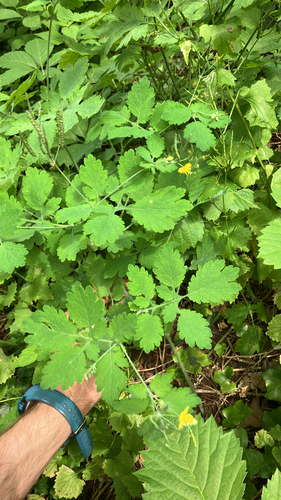
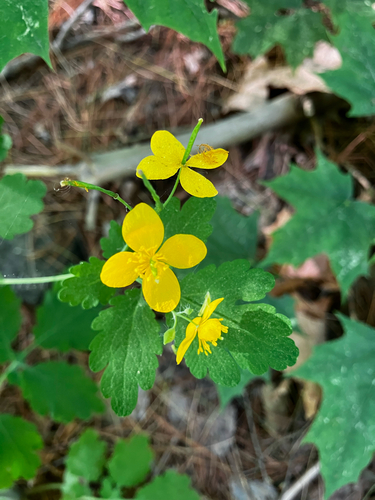
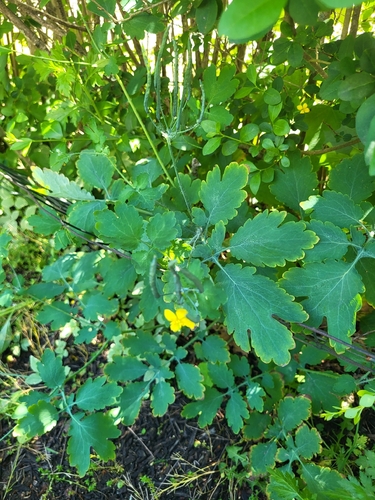
The Greater celandine has bright yellow, four-petaled cup-shaped flowers. Its deeply lobed, blue-green leaves are distinctive, and its stems exude a unique orange-yellow sap when broken, making it visually stand out.
Category
PlantsRarity
Common
Danger
2/5 · Low
Snaps
63
Alchemists once sought its golden sap for making precious gold.
Ancient Greeks believed it bloomed exactly when swallows returned.
Each tiny seed has a tasty fat treat for ants to discover!
Its bright orange sap surprisingly glows under UV light!
Greater celandine can ooze bright orange-yellow sap that tastes bad to deter hungry animals from eating its leaves and stems.
Greater celandine has special fatty appendages on its seeds that attract ants to carry and disperse them to new locations.
Apis mellifera
Collects nectar and pollen.
Myrmica rubra
Disperses seeds with elaiosomes.
Aphis chelidonii
Feeds on plant sap.
Flowering plants are any plants that produce flowers as part of their reproductive cycle.
Spring blooming plants produce their flowers during the spring season, often signifying the end of winter and the start of new growth.
Summer blooming plants produce their flowers during the summer season, often providing vibrant color when many other plants have finished.
Broadleaf trees are angiosperms characterized by flat, wide leaves that are typically shed annually in temperate climates.

Fragrant flowers emit a pleasant aroma, often to attract pollinators or for defense.

Medicinal plants possess chemical compounds that can be used for therapeutic purposes to treat illnesses or maintain health.

Describes plants that are particularly attractive and beneficial to a wide range of pollinating organisms.

This trait signifies organisms belonging to a very old evolutionary group with ancestors dating back millions of years.

This habitat trait indicates species that can coexist with humans in urban and suburban environments, utilizing man-made structures and green spaces.
Danger
2/5 · Low
Do not touch or eat any plants without asking an adult first.
The easiest way to identify Greater celandine is to use the Snappit nature identifier app.
30-100 cm
30-60 cm
2-3 cm
Late spring to mid-summer
No
High
Perennial
Zoom in to split clusters and explore where this object has been snapped.
Jun 6, 2026
The Arboretum at Penn StatePhoto attribution
no rights reserved
License: CC0 1.0 ↗
Image may be shown cropped inside the card frame.
Jun 2, 2026
Central Village Historic DistrictPhoto attribution
(c) Bryan Connolly, some rights reserved (CC BY)
License: CC BY 4.0 ↗
Image may be shown cropped inside the card frame.
May 31, 2026
Capron Park ZooPhoto attribution
(c) Sean Rigney, some rights reserved (CC BY)
License: CC BY 4.0 ↗
Image may be shown cropped inside the card frame.

Michigan, US
You might spot Eastern Gray Squirrel, Tree-Of-Heaven, and House Sparrow.
View guide →

Pennsylvania, US
You might spot American Robin, Red-Winged Blackbird, and Lesser Celandine.
View guide →

Massachusetts, US
You might spot Eastern Newt, Purple Pitcher Plant, and Hobblebush.
View guide →

Rhode Island, US
You might spot Spotted Lanternfly, Duck, and American Robin.
View guide →

Rhode Island, US
You might spot Spotted Lanternfly, Duck, and American Robin.
View guide →

New York, US
You might spot American Robin, Pond Slider, and Northern Cardinal.
View guide →
Take the discovery with you
Snap it with Snappit to identify it, learn what makes it special, and add the discovery to your collection.








.jpg&width=800)

_001.jpg&width=800)




