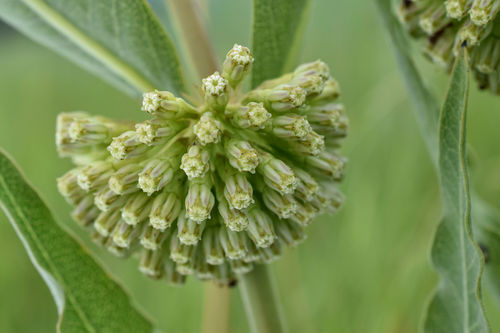


Green Comet Milkweed
asclepias viridiflora
The Green Comet Milkweed (Asclepias viridiflora) is a hardy perennial wildflower native to the prairies and open grasslands of North America. Known for its subtle beauty and ecological resilience, this species plays a vital role in supporting native pollinator populations. Unlike its more flamboyantly colored cousins, it features understated pale green blossoms that blend seamlessly into surrounding grasses, providing a delightful treasure hunt for nature enthusiasts. This species is highly adapted to arid environments, utilizing a deep taproot system to survive droughts and wildfires that would devastate less hardy vegetation. As a member of the milkweed family, it serves as an essential host plant for monarch butterfly caterpillars, offering them both nourishment and chemical protection from predators. Its presence is a key indicator of a healthy, diverse grassland ecosystem.
Habitat: Typically found in dry prairies, glades, barrens, sandy fields, and rocky open woodlands.
This perennial herb typically grows between 30 to 90 centimeters tall, featuring single or clustered puberulent stems that can be upright or slightly reclining. The leaves are oppositely arranged, thick, and highly variable in shape, ranging from lance-shaped to broadly ovate, often with characteristic wavy margins. In mid to late summer, tight, spherical, drooping clusters of 20 to 80 pale green to yellowish-green flowers emerge from the upper leaf axils. Uniquely, the individual flowers lack the projecting 'horns' found in most other milkweeds, giving the hood structures a distinct, streamlined appearance. When injured, the stems and leaves exude a thick, milky white latex sap.
Category
PlantsRarity
Common
Danger
1/5 · Very low
Snaps
2
Its deep, woody taproot makes it highly resilient against prairie wildfires, allowing it to resprout quickly after a burn.
The scientific name 'viridiflora' literally translates to 'green flower' in Latin, referencing its camouflage-like color.
Unlike almost all other milkweeds, the flowers of the Green Comet Milkweed lack internal horns on their hoods, giving them a unique comet-like profile.
Produces a toxic milky sap rich in cardenolides that deters generalist herbivores while feeding specialist caterpillars.
Utilizes a substantial, deep taproot that accesses deep water reserves, ensuring survival during severe droughts.
Packages its pollen into sticky sacs called pollinia, which clamp onto the legs of visiting insects for efficient transport.
Manufactures its own nutrients through photosynthesis, utilizing sunlight, carbon dioxide, water, and soil minerals.

Danaus plexippus
Larvae feed exclusively on the leaves, absorbing toxic cardenolides to gain defense against avian predators.

Tetraopes tetrophthalmus
Feeds on the plant tissues, especially the leaves and buds, tolerating the toxic chemical compounds.

Bombus pensylvanicus
Visits the green blossoms for nectar, inadvertently aiding in pollination by carrying pollinia.
No trait badges are assigned for this object yet.
No aliases listed yet.
Collections for this object will appear here as more themes are added.
Danger
1/5 · Very low
No special safety notes yet.
Start with the whole plant, then compare leaf arrangement, leaf edges, stems and any flowers or fruit. Opposite leaves grow in pairs; alternate leaves come one at a time along the stem. These details tell you far more together than a single green leaf does. Plant Identifier: upload a photo and compare the visible details.
30+ cm
5+ years
Manufactures its own nutrients through photosynthesis, utilizing sunlight, carbon dioxide, water, and soil minerals.
Typically found in dry prairies, glades, barrens, sandy fields, and rocky open woodlands.
Photosynthesis
Zoom in to split clusters and explore where this object has been snapped.

Texas, US
You might spot Silverleaf Nightshade and Green Comet Milkweed.
View guide →

Wisconsin, US
You might spot Green Comet Milkweed, Wood Lily, and Flowering Spurge.
View guide →
Take the discovery with you
Snap it with Snappit to identify it, learn what makes it special, and add the discovery to your collection.