.jpg&width=800)





Red Milkweed Beetle
Tetraopes tetrophthalmus
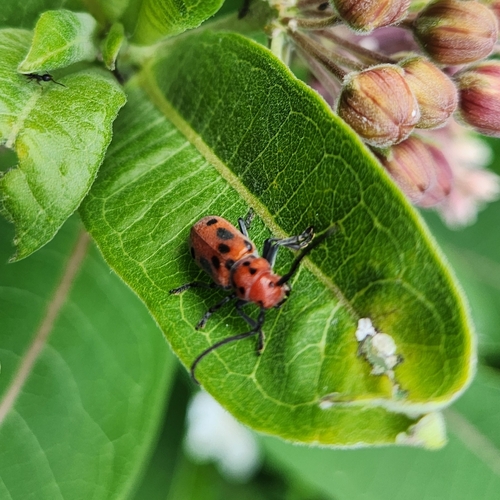
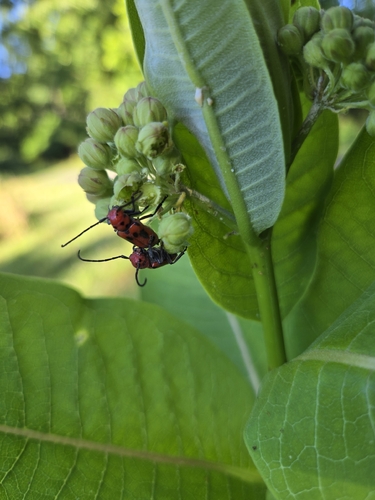
The Red Milkweed Beetle is a bright red bug that loves to munch on milkweed plants. Its shiny color helps it stand out in nature, and it plays an important role in the ecosystem.
Habitat: Grasslands
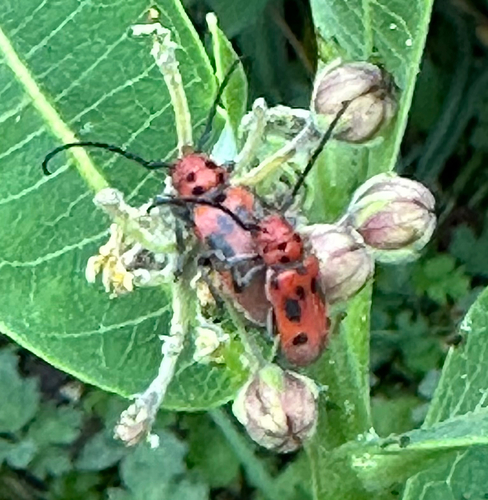
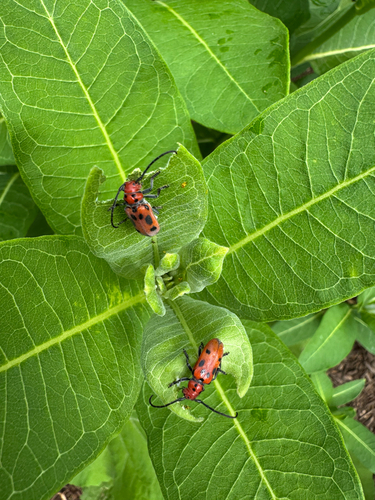
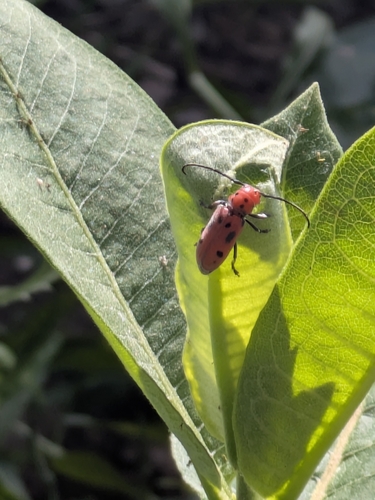
The Red Milkweed Beetle has a striking bright orange or red body with contrasting black spots on its wing covers and underside. Its most distinctive feature is its long, black antennae, which are often as long as its body. This vibrant coloration makes it visually distinct from other beetles.
Category
InsectsRarity
Common
Danger
1/5 · Very low
Snaps
75
Baby milkweed beetles live underground for months, munching on roots!
If scared, a Red Milkweed Beetle might drop to the ground and play dead!
These beetles have special claws to grip milkweed plants, even on windy days!
They are part of the 'longhorn' beetle family, named for their super-long antennae!
Red Milkweed Beetle can eat poisonous milkweed, absorbing the toxins to make themselves taste bad to predators.
Red Milkweed Beetle has vivid red and black markings that signal to predators, 'Don't eat me, I'm yucky!'
Red Milkweed Beetle larvae have strong mandibles that help them chew and feed on milkweed roots underground.
This beetle munches exclusively on milkweed plants, from leaves to roots!
Age differences: Larvae feed on milkweed roots underground, while adult beetles consume the leaves, stems, and sometimes pollen.

Asclepias syriaca
larvae eat roots, adults feed on leaves and stems.

Asclepias tuberosa
a primary food source for adult beetles.
Podisus maculiventris
nymphs and adults can prey on Red Milkweed Beetle larvae.
Solitary animals live alone for most of their lives, only interacting with others for mating or parental care.
Colorful describes organisms or objects displaying a wide range of bright and distinct colors.
Grassland habitats are terrestrial biomes dominated by grasses and herbaceous plants, supporting a variety of grazing animals.
This trait characterizes organisms whose diet consists entirely or primarily of plant material.

Describes plants that are particularly attractive and beneficial to a wide range of pollinating organisms.

Diurnal animals are primarily active during daylight hours, typically resting or sleeping at night.

Describes a species whose presence and role have a disproportionately large effect on its environment.

Describes organisms that transfer pollen, enabling the fertilization and reproduction of plants.
No aliases listed yet.
Danger
1/5 · Very low
It's best to watch these beetles from a distance and not touch them.
The easiest way to identify Red Milkweed Beetle is to use the Snappit nature identifier app.
15-30 mm
8-15 mm
14-28 days
This beetle munches exclusively on milkweed plants, from leaves to roots!
Grasslands
Foraging
6
Zoom in to split clusters and explore where this object has been snapped.
Jun 19, 2026
Humboldt (Alexander Von) ParkPhoto attribution
(c) John Dunlevy, some rights reserved (CC BY)
License: CC BY 4.0 ↗
Image may be shown cropped inside the card frame.
Jun 18, 2026
MacDougal-Sullivan Gardens Historic DistrictPhoto attribution
(c) aberkov, some rights reserved (CC BY)
License: CC BY 4.0 ↗
Image may be shown cropped inside the card frame.
Jun 18, 2026
Arnold ArboretumPhoto attribution
(c) Teá Montagna, some rights reserved (CC BY)
License: CC BY 4.0 ↗
Image may be shown cropped inside the card frame.
Jun 16, 2026
Haskell-Baker WetlandsPhoto attribution
(c) Lydia Dexter, some rights reserved (CC BY)
License: CC BY 4.0 ↗
Image may be shown cropped inside the card frame.
Jun 15, 2026
Reading Public MuseumPhoto attribution
no rights reserved
License: CC0 1.0 ↗
Image may be shown cropped inside the card frame.

Ohio, US
You might spot Eastern Fox Squirrel and Spotted Lanternfly.
View guide →

Illinois, US
You might spot Common Eastern Bumble Bee and Brown-Belted Bumble Bee.
View guide →

Massachusetts, US
You might spot Eastern Cottontail and American Robin.
View guide →

Maryland, US
You might spot Crane-Fly Orchid, Fragile Forktail, and Ebony Jewelwing.
View guide →

Wisconsin, US
You might spot Turkey, White-Tailed Deer, and Dame's Rocket.
View guide →

Vermont, US
You might spot Asian Bittersweet, Alder Buckthorn, and Eastern Newt.
View guide →
Take the discovery with you
Snap it with Snappit to identify it, learn what makes it special, and add the discovery to your collection.






.jpg&width=800)


