

Green Salamander
aneides aeneus
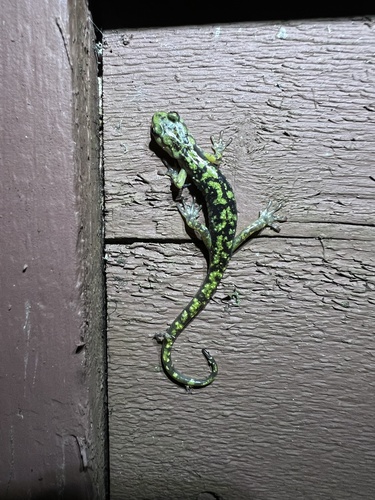
The Green Salamander (Aneides aeneus) is a remarkable amphibian native to the moist, rugged landscapes of the Appalachian region in the eastern United States. As the sole representative of the genus Aneides in the east, this lungless salamander is uniquely adapted for an arboreal and cliff-dwelling lifestyle. It is renowned for its striking, mossy green coloration, which provides exceptional camouflage against the lichen-covered rock faces and damp sandstone crevices it calls home. Unlike many other amphibians, this species lacks lungs and breathes entirely through its moist skin and oral cavity, a trait that confines it to highly humid microclimates. Highly secretive and primarily active at night, the Green Salamander spends its life navigating vertical rocky terrain with specialized climbing adaptations. Its presence serves as a vital indicator of forest health, and encountering one of these hidden gems in its rocky fortress is a true highlight for any wilderness explorer.
Habitat: Typically found in damp, shaded sandstone crevices, rock cliffs, and under the bark of mature trees within hardwood forests.
The Green Salamander is a small, slender amphibian measuring between 8 and 14 centimeters in length, recognized by its distinctively flattened head and body. Its base color is a dark brown or near-black, heavily mottled with brilliant patchworks of bright green, yellow-green, or bronze spots that perfectly mimic lichen. This species possesses prominent, bulging black eyes and specialized square-tipped toes that enhance its grip on vertical rock surfaces. Unlike more robust ground-dwelling salamanders, its ultra-flat profile allows it to easily squeeze into extremely tight rock fissures.
Category
AmphibiansRarity
Common
Danger
1/5 · Very low
Snaps
Be the first to snap!
Their extremely flat body plan is a specialized adaptation allowing them to squeeze into rocky crevices just a few millimeters wide.
They are the only representative of the climbing salamander genus, Aneides, found in the eastern United States; all other species live in the western US.
Unlike most amphibians, they skip the aquatic tadpole-like stage entirely, with eggs hatching directly into fully-formed miniature salamanders.
The salamander's unique green and yellow mottling perfectly mimics moss and lichen, concealing it from predators on rock faces.
Equipped with squared-off toes and a semi-prehensile tail, it can effortlessly scale sheer rock cliffs and vertical tree trunks.
Lacking lungs, it absorbs all necessary oxygen directly through its damp skin and the specialized lining of its mouth.
A nocturnal insectivore that feeds on a variety of small invertebrates crawling along rock faces and trees.
Age differences: Juveniles feed on smaller micro-arthropods like springtails, transitioning to larger insects as they mature.

Diadophis punctatus
A small woodland snake that actively hunts adult and juvenile Green Salamanders in rocky crevice habitats.
Crematogaster cerasi
A common small insect that is routinely captured and consumed by foraging salamanders.
Agkistrodon contortrix
An opportunistic pit viper that preys on salamanders when they venture onto open forest floors or low branches.
No trait badges are assigned for this object yet.
No aliases listed yet.
Collections for this object will appear here as more themes are added.
Danger
1/5 · Very low
No special safety notes yet.
Compare body shape, toes, markings, tail and skin texture. Tadpoles and larvae can look nothing like the adults they turn into. Amphibian Identifier: upload a photo and compare the visible details.
A nocturnal insectivore that feeds on a variety of small invertebrates crawling along rock faces and trees.
Typically found in damp, shaded sandstone crevices, rock cliffs, and under the bark of mature trees within hardwood forests.
Ambush
Zoom in to split clusters and explore where this object has been snapped.
Recent snaps will appear here as new observations are added.
Take the discovery with you
Snap it with Snappit to identify it, learn what makes it special, and add the discovery to your collection.