





Holly Olive
osmanthus heterophyllus
The Holly Olive is a lovely evergreen plant with shiny green leaves. It produces sweet-smelling flowers that attract butterflies and bees!
Habitat: Holly Olives thrive in gardens, parks, and wooded areas.
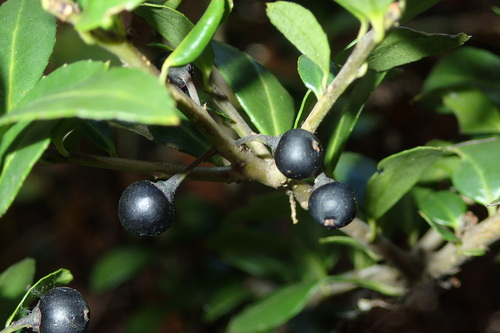
The Holly Olive is a dense evergreen shrub with glossy, dark green leaves that strikingly resemble common holly, though it is not a true holly. Its small, highly fragrant white flowers bloom in clusters, often subtly hidden among the foliage, providing a stark contrast to the dark, spiny leaves.
Category
PlantsRarity
Common
Danger
0/5 · No known danger
Snaps
Be the first to snap!
Despite its looks, the Holly Olive is actually related to common olives, not hollies!
Its incredibly strong, sweet scent can fill an entire garden from just a few small flowers!
Its scientific name 'Osmanthus' means 'fragrant flower' in Greek!
Some Holly Olive plants can have two different leaf shapes growing on the same branch!
Holly Olive has sharp, spiny leaves that mimic real holly to help it deter hungry animals from nibbling on its foliage.
Its tiny flowers release a powerful, sweet scent that travels far, helping to attract pollinators even in cooler weather.
Holly Olive can bloom from fall into early winter, providing a valuable source of nectar when most other plants are dormant.
Apis mellifera
Collects nectar and pollen.

Cervus nippon
Browses on its leaves and stems.
Chrysoperla carnea
Adults hide among dense foliage.
Social animals live in organized groups, cooperating for survival benefits such as foraging, defense, and raising offspring.
Colorful describes organisms or objects displaying a wide range of bright and distinct colors.
This trait characterizes organisms whose diet consists entirely or primarily of plant material.
Forest habitats are terrestrial environments dominated by dense tree cover, supporting a high diversity of plant and animal life.

Describes organisms that transfer pollen, enabling the fertilization and reproduction of plants.
Danger
0/5 · No known danger
No special safety notes yet.
The easiest way to identify Holly Olive is to use the Snappit nature identifier app.
200-600 cm
150-400 cm
0.5-1 cm
Fall_to_winter
No
None
Perennial
Zoom in to split clusters and explore where this object has been snapped.
Recent snaps will appear here as new observations are added.
Take the discovery with you
Snap it with Snappit to identify it, learn what makes it special, and add the discovery to your collection.








.jpg&width=800)



_001.jpg&width=800)




