


Howell'S Montia
montia howellii
Howell's Montia (Montia howellii) is a charming, often overlooked annual herb native to western North America. This diminutive plant is a fascinating example of adaptation to challenging, ephemeral environments, particularly vernal pools and seasonally wet depressions. Its life cycle is perfectly synchronized with the ebb and flow of water, allowing it to complete its growth, flowering, and seed production within a short window when moisture is abundant. Its ability to thrive in these temporary aquatic habitats, often on specialized substrates, makes it a resilient and integral component of these unique ecosystems, contributing to their biodiversity.
Habitat: Found in seasonally wet habitats such as vernal pools, seeps, muddy margins of ponds and streams, and moist depressions, often on serpentine soils or nutrient-poor substrates.
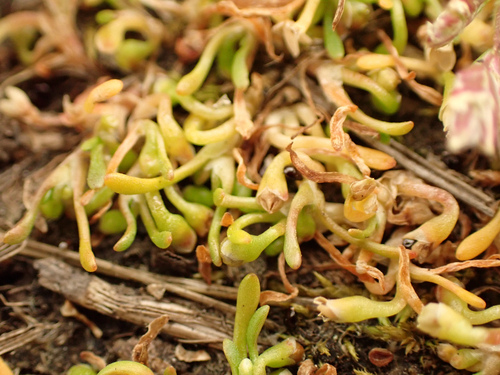
This small, succulent annual typically grows to just 2-10 cm tall, often forming low mats or solitary upright stems. Its leaves are fleshy, bright green to reddish, and can be linear to spatulate, arranged oppositely or in a basal rosette. Delicate, star-like flowers, usually white or pale pink, emerge from the leaf axils or in small terminal clusters. Each flower has five petals, and they are quite tiny, often less than 5 mm across. The stems themselves can be greenish or show a reddish tinge, especially under stress or in full sun.
Category
PlantsRarity
Common
Danger
1/5 · Very low
Snaps
Be the first to snap!
Despite its small size, Howell's Montia plays an important role in the biodiversity of vernal pool ecosystems, often one of the first plants to colonize receding waters.
Its succulent leaves help it retain moisture, a useful adaptation for conditions that rapidly shift from flooded to dry.
The genus name 'Montia' honors Guiseppe Monti, an 18th-century Italian botanist, while 'howellii' commemorates Thomas Howell, an early botanist of the Pacific Northwest.
This plant is an 'ephemeral annual,' meaning it completes its entire life cycle from seed to seed within a single season, perfectly adapted to short-lived wet environments.
Howell's Montia completes its entire life cycle, from germination to seed production, within a brief period when water is available in its temporary wetland habitats.
It possesses physiological adaptations that allow it to thrive in the extreme conditions of vernal pools, tolerating inundation followed by rapid desiccation.
Its seeds can remain viable in the soil for extended periods, waiting for ideal environmental conditions, ensuring species persistence across fluctuating years.
As an autotrophic plant, Howell's Montia produces its own food through photosynthesis, converting sunlight, carbon dioxide, and water into sugars. It absorbs essential nutrients from the soil through its root system.
Lasioglossum spp.
Pollinates flowers, enabling reproduction.

Aphis gossypii
Feeds on plant foliage or sap.
Downingia pulchella
Shares vernal pool habitat, indicating similar environmental requirements and sometimes competing for resources.
No trait badges are assigned for this object yet.
No aliases listed yet.
Collections for this object will appear here as more themes are added.
Danger
1/5 · Very low
No special safety notes yet.
Start with the whole plant, then compare leaf arrangement, leaf edges, stems and any flowers or fruit. Opposite leaves grow in pairs; alternate leaves come one at a time along the stem. These details tell you far more together than a single green leaf does. Plant Identifier: upload a photo and compare the visible details.
2-10 cm
0.0001-0.001 kg
0-1 years
As an autotrophic plant, Howell's Montia produces its own food through photosynthesis, converting sunlight, carbon dioxide, and water into sugars. It absorbs essential nutrients from the soil through its root system.
Found in seasonally wet habitats such as vernal pools, seeps, muddy margins of ponds and streams, and moist depressions, often on serpentine soils or nutrient-poor substrates.
Photosynthesis And Nutrient Absorption
50-500
Zoom in to split clusters and explore where this object has been snapped.
Recent snaps will appear here as new observations are added.
Take the discovery with you
Snap it with Snappit to identify it, learn what makes it special, and add the discovery to your collection.


















