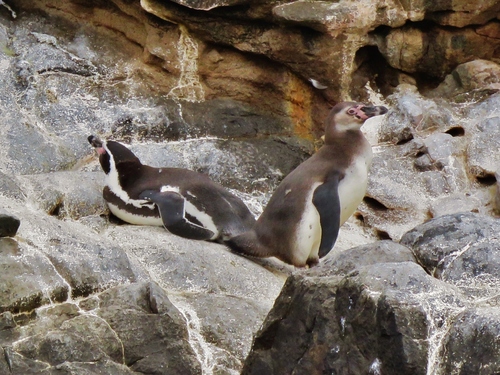


Humboldt Penguin
spheniscus humboldti
The Humboldt Penguin is a medium-sized South American penguin that breeds in coastal Peru and Chile. Unlike their ice-dwelling relatives, these charismatic birds are specially adapted to the warm, arid climates of the Pacific coast, relying on the cold, nutrient-rich waters of the Humboldt Current to feed. They are highly social, nesting in tight colonies and communicating with distinctive braying calls that sound remarkably like donkeys. Because their survival is closely linked to ocean currents, they serve as crucial biological indicators for the health of their marine ecosystem.
Habitat: Found on the arid, rocky coasts and islands of Peru and Chile, closely tied to the nutrient-rich waters of the Humboldt Current.
Humboldt Penguins stand between 56 and 70 centimeters tall and are easily recognized by their distinct facial markings. They feature a black head bordered by a continuous white stripe that runs from behind the eyes, loops around the ears, and joins at the throat. Their upper parts are a dark, slate-black, while their bellies are white, accented by a bold, horseshoe-shaped black band across the breast. A prominent patch of fleshy pink skin surrounds the base of their black bill and eyes, which becomes more vivid when the bird is warm.
Category
BirdsRarity
Common
Danger
1/5 · Very low
Snaps
Be the first to snap!
Each Humboldt penguin has a unique pattern of black spots on its white breast, acting like a natural fingerprint that researchers use for identification.
The bare pink patches on their face act like car radiators, flushing with blood to cool the bird down when running or under intense sun.
They historically nest in self-dug burrows within deep layers of guano, which provides excellent thermal insulation from the desert heat.
Utilizes bare pink patches of skin on its face to radiate excess body heat, preventing overheating in desert climates.
Features a dark back and a white belly, blending seamlessly into the dark depths from above and the bright surface from below.
Uses stiff, modified flippers and a highly streamlined body to swim through water at speeds up to 32 kilometers per hour.
Feeds almost exclusively on small schooling fish and pelagic invertebrates captured during shallow sea dives.
Age differences: Chicks are fed regurgitated, semi-digested fish by both parents until they fledge and learn to hunt independently.
Engraulis ringens
Primary food source, highly crucial for successful breeding seasons.

Otaria flavescens
Preys on adult penguins and juveniles in the water and near nesting colonies.
Larus dominicanus
Opportunistically preys on unguarded Humboldt penguin eggs and small chicks.
No trait badges are assigned for this object yet.
No aliases listed yet.
Collections for this object will appear here as more themes are added.
Danger
1/5 · Very low
No special safety notes yet.
Compare the silhouette, bill shape, tail length, wing bars and markings around the eyes. The same small brown bird at your feeder can look quite different in breeding plumage, winter plumage or its first year. Bird Identifier: upload a photo and compare the visible details.
56+ cm
45+ cm
3.6+ kg
15+ years
32 km/h
Feeds almost exclusively on small schooling fish and pelagic invertebrates captured during shallow sea dives.
Found on the arid, rocky coasts and islands of Peru and Chile, closely tied to the nutrient-rich waters of the Humboldt Current.
Zoom in to split clusters and explore where this object has been snapped.
Recent snaps will appear here as new observations are added.

Ohio, US
You might spot African Lion, Tiger, and Snow Leopard.
View guide →

England, UK
You might spot African Elephant, Bornean Orangutan, and Tiger.
View guide →

England, UK
You might spot White Rhinoceros, Giraffes, and Ring-Tailed Lemur.
View guide →

Municipal District of Cobh, IE
You might spot Ring-Tailed Lemur, Giraffes, and Cheetahs.
View guide →

Indiana, US
You might spot Panthera Pardus Orientalis and Reticulated Giraffe.
View guide →

Wisconsin, US
You might spot African Elephant, Humboldt Penguin, and Gorilla.
View guide →
Take the discovery with you
Snap it with Snappit to identify it, learn what makes it special, and add the discovery to your collection.