





Golden-crowned Kinglet
Regulus satrapa
The Golden-crowned Kinglet is a tiny bird with a bright yellow crown on its head. It loves to flit around in trees, looking for tiny insects to eat. This little bird is very energetic and can be seen hopping from branch to branch!
Habitat: Forests
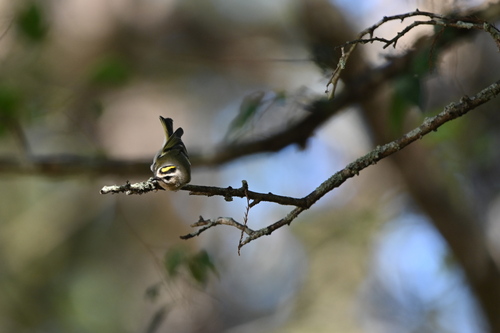
The Golden-crowned Kinglet is a tiny, olive-green bird with grayish underparts. It has distinctive black stripes on its head, framing a bright yellow or orange-yellow crown patch, bordered by black.
Category
BirdsRarity
Common
Danger
1/5 · Very low
Snaps
3
A male kinglet's bright orange crown is usually hidden, only flashing it when excited or displaying!
Despite their small size, they sometimes travel thousands of kilometers during migration!
These busy birds can eat up to half their body weight in insects every single day!
They can shiver their tiny bodies to create heat and stay warm in icy weather!
Golden-crowned Kinglet can hang upside down because of its strong legs and tiny claws that help them snatch insects from needles and twigs.
Golden-crowned Kinglet has a thick, insulating feather coat that helps them stay warm and survive freezing winter temperatures.
Golden-crowned Kinglet has a very high-pitched call that allows them to communicate without giving away their location to predators.
Tiny insect-eaters that feast on small bugs and spiders found in the forest canopy.

Picea glauca
Provides nesting sites and food resources.

Abies balsamea
Offers crucial foraging habitat and shelter.

Accipiter striatus
A common predator of small forest birds.
Dendroctonus rufipennis
Eats larvae and adults from tree bark.
Social animals live in organized groups, cooperating for survival benefits such as foraging, defense, and raising offspring.
Singing animals produce complex vocalizations, often for purposes of attracting mates, defending territory, or communicating within their species.
Arboreal animals live primarily in trees, utilizing them for shelter, food, and protection from predators.
Colorful describes organisms or objects displaying a wide range of bright and distinct colors.

This trait identifies organisms whose diet primarily consists of insects and other small invertebrates.

Forest habitats are terrestrial environments dominated by dense tree cover, supporting a high diversity of plant and animal life.

Diurnal animals are primarily active during daylight hours, typically resting or sleeping at night.

Pertaining to species that are significantly smaller than typical or average for their kind.
No aliases listed yet.
Danger
1/5 · Very low
Always watch birds from a distance to keep them safe and happy.
The easiest way to identify Golden-crowned Kinglet is to use the Snappit nature identifier app.
8-11 cm
14-18 cm
0.004-0.008 kg
2-4 years
40 km/h
Tiny insect-eaters that feast on small bugs and spiders found in the forest canopy.
Forests
Zoom in to split clusters and explore where this object has been snapped.
Nov 14, 2024
Pomme de Terre Wildlife Management AreaPhoto attribution
(c) Jody Shugart, some rights reserved (CC BY)
License: CC BY 4.0 ↗
Image may be shown cropped inside the card frame.
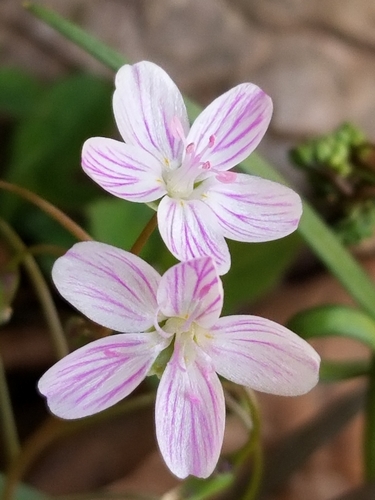
New Jersey, US
You might spot Virginia Springbeauty, Wineberry, and Multiflora Rose.
View guide →

South Carolina, US
You might spot Brown-Headed Cowbird and Eastern Box Turtle.
View guide →

Connecticut, US
You might spot Green Frog, American Holly, and Eastern White Pine.
View guide →
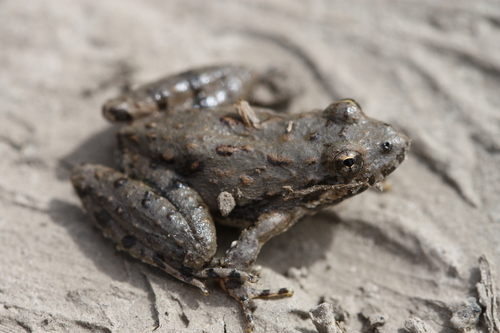
Louisiana, US
You might spot Blanchard's Cricket Frog and Indian Heliotrope.
View guide →
Take the discovery with you
Snap it with Snappit to identify it, learn what makes it special, and add the discovery to your collection.




.jpg&width=800)








