

Hyaenas
hyaenidae
Hyaenas are fascinating and highly intelligent carnivores belonging to the family Hyaenidae. Despite their dog-like appearance, they are evolutionarily closer to cats, civets, and mongooses within the mammalian suborder Feliformia. Comprising four extant species—the spotted, striped, and brown hyenas, along with the specialized, insectivorous aardwolf—this diverse family occupies a critical role in their respective ecosystems. They are renowned for their incredible bone-crushing bite force, highly organized social structures, and complex vocalizations, including the famous "laugh" of the spotted hyena. While historically misunderstood as mere scavengers, many hyena species are actually highly successful and formidable apex predators capable of taking down large prey. Their unique adaptations, robust build, and complex matriarchal societies (particularly in the spotted hyena) make them one of the most captivating groups of mammals in Africa and parts of Asia.
Habitat: Hyaenas are highly adaptable and can be found across a diverse range of habitats including savannas, grasslands, semi-deserts, open woodlands, and mountainous regions.
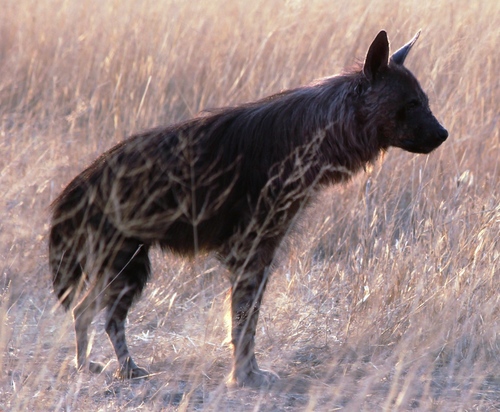
Hyenas possess a distinctive, sloping profile due to their heavily built forequarters and comparatively lower, less developed hindquarters. They have broad heads, powerful jaws, and large, rounded or pointed ears. Their coats vary significantly by species: the spotted hyena features a yellowish-gray coat patterned with dark spots; the striped hyena is adorned with vertical black stripes over pale grey or beige fur and a prominent dorsal mane; the brown hyena has a dark brown, shaggy coat with striped legs; and the smaller aardwolf sports a yellowish coat with distinct black stripes. Sizes range from the small, slender aardwolf, which weighs around 10 kg, to the robust spotted hyena, which can weigh over 80 kg.
Category
MammalsRarity
Common
Danger
1/5 · Very low
Snaps
Be the first to snap!
Despite looking very much like dogs, hyenas are evolutionarily much closer to cats and mongooses in the suborder Feliformia.
Female spotted hyenas are significantly larger and more dominant than males, leading highly complex matriarchal societies called clans.
Hyenas have extremely strong stomach acids, allowing them to fully digest animal parts most other predators leave behind, including skin, hooves, and bone.
The aardwolf, a small and often forgotten member of the hyena family, possesses highly reduced teeth because it eats almost entirely termites.
Possessing exceptionally robust teeth and massive jaw muscles, most hyenas can crack open large bones to extract highly nutritious marrow that other predators cannot access.
They have a highly efficient, loping gait that allows them to trot effortlessly for hours, enabling them to pursue prey or patrol vast territories over long distances without overheating.
Spotted hyenas in particular utilize a highly sophisticated repertoire of vocalizations, postures, and scent-marking, including 'whoops' and 'laughs', to convey identity, rank, and intent to their clan members.
While the aardwolf specializes in eating termites, the other three hyena species consume a mix of scavenged carrion and freshly hunted vertebrates, including medium to large ungulates.
Age differences: Pups rely on their mother's highly nutritious milk for up to 18 months, gradually integrating solid meat brought back to the den.
Panthera leo
Lions and hyenas frequently steal kills from one another and engage in intense, often fatal, territorial clashes.
Connochaetes taurinus
Spotted hyenas are highly successful pack hunters that frequently prey on wildebeest.
Trinervitermes trinervoides
The aardwolf relies almost exclusively on these specific termites, consuming up to 300,000 in a single night.

Gyps africanus
Vultures and hyenas both flock to fresh carcasses, competing for access to the carrion.
No trait badges are assigned for this object yet.
Collections for this object will appear here as more themes are added.
Danger
1/5 · Very low
No special safety notes yet.
Compare ears, muzzle, tail, feet and coat markings. Size is hard to judge without something nearby for scale, and young mammals may not have adult coloring yet. Mammal Identifier: upload a photo and compare the visible details.
85-165 cm
8-86 kg
10-25 years
60 km/h
While the aardwolf specializes in eating termites, the other three hyena species consume a mix of scavenged carrion and freshly hunted vertebrates, including medium to large ungulates.
Hyaenas are highly adaptable and can be found across a diverse range of habitats including savannas, grasslands, semi-deserts, open woodlands, and mountainous regions.
Pursuit And Foraging
Zoom in to split clusters and explore where this object has been snapped.
Recent snaps will appear here as new observations are added.
Take the discovery with you
Snap it with Snappit to identify it, learn what makes it special, and add the discovery to your collection.