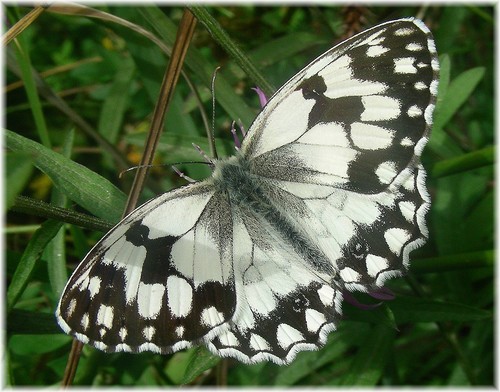


Iberian Marbled White
melanargia lachesis
The Iberian Marbled White (Melanargia lachesis) is a striking and elegant butterfly endemic to the Iberian Peninsula and parts of southern France. Unlike most members of the Nymphalidae family, which are known for their bright, flashy colors, this species captivates nature enthusiasts with its crisp, monochrome black-and-white patterns. During the warm summer months, they can be seen fluttering gracefully over dry, grassy meadows and rocky hillsides. Their distinct coloration and preference for sunny, wild habitats make them a beloved symbol of Mediterranean summers, offering a beautiful contrast against the golden grasses and purple thistles they frequent.
Habitat: Typically found in warm, dry, open grasslands, rocky slopes, scrublands, and forest margins with abundant tall grasses and nectar-rich wildflowers.
Melanargia lachesis is instantly recognizable by its striking checkerboard-like pattern of stark black and bright white scales. It is distinct from the similar Marbled White (Melanargia galathea) by having a noticeably larger, uninterrupted white patch at the base of the wings, with reduced black markings in the basal and discal areas. The undersides of the wings feature intricate, pale gray-brown marbling with a row of small, black-and-white eyespots (ocelli) that help deflect predator attacks. The wingspan typically ranges from 5 to 6 centimeters, making it a medium-sized, highly conspicuous butterfly in its natural habitat.
Category
InsectsRarity
Common
Danger
1/5 · Very low
Snaps
Be the first to snap!
Although they belong to the Nymphalidae family (the 'brush-footed' butterflies), their black-and-white checkerboard pattern more closely resembles that of certain swallowtails or true whites.
Because their caterpillars overwinter at the base of grass stems, these butterflies require untended, wild meadows that aren't overly grazed or mown during the colder months.
The caterpillar of the Iberian Marbled White is largely nocturnal, feeding on coarse grasses under the cover of darkness to avoid daytime predators.
Unlike many butterflies that carefully attach their eggs to specific leaves, the female Iberian Marbled White often drops her eggs mid-flight, letting them scatter directly into the dense grass below.
The stark black-and-white marbled pattern breaks up the butterfly's outline, making it difficult for predators to pinpoint its exact shape when resting among speckled shadows in tall grass.
Small circular ocelli on the underside of the wings mimic the eyes of larger animals, often tricking birds into attacking the fragile wing edges rather than the vital body parts.
Like many butterflies, it absorbs solar radiation through its wings, meticulously angling its body toward the sun in the early mornings to warm its flight muscles for rapid takeoffs.
The caterpillars feed exclusively on various wild grasses, while adult butterflies consume nectar from a variety of flowering plants, favoring purple and blue blooms.
Age differences: Larvae consume the leaves of coarse grasses, whereas adults feed entirely on liquid floral nectar.
Festuca ovina
The female butterflies lay their eggs on or near these grasses, which serve as the primary food source for the developing caterpillars.
Knautia arvensis
The butterfly acts as a minor pollinator while feeding on the nectar of this preferred wildflower.

Mantis religiosa
These ambush predators hide in the tall grasses and wildflowers, preying on unsuspecting butterflies as they land to feed on nectar.
No trait badges are assigned for this object yet.
No aliases listed yet.
Collections for this object will appear here as more themes are added.
Danger
1/5 · Very low
No special safety notes yet.
Compare the wing outline, spots, bands, eyespots and wing edges. The underside can look completely different from the top. Check for tails, the antennae and where the markings sit instead of relying on color alone. Butterfly Identifier: upload a photo and compare the visible details.
2-3 cm
5-6 cm
0.0001-0.0003 kg
1 years
15 km/h
The caterpillars feed exclusively on various wild grasses, while adult butterflies consume nectar from a variety of flowering plants, favoring purple and blue blooms.
Typically found in warm, dry, open grasslands, rocky slopes, scrublands, and forest margins with abundant tall grasses and nectar-rich wildflowers.
Zoom in to split clusters and explore where this object has been snapped.
Recent snaps will appear here as new observations are added.
Take the discovery with you
Snap it with Snappit to identify it, learn what makes it special, and add the discovery to your collection.