

Jasmine Moth
palpita vitrealis
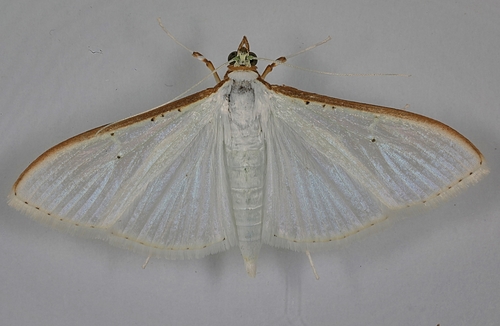
The Jasmine Moth (Palpita vitrealis), also known as the white pearl moth, is a delicate and mesmerizing lepidopteran belonging to the family Crambidae. Renowned for its glass-like, iridescent wings, this moth looks like an ethereal fairy of the night. It is widely distributed across southern Europe, Africa, and parts of Asia, particularly thriving in areas where its larval host plants, such as jasmine and olive trees, grow in abundance. While sometimes considered a minor agricultural pest in olive groves due to its caterpillar stage, the adult moth is a marvel of nature. As a strong seasonal migrator, it frequently travels great distances, occasionally bringing its pearlescent beauty to northern regions far outside its typical breeding range.
Habitat: Typically found in warm agricultural regions, domestic gardens, olive orchards, and Mediterranean shrublands where its larval host plants are abundant.
This species features a wingspan of 2 to 4 centimeters, characterized by translucent, pristine white wings that shimmer with a mother-of-pearl or pale greenish-gold iridescence under the light. The forewings are bordered by a distinct, thin, light-brown or ochreous band along the leading costal margin, which contrasts sharply with the translucent body. Its slender body is clean white, matched by long, delicate legs and antennae that complete its fragile, spectral appearance.
Category
InsectsRarity
Common
Danger
1/5 · Very low
Snaps
Be the first to snap!
Despite its fragile appearance, this tiny moth is capable of migrating across the English Channel to reach the United Kingdom during warm summer winds.
The caterpillars spin thin silk webs around the leaves of their host plants to create a protective shelter while they feed.
The translucent wings of the Jasmine Moth function like natural glass, reflecting brilliant greens and purples when caught by light at certain angles.
Its wings are mostly devoid of heavy scales, allowing light to pass directly through them and making the moth nearly invisible to predators when resting on green foliage.
Possesses specialized tympanal organs on its abdomen that can detect the echolocation signals of hunting bats, triggerring immediate evasive flight.
Utilizes seasonal wind currents to migrate over vast distances, successfully traversing seas and mountain ranges to colonize new territories.
The larvae feed voraciously on the foliage of host plants in the family Oleaceae, while the adults feed on the sugary nectar of various night-blooming flowers.
Age differences: Caterpillars consume leafy green tissue and buds, while the adult moths feed exclusively on liquid nectar to fuel their flights.

Olea europaea
The caterpillar feeds on the foliage of this economically and ecologically important Mediterranean tree.
Jasminum officinale
This plant serves as a major host for egg deposition and larval feeding, giving the moth its common name.
Pipistrellus pipistrellus
An active nocturnal predator that hunts and consumes adult moths mid-air.
No trait badges are assigned for this object yet.
No aliases listed yet.
Collections for this object will appear here as more themes are added.
Danger
1/5 · Very low
No special safety notes yet.
Compare resting wing shape, forewing markings, antennae and body build. Small brown moths can hinge on fine details a phone photo can't always catch. Moth Identifier: upload a photo and compare the visible details.
1-2 cm
2-4 cm
0.0001-0.0003 kg
15 km/h
The larvae feed voraciously on the foliage of host plants in the family Oleaceae, while the adults feed on the sugary nectar of various night-blooming flowers.
Typically found in warm agricultural regions, domestic gardens, olive orchards, and Mediterranean shrublands where its larval host plants are abundant.
Foraging
Zoom in to split clusters and explore where this object has been snapped.
Recent snaps will appear here as new observations are added.
Take the discovery with you
Snap it with Snappit to identify it, learn what makes it special, and add the discovery to your collection.