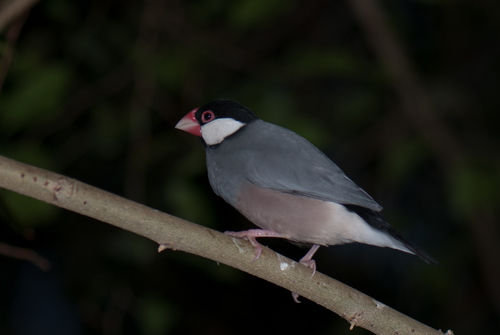


Java Sparrow
padda oryzivora
The Java Sparrow, also known as the Java Finch or Java Rice Bird, is a small, striking passerine native to Java and Bali. Renowned for its elegant appearance and social behavior, it has long been a popular cage bird, leading to its introduction and establishment of wild populations across various tropical regions globally. Despite its widespread presence in captivity and as an introduced species, the wild populations in its native range face severe threats, highlighting a paradox in its conservation status. These resilient birds are known for their strong association with human-modified landscapes, particularly agricultural areas where rice is cultivated, and often form large, lively flocks. Their adaptable nature and captivating calls make them a fascinating subject for both birdwatchers and conservationists.
Habitat: The Java Sparrow is typically found in open grasslands, cultivated fields, particularly rice paddies, and often in proximity to human settlements such as urban parks, gardens, and villages.
The Java Sparrow is easily identified by its distinctive plumage. It features a slate-grey body, a prominent black head, and a stark white cheek patch that contrasts sharply with the head. Its most striking features include a thick, conical, rose-pink bill and a reddish-pink orbital ring around its dark eyes. The belly is a paler grey, fading to white on the undertail coverts, while the rump and tail are also slate-grey. Juveniles are duller with a black bill and less defined markings. Measuring about 13-17 cm in length, it has a compact build typical of a finch.
Category
BirdsRarity
Common
Danger
1/5 · Very low
Snaps
Be the first to snap!
Despite being critically endangered in its native Indonesia, it is considered an agricultural pest in many areas where it has been introduced due to its appetite for rice.
Java Sparrows are renowned for their striking beauty and were frequently depicted in traditional Chinese and Japanese art.
The scientific name "Padda oryzivora" literally translates to "rice eater," reflecting its strong association with rice fields.
They communicate through a variety of chirps and calls, and males perform elaborate courtship dances and songs to attract females.
Their powerful, conical bill is perfectly adapted for efficiently husking and consuming various seeds, especially grains like rice, allowing them to exploit abundant food sources.
Java Sparrows forage and roost in large flocks, a behavior that provides increased protection against predators through collective vigilance and alarm calling.
This species shows remarkable ability to thrive in human-modified environments, including busy urban parks and agricultural lands, effectively utilizing available food and nesting sites.
The Java Sparrow is primarily granivorous, feeding almost exclusively on seeds, particularly rice. They can become significant agricultural pests in regions where they are introduced due to their preference for ripening grains.
Oryza sativa
Primary food source in agricultural areas.
Felis catus
Common predator, especially in urban and suburban environments.
Corvus splendens
May prey on eggs and chicks in nests, and compete for food resources.
Spilopelia chinensis
In introduced ranges, these species may compete for similar seed resources and nesting sites.
No trait badges are assigned for this object yet.
No aliases listed yet.
Collections for this object will appear here as more themes are added.
Danger
1/5 · Very low
No special safety notes yet.
Compare the silhouette, bill shape, tail length, wing bars and markings around the eyes. The same small brown bird at your feeder can look quite different in breeding plumage, winter plumage or its first year. Bird Identifier: upload a photo and compare the visible details.
13-17 cm
20-25 cm
0.02-0.03 kg
5-10 years
The Java Sparrow is primarily granivorous, feeding almost exclusively on seeds, particularly rice. They can become significant agricultural pests in regions where they are introduced due to their preference for ripening grains.
The Java Sparrow is typically found in open grasslands, cultivated fields, particularly rice paddies, and often in proximity to human settlements such as urban parks, gardens, and villages.
Foraging
Zoom in to split clusters and explore where this object has been snapped.
Recent snaps will appear here as new observations are added.
Take the discovery with you
Snap it with Snappit to identify it, learn what makes it special, and add the discovery to your collection.