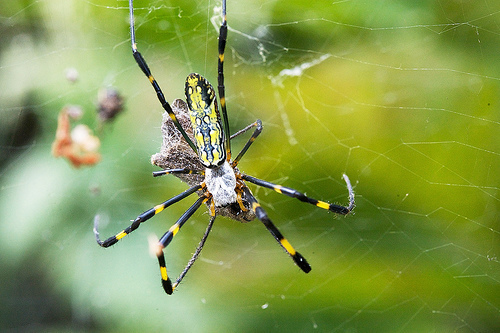


Joro Spider
trichonephila clavata
The Joro spider is a striking, large orb-weaver that commands attention with its vibrant colors and massive webs. Native to East Asia, including Japan, Korea, and China, this fascinating arachnid has recently made headlines as a rapidly spreading invasive species in the Southeastern United States. Named after the 'Jorōgumo,' a legendary shape-shifting spider from Japanese folklore, it weaves enormous, multi-layered webs of golden silk that can span several feet across. Despite their intimidating size and alien-like appearance, Joro spiders are incredibly timid and pose virtually no threat to humans or pets. Instead, they act as highly efficient pest controllers, catching everything from mosquitoes to invasive stink bugs, making them an interesting, albeit controversial, addition to their new ecosystems.
Habitat: Found in open woodlands and forest edges, often spinning large golden webs between trees or shrubs.
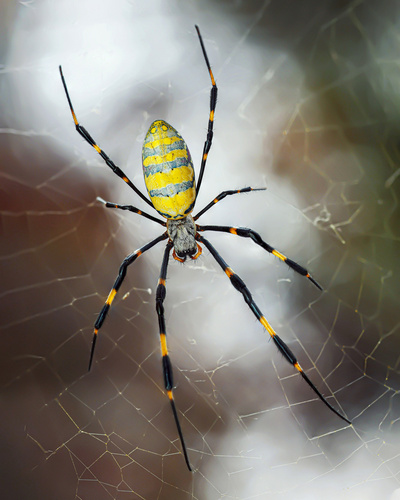
Female Joro spiders are highly conspicuous, featuring a cylindrical abdomen adorned with striking bands of bright yellow, dark blue or black, and a prominent bright red patch on their underside. Their long, spindly legs are distinctly banded with black and yellow. Females are quite large, with a body length of about 1 inch (1.5 to 3 cm) and a leg span reaching up to 4 inches (10 cm). In stark contrast, male Joro spiders are much smaller—often only a quarter of the female's size—and sport a dull, brown appearance that makes them easily overlooked as they hang out on the periphery of the female's massive golden web.
Category
InvertebrateRarity
Common
Danger
1/5 · Very low
Snaps
Be the first to snap!
Despite their large fangs and menacing appearance, their bite is remarkably weak and rarely breaks human skin; if it does, it feels no worse than a bee sting.
The spider gets its name from the Jorōgumo, a mythical Japanese creature that can shape-shift into a beautiful woman to ensnare unsuspecting men.
Their webs are incredibly complex, consisting of a central orb and irregular silk layers in front and behind, sometimes reaching up to 10 feet in depth.
They are among the very few predators that willingly eat the brown marmorated stink bug, a heavily armored agricultural pest that most birds and spiders avoid.
Produces highly durable, golden-tinted silk that is strong enough to capture large insects and even occasionally tiny vertebrates.
Spiderlings extrude long strands of silk into the wind to take flight, allowing them to disperse over distances of tens to hundreds of miles.
Unlike many related tropical orb-weavers, they can survive brief freezes, enabling them to expand their range into cooler northern climates.
They are highly opportunistic predators that consume almost any flying or jumping insect that blunders into their massive webs.
Age differences: Spiderlings eat tiny midges and gnats, while mature adults tackle much larger, robust prey like wasps and stink bugs.

Halyomorpha halys
Joro spiders act as a primary predator for the invasive Brown Marmorated Stink Bug.
Argyrodes spp.
Dew-drop spiders live as kleptoparasites in Joro webs, stealing their captured prey.

Cardinalis cardinalis
Birds like the Northern Cardinal have been observed picking Joro spiders from their webs to eat.
Trichonephila clavipes
Competes for web-building space and prey with native American orb-weavers.
No trait badges are assigned for this object yet.
No aliases listed yet.
Collections for this object will appear here as more themes are added.
Danger
1/5 · Very low
No special safety notes yet.
Compare body proportions, leg shape, abdomen markings and the web, if there is one. Eye arrangement can be decisive but rarely shows up in a casual phone photo. A web is a supporting clue, not proof of who built it. Spider Identifier: upload a photo and compare the visible details.
1-3 cm
0.0005-0.0015 kg
1 years
They are highly opportunistic predators that consume almost any flying or jumping insect that blunders into their massive webs.
Found in open woodlands and forest edges, often spinning large golden webs between trees or shrubs.
Ambush
400-1500
Zoom in to split clusters and explore where this object has been snapped.
Recent snaps will appear here as new observations are added.

Georgia, US
You might spot Strawberry Bush, Fire Pink, and Red Salamander.
View guide →
Georgia, US
You might spot Joro Spider, American Pokeweed, and Eastern Gray Squirrel.
View guide →

Georgia, US
You might spot Anole, Asian Lady Beetle, and Joro Spider.
View guide →

Georgia, US
You might spot Joro Spider, Eastern Gray Squirrel, and Christmas Fern.
View guide →

Georgia, US
You might spot Joro Spider, American Sweetgum, and American Tuliptree.
View guide →

Georgia, US
You might spot Silk Tree, Joro Spider, and Kingsnake.
View guide →
Take the discovery with you
Snap it with Snappit to identify it, learn what makes it special, and add the discovery to your collection.