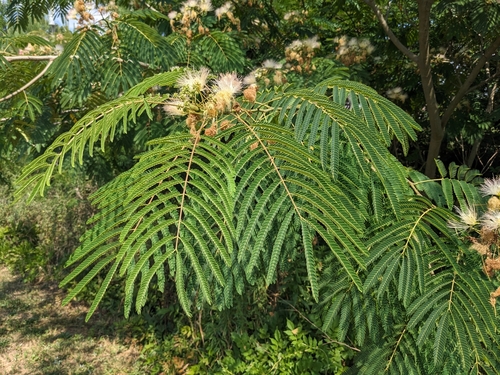





Silk Tree

Explore Gillsville Historic District, a captivating glimpse into old Georgia.
Explore Gillsville Historic District, a captivating glimpse into old Georgia. This 54-acre district in Gillsville, Georgia, is recognized on the National Register of Historic Places, preserving a linear collection of late 19th and early 20th-century commercial and residential architecture. It uniquely showcases the development patterns of small railroad towns that once dotted the Georgian landscape, offering visitors a tranquil journey through time.
The district's charm lies in its architectural diversity, featuring a commercial town center with distinctive one-story brick structures adorned with corbelling and stepped cornices. Nearby, a prominent two-story, wood-framed corner building stands as a testament to the town's mercantile past. Residential areas boast an array of vernacular and Victorian-eclectic homes, many showcasing beautiful details like wrap-around porches, multiple gables, and decorative balustrades. The area also reflects a rich folk pottery heritage, with local shops like Craven's Pottery and Hewell's Pottery continuing a craft practiced for generations.
Visiting the Gillsville Historic District offers a memorable experience for anyone interested in American history, architecture, and local culture. It’s a place where the past feels tangible, inviting leisurely strolls to admire well-preserved buildings and explore the vibrant tradition of folk art. This quiet district provides a unique opportunity to connect with the authentic small-town essence of Northeast Georgia. Turn your visit into a safari! Use the Snappit app to scan and log wildlife sightings here.
The Gillsville Historic District was officially listed on the National Register of Historic Places on August 30, 1985. Its historical significance stems from its architecture, commercial development, community planning, and local heritage. The town itself was named after Josiah H. Gill, who served as its first postmaster in 1833. The district's linear layout, paralleling the railroad tracks, is a direct reflection of its development in the 1870s, characteristic of many small railroad towns across Georgia. John Garrison notably contributed to this growth by deeding 825 acres for the railroad's construction in 1872 and serving as the first railroad agent. While a significant fire in 1900 destroyed much of Gillsville's downtown, several historic structures, including some commercial and residential buildings, survived, preserving the district's unique character.
Walk along Georgia Route 52 and the railroad corridor to observe the diverse late 19th and early 20th-century architecture. Explore the folk pottery shops to witness a living tradition, and consider a stop at the Gillsville Café. The Gillsville Cemetery at the northwestern end of the district also offers historical interest.
Weather will be the primary factor. Summers can be hot and humid, while winters are generally mild. No specific seasonal events for the historic district itself were noted, but local Gillsville events may occur throughout the year.
As an historic district largely along existing roads and railroad right-of-way, access is generally good for walking. Specific paved trails or extensive wheelchair-accessible facilities are not detailed, but the district's linear nature makes it amenable to exploration by foot or vehicle.
The historic commercial brick buildings in the town center, the two-story wood-framed corner commercial building, and the charming Victorian-eclectic and vernacular residential homes with their distinctive architectural details are central to the district's appeal. Don't miss Craven's Pottery and Hewell's Pottery for a taste of local folk art.
Each card links to a full Explore page with photos, traits, and fun facts.
Start with the big picture, then zoom in to explore individual wildlife observations around this place.
Wear comfortable walking shoes to fully explore the linear district.
Bring a camera to capture the charming historic architecture and unique folk art.
Visit the local pottery shops, such as Craven's Pottery or Hewell's Pottery, to see traditional crafts and purchase unique souvenirs.
Consider packing a picnic to enjoy at the local city park.
Check the City of Gillsville's website for any local events or festivals that might coincide with your visit.
If you need local official information, note that Gillsville City Hall has limited operating hours, sometimes only on Tuesdays or Thursdays for a few hours.
Jul 5, 2025
Photo attribution
no rights reserved
License: CC0 1.0 ↗
Image may be shown cropped inside the card frame.
Jun 17, 2024
Photo attribution
(c) Matthew Gerke, some rights reserved (CC BY)
License: CC BY 4.0 ↗
Image may be shown cropped inside the card frame.
Jun 17, 2024
Photo attribution
(c) Matthew Gerke, some rights reserved (CC BY)
License: CC BY 4.0 ↗
Image may be shown cropped inside the card frame.
May 12, 2026
May 10, 2026

Maryland, US
You might spot White-Tailed Deer and Eastern Gray Squirrel.
View guide →
.jpg)
District of Columbia, US
You might spot Eastern Gray Squirrel, Duck, and House Sparrow.
View guide →

Illinois, US
You might spot American Robin, Canada Goose, and House Sparrow.
View guide →

Virginia, US
You might spot Spotted Lanternfly and Northern Cardinal.
View guide →
Take the discovery with you
Identify the wildlife you spot, learn as you go, and keep a collection of the adventure.