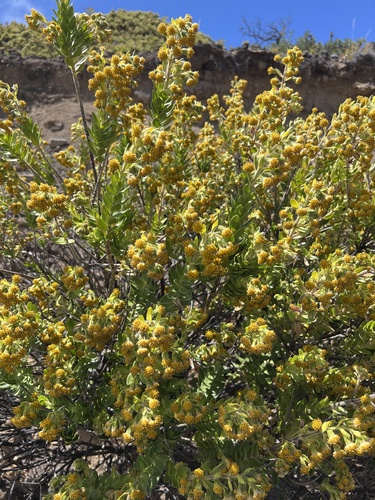


KūPaoa
dubautia menziesii
KūPaoa, or Dubautia menziesii, is a striking member of the Hawaiian silversword alliance, endemic to the high-elevation volcanic landscapes of Maui and Hawaiʻi. This hardy shrub has evolved remarkable adaptations to thrive in harsh subalpine and alpine environments, characterized by intense solar radiation, strong winds, and nutrient-poor volcanic soils. Its unique morphology, including dense foliage and often fuzzy leaves, helps it conserve moisture and protect against environmental extremes, making it a critical component of these fragile ecosystems. KūPaoa's presence signifies the resilience of native Hawaiian flora in some of the most challenging terrestrial habitats.
Habitat: KūPaoa is typically found in high-elevation subalpine shrublands, alpine zones, and on young lava flows and cinder cones on the volcanoes of Maui and Hawaiʻi.
KūPaoa typically grows as a compact to sprawling shrub, reaching heights of 0.5 to 3 meters, sometimes forming small tree-like structures. Its leaves are small, narrow, and often covered in silvery-white hairs, giving them a slightly fuzzy or woolly texture, which helps reflect sunlight and reduce water loss. The flowers, appearing in terminal clusters, are usually bright yellow and daisy-like, characteristic of the Asteraceae family. Stems are woody, and the overall plant structure is dense and bushy, often hugging the ground in exposed areas or growing more upright in sheltered spots.
Category
PlantsRarity
Common
Danger
1/5 · Very low
Snaps
Be the first to snap!
Its dense, often silvery hairs are not just for show; they act as a natural sunscreen, protecting the plant from the intense solar radiation at high altitudes and helping to reduce water loss.
KūPaoa can be found growing on barren lava flows, demonstrating its ability to colonize and thrive in some of the most geologically recent and nutrient-poor environments on Earth.
KūPaoa is part of the remarkable Hawaiian silversword alliance, a group of over 30 species that all evolved from a single tarweed ancestor that arrived in Hawaii millions of years ago, showcasing an extraordinary example of adaptive radiation.
The genus name Dubautia honors Joseph-Eugène DuBaut, an officer on a French scientific expedition, while menziesii honors the Scottish botanist Archibald Menzies.
KūPaoa possesses specialized physiological mechanisms, such as increased pigment production and robust cell structures, to withstand intense ultraviolet radiation and extreme temperature fluctuations common in its high-elevation habitat.
Its small, leathery leaves often covered in dense hairs minimize water loss through transpiration, allowing it to survive in arid, well-drained volcanic soils where water availability can be sporadic.
This plant is adapted to colonize nutrient-poor, young volcanic substrates, with a root system capable of anchoring in fractured lava and extracting essential minerals from developing soils.
KūPaoa, like all photosynthetic plants, produces its own food through photosynthesis, converting sunlight, carbon dioxide, and water into sugars. It absorbs essential mineral nutrients from the volcanic soils it inhabits.
Hylaeus anthracinus
Pollinates KūPaoa flowers, collecting nectar and pollen.
Himatione sanguinea
Native bird that may feed on KūPaoa nectar or seeds, aiding in pollination or seed dispersal.
Capra hircus
Invasive herbivore that can browse on native vegetation, including KūPaoa, causing significant damage.
Argyroxiphium sandwicense ssp. sandwicense
Another prominent member of the silversword alliance, often found in similar high-elevation habitats and competing for resources.
No trait badges are assigned for this object yet.
No aliases listed yet.
Collections for this object will appear here as more themes are added.
Danger
1/5 · Very low
No special safety notes yet.
Start with the whole plant, then compare leaf arrangement, leaf edges, stems and any flowers or fruit. Opposite leaves grow in pairs; alternate leaves come one at a time along the stem. These details tell you far more together than a single green leaf does. Plant Identifier: upload a photo and compare the visible details.
50-300 cm
2-25 kg
20-50 years
KūPaoa, like all photosynthetic plants, produces its own food through photosynthesis, converting sunlight, carbon dioxide, and water into sugars. It absorbs essential mineral nutrients from the volcanic soils it inhabits.
KūPaoa is typically found in high-elevation subalpine shrublands, alpine zones, and on young lava flows and cinder cones on the volcanoes of Maui and Hawaiʻi.
Photosynthesis
Zoom in to split clusters and explore where this object has been snapped.
Recent snaps will appear here as new observations are added.
Take the discovery with you
Snap it with Snappit to identify it, learn what makes it special, and add the discovery to your collection.