


Laevigatae
laevigatae
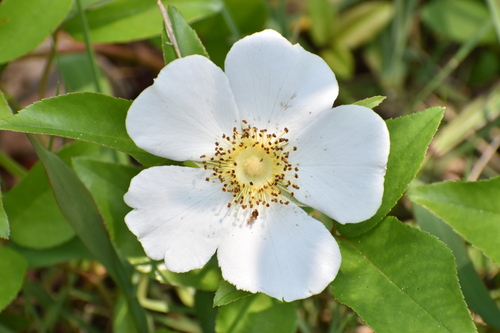
Laevigatae, commonly represented by the species Rosa laevigata (the Cherokee Rose), is a robust climbing rose characterized by its glossy evergreen foliage and large, fragrant white blooms. Originally native to southern China and Taiwan, this vigorous scrambler has successfully naturalized in many warm-temperate regions globally, particularly in the southeastern United States where it is celebrated as Georgia's state flower. It plays an important role in local ecosystems by providing dense nesting cover for birds and abundant nectar for native pollinators.
Habitat: Commonly found growing along forest edges, roadsides, fence lines, and riparian areas in warm-temperate climates.
This climbing woody shrub features long, arching green branches armed with stout, hooked prickles. Its compound leaves typically contain three highly glossy, elliptic leaflets with finely serrated margins. In late spring, it produces solitary, single-petaled flowers measuring 6 to 10 centimeters across, showcasing pure white petals surrounding a dense, golden-yellow center of numerous stamens. The subsequent fruits (hips) are distinctively pear-shaped and covered in stiff bristles.
Category
PlantsRarity
Common
Danger
1/5 · Very low
Snaps
Be the first to snap!
The Cherokee Rose is famously associated with the Trail of Tears, where legend says the flowers grew wherever a mother's tear fell.
The hips are traditionally harvested in East Asia to prepare a tonic tea used in traditional medicine for its astringent properties.
Unlike most wild roses which have five to nine leaflets per leaf, the Laevigatae section typically has leaves with only three highly polished leaflets.
Utilizes sharp, downward-curved prickles along its stems to anchor onto neighboring trees and structures, allowing it to climb up to ten meters to reach sunlight.
Possesses an exceptionally thick, waxy cuticle on its leaves that minimizes water loss during dry spells and provides a physical barrier against fungal pathogens.
Produces hips covered in sharp, stiff bristles that protect developing seeds from premature predation by soft-bodied herbivores.
As a plant, it creates its own food through photosynthesis, utilizing sunlight, carbon dioxide, and water to produce glucose while absorbing minerals from the soil.
Apis mellifera
Bees visit the large white flowers to collect pollen, serving as primary pollinators.

Mimus polyglottos
Birds feed on the ripe, vitamin C-rich hips during the winter months, helping to disperse the seeds across new areas.

Popillia japonica
Adult beetles voraciously feed on the leaves and delicate white petals during the summer.
No trait badges are assigned for this object yet.
Collections for this object will appear here as more themes are added.
Danger
1/5 · Very low
No special safety notes yet.
Start with the whole plant, then compare leaf arrangement, leaf edges, stems and any flowers or fruit. Opposite leaves grow in pairs; alternate leaves come one at a time along the stem. These details tell you far more together than a single green leaf does. Plant Identifier: upload a photo and compare the visible details.
200+ cm
10+ years
As a plant, it creates its own food through photosynthesis, utilizing sunlight, carbon dioxide, and water to produce glucose while absorbing minerals from the soil.
Commonly found growing along forest edges, roadsides, fence lines, and riparian areas in warm-temperate climates.
Zoom in to split clusters and explore where this object has been snapped.
Recent snaps will appear here as new observations are added.
Take the discovery with you
Snap it with Snappit to identify it, learn what makes it special, and add the discovery to your collection.

















