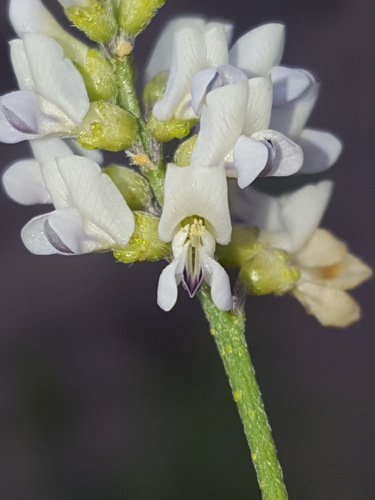


Lance-Leaved Scurf-Pea
ladeania lanceolata
The Lance-Leaved Scurf-Pea (Ladeania lanceolata), also known as the lemon scurfpea, is a resilient perennial wildflower native to the sandy prairies and dunes of western North America. Belonging to the legume family, this hardy plant plays an essential ecological role by stabilizing shifting sands with its extensive underground rhizome network. Beyond its physical resilience, it is famous for the refreshing lemon-like aroma it releases when its leaves are crushed. This fragrant plant produces delicate clusters of small, pea-like flowers that transition from white to pale blue or purple. It thrives in arid, nutrient-poor soils where few other plants can survive, forming dense colonies that provide critical cover and forage for local wildlife. Its presence is often an indicator of healthy, active sand dune ecosystems.
Habitat: Typically found in semi-arid environments, favoring active or semi-stabilized sand dunes, sandy prairies, and open grasslands.
This perennial herb typically grows between 15 and 60 cm tall, featuring erect, branching stems covered in small, gland-dotted pits that give it a scurfy texture. The leaves are palmately trifoliate, meaning they are split into three narrow, lance-shaped leaflets that are light green and up to 4 cm long. In late spring and summer, it produces compact, rounded clusters of tiny, pea-like flowers, which are typically white to cream-colored with a hint of purple or blue at the tips. Following pollination, it forms small, round, hairy seed pods covered in distinct glandular dots.
Category
PlantsRarity
Common
Danger
1/5 · Very low
Snaps
Be the first to snap!
Due to its deep, tough root systems, this plant is an excellent natural dune stabilizer, helping prevent wind erosion in fragile sandy environments.
Indigenous peoples, including the Blackfoot and Lakota, historically used infusions of this plant to treat skin issues, chest colds, and horse ailments.
The leaves of the Lance-Leaved Scurf-Pea emit a strong, pleasant citrus aroma resembling lemons when bruised or crushed.
The plant possesses an extensive system of deep, creeping rhizomes that allow it to anchor in shifting sands and survive in highly unstable dune environments.
In symbiosis with soil bacteria, it converts atmospheric nitrogen into a usable form, enriching nutrient-poor sandy soils for itself and neighboring plants.
The foliage is covered in tiny glands that secrete aromatic oils, giving off a lemon scent that deters herbivores and helps reduce water loss.
As a photoautotrophic plant, it manufactures its own food through photosynthesis, utilizing sunlight, carbon dioxide, and water while absorbing essential soil nutrients.
Rhizobium leguminosarum
Forms a subterranean symbiotic relationship to fix atmospheric nitrogen into the soil.

Antilocapra americana
Provides seasonal browse for native herbivores on the Great Plains.
Apis mellifera
Visits the small pea-like flowers to collect nectar, acting as a key pollinator.
No trait badges are assigned for this object yet.
No aliases listed yet.
Collections for this object will appear here as more themes are added.
Danger
1/5 · Very low
No special safety notes yet.
Start with the whole plant, then compare leaf arrangement, leaf edges, stems and any flowers or fruit. Opposite leaves grow in pairs; alternate leaves come one at a time along the stem. These details tell you far more together than a single green leaf does. Plant Identifier: upload a photo and compare the visible details.
15+ cm
3+ years
As a photoautotrophic plant, it manufactures its own food through photosynthesis, utilizing sunlight, carbon dioxide, and water while absorbing essential soil nutrients.
Typically found in semi-arid environments, favoring active or semi-stabilized sand dunes, sandy prairies, and open grasslands.
Zoom in to split clusters and explore where this object has been snapped.
Recent snaps will appear here as new observations are added.
Take the discovery with you
Snap it with Snappit to identify it, learn what makes it special, and add the discovery to your collection.