




Lanternfish
Hygophum
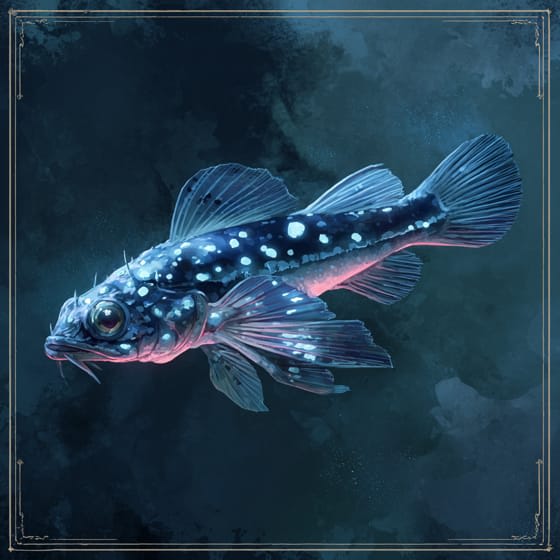
Lanternfishes (family Myctophidae) are small deep-sea fishes, most under 15 cm long, named for the rows of light organs called photophores along their bellies and sides. About 250 species live in all the world's oceans, and many swim up hundreds of metres at night to feed near the surface, then sink back into the dim twilight zone by day. The genus Hygophum, shown here, has nine species; their males and females carry their tail lights in different places.
Also known as Myctophid, Myctophids, Lanternfishes
Rarity: Common
300–800 m climbed at dusk (Hygophum hygomii)
Downwards reflectors aim the glow
♂ top · ♀ below tail light (Hygophum)Still debated
≈252 species, each with its own light layout
6.2 mm eye on a 4.5 cm fish
38 kHz echo sounders that map the layerStill debated
≈16% of sinking carbon carried by fish (estimate)Still debated
Tap a pin on the model or a part below.
6.2 mm eye of a 4.5 cm Hygophum benoiti
Copepods main prey
Blue-green colour of the light
Top or bottom male or female (Hygophum)
8.1 cm largest Hygophum hygomii
Gas or none depends on the species
≈10% of primary production, respired by twilight-zone fish (estimate)
600–800 m daytime depth, Hygophum hygomii
Male and female Hygophum carry their tail lights in different places, and young lanternfish look nothing like adults. Pick one to change the model.
Living lanternfish are rarely photographed, so these are historical scientific illustrations from Wikimedia Commons.
Measured by scientists and fish databases. Big estimates come with big ranges.
Tap Myth or Fact for each claim, then check the answer.
0 of 8 answered
They are among the most abundant vertebrates, but nobody has counted them. Bristlemouths, especially the genus Cyclothone, are widely considered even more numerous.[12, 29]
Early sonar seemed to show it. The false bottom was echoes from crowds of small gas-filled fish, mostly lanternfish, swimming up towards the surface at night.[5]
Belly lights hide the fish's dark outline against the faint light from above. This camouflage is called counter-illumination.[6, 19]
Some species keep gas all their lives, some never have any and some lose it as adults. Several common Southern Ocean species have none.[12]
In many species the tail or head lights differ. In Hygophum reinhardtii, males have a light gland on top of the tail stalk and females have patches underneath.[8, 7]
Estimates for all twilight-zone fish range from about 1 to 20 billion tonnes, depending on how sonar echoes are turned into fish.[23, 13]
Many do, but not all. Sonar shows about half of the twilight-zone echo making the daily trip, from about 20% to 90% in different oceans.[18, 4]
Female anglerfish use a glowing lure, but for lanternfish the known uses are camouflage and probably signalling. Luring has not been shown.[30, 7, 6]
Superlatives, each checked against its source.
Follow Hygophum hygomii, the Bermuda lantern fish, through 24 hours.
Three glowing fishes of the deep, with three very different ways of using light.
| Lanternfish | Anglerfish (bulbous dreamer) | Hatchetfish | |
|---|---|---|---|
| Group[7, 30, 32] | Family Myctophidae, ≈252 species | Oneirodes eschrichtii, one of many anglerfishes | Family Sternoptychidae, 74 species |
| Size[5, 30, 32] | 2–30 cm, most under 15 cm | Females up to 29 cm, males 2.8 cm | 2.8–12 cm |
| Light organs[5, 7, 30, 32] | Rows of photophores on belly and sides, plus tail (and in some, head) lights | One glowing lure on the female's forehead, lit by bacteria | Light organs over the body, pointing down |
| Main use of light[6, 7, 30, 32] | Camouflage, and probably signalling | Luring prey | Camouflage (counter-illumination) |
| Food[4, 30, 32] | Zooplankton, mostly copepods | Mainly smaller fish | Ostracods, copepods, small crustaceans, fish larvae |
| How it feeds[5, 30, 32] | Most migrate to surface waters at night to feed | Flashing lure, large mouth, large teeth | Some species migrate up at night to feed |
Anglerfish facts are for one species; anglerfishes vary a lot.
Not as far as we know. But the twilight zone is attracting fishing interest and is changing with the climate, and scientists say we need to understand it first.
IUCN Red List
Least Concern (LC)
Trend unknownEight of the nine Hygophum species are listed as Least Concern; we found no listing for Hygophum atratum. There is no single assessment for all lanternfishes.[11, 17, 33, 34]
IUCN Red List, 2012 (H. hygomii, H. benoiti)
Shrinking habitat≈39%
In the California Current, one model projects the livable twilight zone could shrink by about 40 m (39%) by 2100 under high emissions, mainly because low-oxygen water rises.[35]
Genetics for management
DNA shows glacier lanternfish form three separate groups across the North Atlantic and Mediterranean, information needed before any fishery starts.[31]
A careful approach
Modellers recommend a precautionary approach to twilight-zone fishing, because it could affect how much carbon the ocean stores.[24]
Hygophum hygomii (Bermuda lantern fish)Least Concern
Hygophum benoiti (Benoit's lanternfish)Least Concern
Least Concern, assessed 2012.[17]
Six more Hygophum speciesLeast Concern
H. bruuni, H. hanseni, H. macrochir, H. proximum, H. reinhardtii and H. taaningi are also listed as Least Concern.[33]
Hygophum atratumNot Evaluated
We found no Red List category for this species; it may not have been assessed.[33]
12 questions. Every answer is somewhere on this page.
Question 1 of 12Score 0
Answer: Photophores. Photophores are small light organs in rows along the belly and sides.
Answer: To hide their outline from below. Counter-illumination: the glow blends their outline into the faint light from above.
Answer: On top of the tail stalk. Males have one gland on top; females have three merged patches underneath.
Answer: About 250. About 252 species in 34 genera.
Answer: 600–800 m down. It rests 600–800 m down by day and rises to the top 300 m at night.
Answer: The sea floor. The sea floor seemed to rise at night; it was really crowds of migrating fish.
Answer: A gas-filled swim bladder. Gas reflects sound strongly. Species without gas are much harder to detect.
Answer: Copepods. Copepods, tiny crustaceans, are their main prey.
Answer: A mirror layer called the tapetum lucidum. The tapetum lucidum reflects light back through the rod-only retina.
Answer: About 50%. About half, from about 20% in the Indian Ocean to about 90% in the eastern Pacific.
Answer: Bristlemouths. Bristlemouths, especially Cyclothone, are widely considered the most abundant.
Answer: About 8 cm. It reaches about 8.1 cm.
Diet, food web, safety and badges from the Snappit field guide.
Lanternfish are tiny predators that eat small plankton and crustaceans floating in the ocean.
Primary Foods
Whales and dolphinsEaten by
Many whales and dolphins eat lanternfish.

TunaEaten by
Tunas are among the many fish that eat lanternfish.
Humboldt SquidEaten by
Humboldt squid are among the many animals that eat lanternfish.
CopepodHunts
Lanternfish actively hunt and consume these small crustaceans.
Antarctic KrillHunts
Some lanternfish eat krill, but copepods are the main prey of the species that migrate.
Danger 1/5 · Very low
Lanternfish are not dangerous to humans but should be admired from a distance to protect their habitat.
Look at body shape, where the fins sit and their outline, mouth position, stripes and spots. Young fish and breeding adults can wear different patterns, and aquarium color varieties can look nothing like wild fish. Fish Identifier: upload a photo and compare the visible details.
2-30 cm
0.001-0.05 kg
1-5 years
Lanternfish are tiny predators that eat small plankton and crustaceans floating in the ocean.
Deep Sea
Foraging
1000 m
A small deep-sea fish of the family Myctophidae, named for its rows of light organs (photophores). There are about 252 species in all oceans, and most are under 15 cm long.
Mainly for camouflage: belly lights hide their outline from predators below (counter-illumination). Species-specific light patterns and tail lights probably also help them recognise and signal to each other, though that is harder to prove.
By day most live in the twilight zone, about 200–1,000 m down. Hygophum hygomii spends the day 600–800 m down and rises to between the surface and 300 m at night.
Nobody knows exactly. One model puts all twilight-zone fish, of which lanternfish are a big part, at about 1.8–16 billion tonnes, and published estimates range from about 1 to 20 billion tonnes.
Many animals: tuna, sharks, other deep-sea fish (including other lanternfish), whales, dolphins, salmon, penguins and jumbo squid.
A layer in the ocean that reflects sonar strongly, made of crowds of animals, many of them lanternfish with gas-filled swim bladders. It moves up at night and down by day, and early sonar users mistook it for the sea floor.
No. They are small fish, mostly under 15 cm, that live far out at sea and deep down. You are only likely to see one on a research ship or in a museum.
Hardly at all so far: twilight-zone fish are largely unexploited. But there is growing interest in catching them for fishmeal, fish-farm feed and supplements, and scientists urge caution because so much is unknown.
Take the discovery with you
Snap it with Snappit to identify it, learn what makes it special, and add the discovery to your collection.


 Glowing
 Nocturnal










