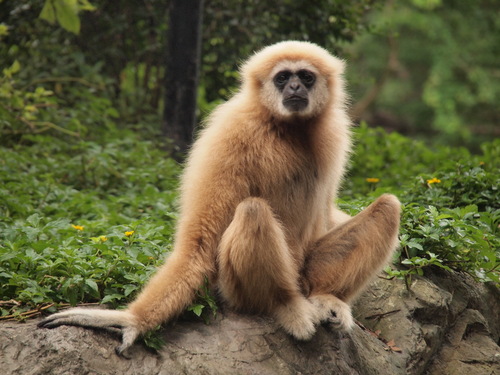


Lar Gibbon
hylobates lar
The Lar Gibbon, also known as the white-handed gibbon, is one of the most recognizable and charismatic primates of Southeast Asia's tropical rainforests. Famous for their incredible agility, these small apes spend almost their entire lives high in the forest canopy, moving through the branches with a spectacular hand-over-hand swinging motion known as brachiation. What truly sets them apart is their complex social life and haunting, melodic vocalizations. Monogamous pairs sing elaborate duets at dawn to defend their territory and strengthen their pair bond, filling the misty jungle air with beautiful, echoing songs. Despite their wild elegance, these arboreal masters face severe threats from habitat loss and the illegal pet trade, making them a critical focus of conservation efforts.
Habitat: Found in dense, undisturbed tropical rainforests and dipterocarp forests, primarily high in the canopy layer.
Lar Gibbons are small, tailless apes characterized by their extremely long arms and distinctive color patterns. They exhibit color dichromatism, with coats ranging from dark brown or black to light buff or sandy blonde. Regardless of their main coat color, they always feature a ring of white fur encircling their dark face, as well as distinct white coloration on their hands and feet. They have a lean, lightweight build and exceptionally elongated hands that act as natural hooks for gripping branches.
Category
MammalsRarity
Common
Danger
1/5 · Very low
Snaps
Be the first to snap!
Gibbons do not have tails, making them true apes rather than monkeys.
Their wrist joints are ball-and-socket joints, allowing for a 360-degree rotation that maximizes swing efficiency.
They can cover up to 15 meters (50 feet) in a single leap while swinging through the trees.
They form strictly monogamous family units consisting of a breeding pair and their offspring, which is rare among primates.
They possess long, hook-like fingers and ball-and-socket wrist joints that allow them to swing effortlessly from branch to branch at high speeds.
Monogamous pairs perform highly synchronized, complex vocal duets to communicate, define territory borders, and reinforce pair bonds.
When on the ground or walking along wide branches, they raise their exceptionally long arms above their heads to maintain perfect balance while walking upright.
Primarily frugivorous, Lar Gibbons spend much of their day foraging high in the canopy for ripe fruits, supplementing their diet with leaves, flowers, and occasional insects.
Age differences: Infants nurse for up to two years before gradually transitioning to a solid diet of soft fruits and tender leaves.

Symphalangus syndactylus
Competes with the Lar Gibbon for resources in the same canopy, feeding on similar ripe fruits like figs.
Neofelis nebulosa
One of the primary natural predators of Lar Gibbons in the forest canopy.
Ficus racemosa
Provides essential fruit and nesting or brachiating structures, while the gibbon assists in seed dispersal.
No trait badges are assigned for this object yet.
No aliases listed yet.
Collections for this object will appear here as more themes are added.
Danger
1/5 · Very low
No special safety notes yet.
Compare ears, muzzle, tail, feet and coat markings. Size is hard to judge without something nearby for scale, and young mammals may not have adult coloring yet. Mammal Identifier: upload a photo and compare the visible details.
42-60 cm
4.5-7.5 kg
25-44 years
55 km/h
Primarily frugivorous, Lar Gibbons spend much of their day foraging high in the canopy for ripe fruits, supplementing their diet with leaves, flowers, and occasional insects.
Found in dense, undisturbed tropical rainforests and dipterocarp forests, primarily high in the canopy layer.
Foraging
Zoom in to split clusters and explore where this object has been snapped.
Recent snaps will appear here as new observations are added.

Kansas, US
You might spot Tiger, Sloth Bear, and Panthera Pardus Orientalis.
View guide →

England, UK
You might spot Ring-Tailed Lemur, Meerkat, and Red Panda.
View guide →

England, UK
You might spot Chimpanzee, Bornean Orangutan, and Sumatran Orangutan.
View guide →
Take the discovery with you
Snap it with Snappit to identify it, learn what makes it special, and add the discovery to your collection.