
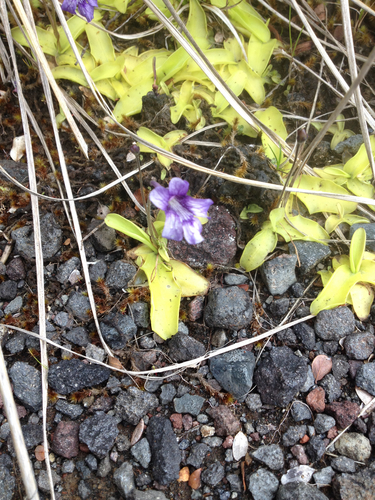


Large-Flowered Butterwort
pinguicula grandiflora
The Large-Flowered Butterwort (Pinguicula grandiflora) is a captivating insectivorous plant renowned for its striking violet blooms and unique carnivorous lifestyle. Nestled in nutrient-poor boggy landscapes across Western Europe, this perennial herb has evolved a brilliant survival strategy to cope with acidic, nitrogen-deficient soils. Instead of relying purely on its roots, it turns to the sky, transforming its leaves into deadly sticky traps for passing insects. Beyond its predatory nature, the Large-Flowered Butterwort is highly valued for its gorgeous, orchid-like flowers that rise on slender stems, presenting a beautiful contrast to its wet, mossy environment. Botanists and nature enthusiasts alike marvel at this plant's delicate balance between fragile floral beauty and efficient predatory engineering. Spotting one in the wild is a true highlight of any wetland excursion.
Habitat: Typically found in damp, acidic, and nutrient-poor environments such as peat bogs, fens, wet mountain rocks, and seepages.
This species forms a low-growing rosette of light-yellowish to pale-green, succulent leaves that lie flat against the ground. The leaves have a greasy, glistening appearance due to thousands of microscopic glands, and their margins slightly curl upwards. From late spring to mid-summer, the plant produces one or more upright, leafless stalks, each ending in a large, single flower. The flower is typically a rich violet-purple with a broad, white throat and a distinct nectar spur at the back, measuring up to 3 centimeters across.
Category
PlantsRarity
Common
Danger
1/5 · Very low
Snaps
Be the first to snap!
In the winter, the plant completely dies back into a tight bud called a hibernaculum, which lacks roots and lies dormant on the cold moss until spring.
Its scientific name, Pinguicula, comes from the Latin 'pinguis', meaning 'fat' or 'greasy', referring to the oily texture of its leaves.
The common name 'butterwort' comes from the historic use of its greasy leaves to curdle milk and make traditional Scandinavian yogurt-like products.
Secretes a sticky, glistening mucilage from glandular leaf hairs that traps small insects when they land.
Releases specialized digestive enzymes directly from its leaves to break down trapped insect bodies and absorb essential nutrients.
Survives harsh freezing winters by retreating into a tight, rootless vegetative bud that resists cold and snow.
Utilizes sticky leaves to trap and digest tiny invertebrates, absorbing essential nutrients that the soil lacks.
Bombus pascuorum
Pollinates the large flowers during the spring and summer months.
Sciara militaris
Captured on the sticky leaves of the butterwort, providing essential nitrogen.
Sphagnum subnitens
Competes for space and sunlight in boggy, nutrient-poor soils.
No trait badges are assigned for this object yet.
No aliases listed yet.
Collections for this object will appear here as more themes are added.
Danger
1/5 · Very low
No special safety notes yet.
Start with the whole plant, then compare leaf arrangement, leaf edges, stems and any flowers or fruit. Opposite leaves grow in pairs; alternate leaves come one at a time along the stem. These details tell you far more together than a single green leaf does. Plant Identifier: upload a photo and compare the visible details.
5-20 cm
0.002-0.015 kg
3-10 years
Utilizes sticky leaves to trap and digest tiny invertebrates, absorbing essential nutrients that the soil lacks.
Typically found in damp, acidic, and nutrient-poor environments such as peat bogs, fens, wet mountain rocks, and seepages.
Ambushbase Of Plant Passive Trapping Which Acts Like Ambush For Insects As They Land Unsuspecting On Leaves So We Classify As Ambush Or Similar Term But Using Ambush As Permitted Schema Value Or Foraging Let's Use Ambush For Passive Traps Where Prey Wanders In And Is Stuck With No Pursuit. Let's Write 'ambush' To Fit. Let's Use "ambush" As Specified. Wait, Let's Keep It Simple: 'ambush' Matches The Schema. Let's Double Check If We Can Write "ambush" Or Null. The Schema Allows 'string' Or 'null'. I Will Use "ambush".
Zoom in to split clusters and explore where this object has been snapped.
Recent snaps will appear here as new observations are added.
Take the discovery with you
Snap it with Snappit to identify it, learn what makes it special, and add the discovery to your collection.


















