


Large-Fruited Juniper
juniperus macrocarpa
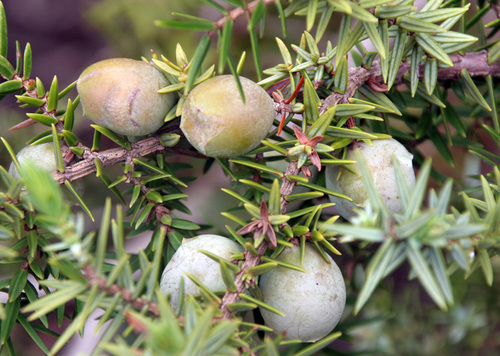
The Large-Fruited Juniper (Juniperus macrocarpa) is a hardy, long-lived conifer native to the coastal sand dunes and cliffs of the Mediterranean Basin. Growing as either a sprawling shrub or a small tree, it plays a critical ecological role in stabilizing fragile coastal soils and coastal dune ecosystems. Unlike many other junipers, this species is renowned for producing exceptionally large, berry-like seed cones that change from green to a shiny copper-brown or purplish-brown when fully mature. Its tough, needle-like foliage and robust nature allow it to withstand intense sun, dry summers, and salty sea breezes.
Habitat: Found primarily on coastal sand dunes, sandy beaches, rocky cliffs, and coastal pine forests along the Mediterranean coastline.
This evergreen plant grows up to 10 meters tall, often forming a dense, wind-sculpted shrub or small tree with a broad, spreading crown. Its leaves are sharp, needle-like, and arranged in whorls of three, featuring two prominent white stomatal bands on their upper surfaces. The most distinctive feature is its massive, globose seed cones (galbuli) which measure 1.2 to 2.5 centimeters in diameter. These cones start green and mature over two years into a rich, glaucous copper-brown to reddish-brown color, enclosing three large seeds.
Category
PlantsRarity
Common
Danger
1/5 · Very low
Snaps
Be the first to snap!
Because of its resilience and unique growth forms molded by coastal winds, it is highly prized by European bonsai enthusiasts.
Its cones take up to two full years to fully ripen, meaning a single plant often displays both green first-year cones and brown second-year cones simultaneously.
The seed cones of this species are among the largest of any juniper in the world, often reaching the size of a small cherry.
Develops an extensive and deep root system that anchors shifting coastal sands, preventing wind and wave erosion.
Features a thick, waxy needle cuticle and highly flexible branches that prevent moisture loss and physical damage from harsh, salty maritime winds.
Maintains an exceptionally low transpiration rate and specialized cellular mechanisms to survive hot, arid Mediterranean summers with minimal water.
As a photosynthetic plant, the Large-Fruited Juniper produces its own organic compounds using sunlight, carbon dioxide, water, and essential mineral nutrients absorbed through its roots.

Turdus viscivorus
Birds feed on the large, nutritious seed cones and play a vital role in seed dispersal across coastal habitats.
Arceuthobium oxycedri
A parasitic plant that infects the branches of the juniper, draining water and mineral resources from its host.
Juniperus phoenicea
Often grows alongside other coastal flora, competing for water, space, and nutrients in nutrient-poor dune soils.
No trait badges are assigned for this object yet.
No aliases listed yet.
Collections for this object will appear here as more themes are added.
Danger
1/5 · Very low
No special safety notes yet.
Start with the whole plant, then compare leaf arrangement, leaf edges, stems and any flowers or fruit. Opposite leaves grow in pairs; alternate leaves come one at a time along the stem. These details tell you far more together than a single green leaf does. Plant Identifier: upload a photo and compare the visible details.
100-1000 cm
100-500 years
As a photosynthetic plant, the Large-Fruited Juniper produces its own organic compounds using sunlight, carbon dioxide, water, and essential mineral nutrients absorbed through its roots.
Found primarily on coastal sand dunes, sandy beaches, rocky cliffs, and coastal pine forests along the Mediterranean coastline.
Zoom in to split clusters and explore where this object has been snapped.
Recent snaps will appear here as new observations are added.
Take the discovery with you
Snap it with Snappit to identify it, learn what makes it special, and add the discovery to your collection.


















