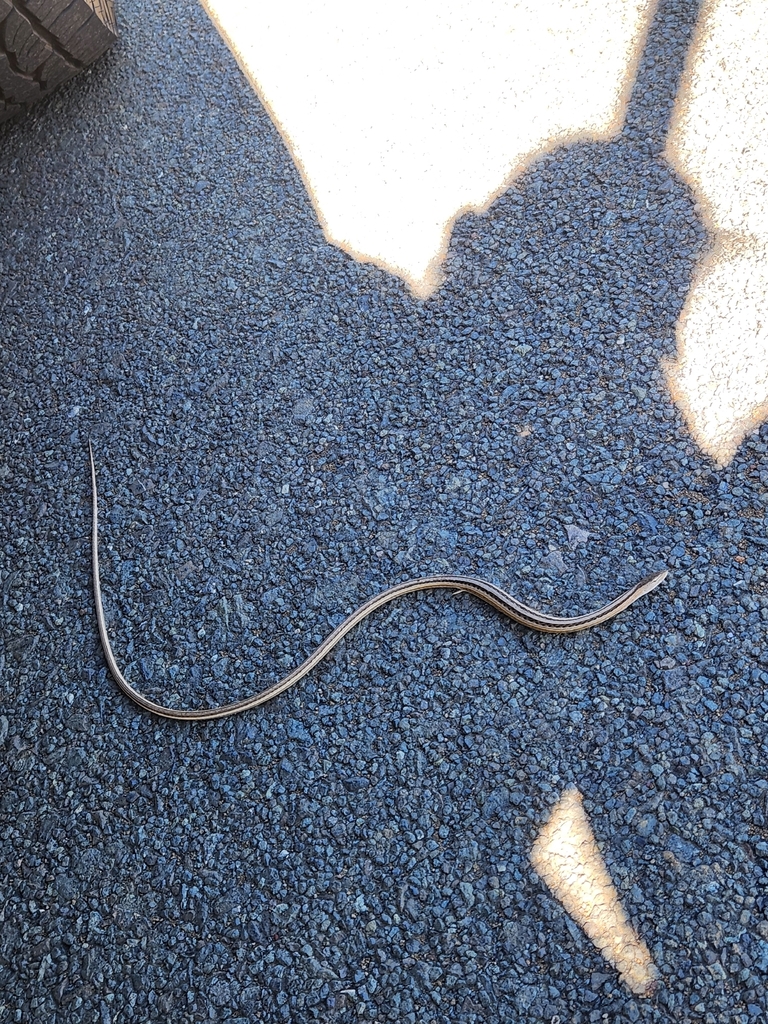





Large-Scale Grass Lizard
chamaesaura macrolepis
The Large-Scale Grass Lizard is a fascinating reptile that loves to bask in the sun. With its large, scaly body and quick movements, it is a master of camouflage in grassy areas!
Habitat: Open grasslands and savannahs in warm climates.
The Large-Scale Grass Lizard has an exceptionally long, slender body with tiny, reduced limbs, making it look snake-like. Its body is covered in large, keeled scales and typically appears in shades of brown, olive-green, or grey to blend seamlessly into tall grasses.
Category
ReptilesRarity
Common
Danger
1/5 · Very low
Snaps
Be the first to snap!
Despite having legs, it often moves by wiggling like a snake through dense grasses.
Its body can be up to three times longer than its head, thanks to an incredibly long tail!
These lizards are sometimes called "snake-lizards" because of their very long body and reduced limbs.
They can hold their breath for several minutes to hide from airborne threats in water puddles.
Large-Scale Grass Lizard can drop its tail if grabbed, wiggling to distract a predator and allow the lizard to escape.
Large-Scale Grass Lizard has live birth (viviparity) which helps its young avoid egg predators and develop safely inside the mother.
Large-Scale Grass Lizard has a sleek, often striped body coloration that helps it blend perfectly into the tall grass, hiding from predators.
Large-Scale Grass Lizard has large, tough, keeled scales that provide extra protection against rough vegetation and potential attackers.
This lizard is a skilled hunter of small insects and other tiny invertebrates found in the grass.
Buteo rufofuscus
A common bird of prey in its habitat.
Dispholidus typus
A tree snake that hunts lizards.
Gryllus bimaculatus
A primary food source in its grassy environment.

Locusta migratoria
A large insect prey abundant in its habitat.
Solitary animals live alone for most of their lives, only interacting with others for mating or parental care.
Camouflaged describes organisms that possess coloring or patterns that allow them to blend into their environment.
This trait identifies organisms whose diet consists entirely or primarily of animal tissue.
Diurnal animals are primarily active during daylight hours, typically resting or sleeping at night.
Danger
1/5 · Very low
Always observe lizards from a distance; they are wild animals.
Compare scales, body proportions, legs, tail and shell, if there is one. Many reptiles change their look with age, temperature or breeding condition. Reptile Identifier: upload a photo and compare the visible details.
30-70 cm
0.03-0.1 kg
5-8 years
15 km/h
This lizard is a skilled hunter of small insects and other tiny invertebrates found in the grass.
Open grasslands and savannahs in warm climates.
Foraging
Zoom in to split clusters and explore where this object has been snapped.
Recent snaps will appear here as new observations are added.
Take the discovery with you
Snap it with Snappit to identify it, learn what makes it special, and add the discovery to your collection.