

Light-Backed Duiker
cephalophus silvicultor
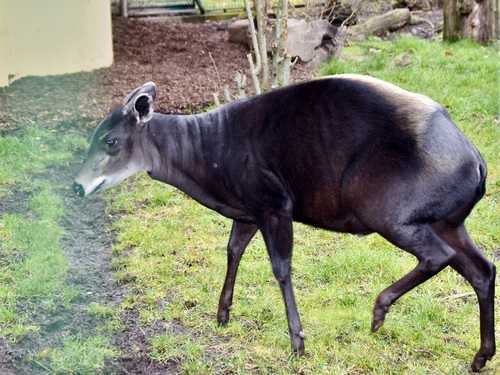
The Light-Backed Duiker, often referred to as the yellow-backed duiker, is the largest and most robust of all the duiker species. Native to the dense, moist forest zones of West and Central Africa, this elusive mammal is a key seed disperser in its tropical ecosystem. It spends most of its time hidden in the thick understory, relying on its well-developed senses of smell and hearing to navigate and avoid predators.
Habitat: Found in dense tropical rainforests, moist woodland savannas, montane forests, and swamp edges of Central and West Africa.
This stocky, wedge-shaped antelope features a dark brown to black coat with a highly contrasting patch of pale-yellow to cream-colored hair on its lower back, which flares when the animal is startled. It has an arched back, short but sturdy legs, a slightly elongated face with a prominent crest of reddish-brown hair between its short, straight horns, and large, visible scent glands under each eye.
Category
MammalsRarity
Common
Danger
1/5 · Very low
Snaps
Be the first to snap!
Despite being herbivores, these animals have been occasionally documented eating small birds and carrion to supplement their mineral intake.
The word 'duiker' comes from the Afrikaans word for 'diver', referring to the animal's behavior of diving into thick vegetation when startled.
Their exceptionally large mouths allow them to swallow remarkably large fruits and hard seeds whole, which they later regurgitate or pass.
When startled or alarmed, the duiker can erect the patch of light-colored hair on its rump to warn conspecifics of danger.
It possesses prominent facial glands below the eyes used to deposit strong, dark secretions onto branches to mark its territory.
Its wedge-like body structure allows it to duck and dive seamlessly through the thickest tangled undergrowth to escape predators.
The Light-Backed Duiker is primarily a frugivore, actively searching the forest floor for fallen fruits and seeds, supplemented occasionally with leaves, fungi, and animal matter.
Age differences: Weaned young transition from milk to high-protein seeds and fallen forest fruits as they mature.
Panthera pardus
Preyed upon by large forest predators that stalk the dense undergrowth.
Python sebae
Younger or smaller individuals are occasionally vulnerable to ambush by giant constrictors.

Potamochoerus porcus
Competes directly for fallen fruits and nuts on the forest floor.
No trait badges are assigned for this object yet.
No aliases listed yet.
Collections for this object will appear here as more themes are added.
Danger
1/5 · Very low
No special safety notes yet.
Compare ears, muzzle, tail, feet and coat markings. Size is hard to judge without something nearby for scale, and young mammals may not have adult coloring yet. Mammal Identifier: upload a photo and compare the visible details.
115+ cm
45+ kg
10+ years
40 km/h
The Light-Backed Duiker is primarily a frugivore, actively searching the forest floor for fallen fruits and seeds, supplemented occasionally with leaves, fungi, and animal matter.
Found in dense tropical rainforests, moist woodland savannas, montane forests, and swamp edges of Central and West Africa.
Foraging
Zoom in to split clusters and explore where this object has been snapped.
Recent snaps will appear here as new observations are added.
Take the discovery with you
Snap it with Snappit to identify it, learn what makes it special, and add the discovery to your collection.