





Red River Hog
Potamochoerus porcus
The Red River Hog is a playful and colorful pig with bright red fur and a curly tail. They love to dig in the mud and are great at finding food in the forest!
Habitat: Forests
The Red River Hog is strikingly vibrant with a reddish-brown coat, a distinct white stripe along its spine, and long, dark ear tufts. Its face has white markings around the eyes and jaw, contrasting with its dark snout. These unique patterns make it stand out from other wild pigs.
Category
MammalsRarity
Common
Danger
3/5 · Moderate
Snaps
Be the first to snap!
Baby Red River Hogs are born with stripes, helping them camouflage in the forest undergrowth!
Red River Hogs love mud baths to keep cool and protect their skin from insects and sun.
These hogs are very social and live in groups called sounders, led by an older female.
They communicate using a variety of grunts, squeals, and even booming roaring sounds!
Red River Hogs can sniff out buried roots and fungi with their sensitive snouts, helping them find food.
Red River Hogs are strong swimmers, easily crossing rivers and wallowing in mud to cool down.
Red River Hogs have stiff bristles that offer protection from thorny plants and insect bites.
Red River Hogs use their sharp tusks for digging, defending against predators, and even battles.
These hogs are omnivores, munching on plants and small critters found in their forest homes.
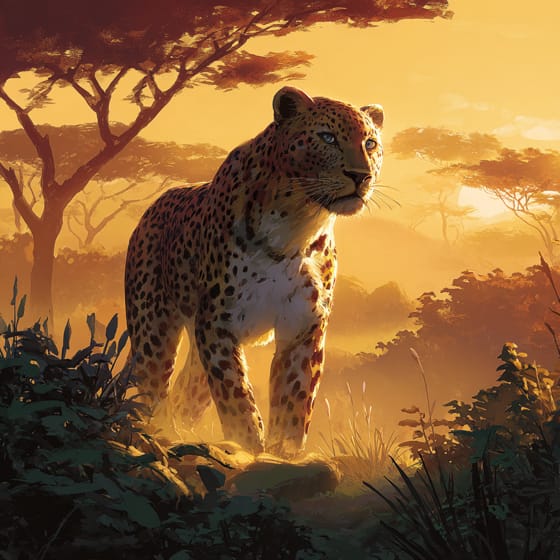
Panthera pardus
Leopards are a main predator of adult hogs.

Homo sapiens
Hunted by humans for their meat and tusks.
Ficus exasperata
Consumes fruits, helping disperse seeds in the forest.
Civettictis civetta
Follows hogs to eat insects uncovered by their rooting.
Furry describes animals possessing a dense covering of soft hair or fur.
Social animals live in organized groups, cooperating for survival benefits such as foraging, defense, and raising offspring.
This trait identifies organisms whose diet includes both plant and animal matter.
Burrowing animals dig tunnels and chambers in the ground, using these subterranean structures for shelter, hunting, or breeding.

Colorful describes organisms or objects displaying a wide range of bright and distinct colors.

Forest habitats are terrestrial environments dominated by dense tree cover, supporting a high diversity of plant and animal life.

This trait identifies organisms that exhibit exceptional swiftness in movement for hunting, escape, or travel.
Danger
3/5 · Moderate
Always watch from a distance and never try to touch wild animals.
The easiest way to identify Red River Hog is to use the Snappit nature identifier app.
130-190 cm
45-120 kg
15-20 years
40 km/h
These hogs are omnivores, munching on plants and small critters found in their forest homes.
Forests
Foraging
Zoom in to split clusters and explore where this object has been snapped.
Recent snaps will appear here as new observations are added.
Rhode Island, US
You might spot African Elephant, Giraffes, and Snow Leopard.
View guide →
Pennsylvania, US
You might spot African Lion, Tiger, and Gorilla.
View guide →

England, UK
You might spot African Elephant, Gorilla, and Tiger.
View guide →
Take the discovery with you
Snap it with Snappit to identify it, learn what makes it special, and add the discovery to your collection.




.jpg&width=800)


.JPG&width=800)


.jpg&width=800)
