
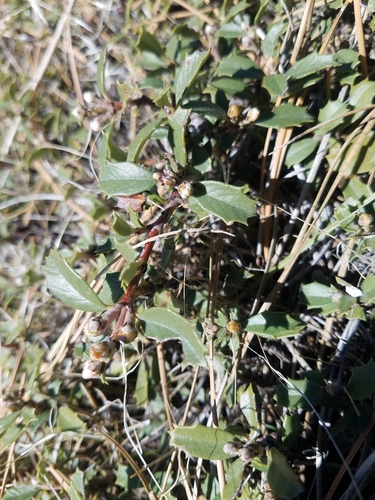


Mahala Mat
ceanothus prostratus
The Mahala Mat (Ceanothus prostratus), also known as prostrate ceanothus or squaw carpet, is a remarkable evergreen shrub native to the mountainous regions of western North America. Unlike its taller relatives in the buckthorn family, this resilient plant hugs the ground, forming dense, creeping mats that can spread several meters across the forest floor. It thrives in the understory of open coniferous forests, particularly in dry, rocky soils where few other plants can successfully take root. Beyond its rugged beauty, the Mahala Mat plays a crucial ecological role as a pioneer species. It forms a symbiotic relationship with nitrogen-fixing bacteria in its roots, actively enriching the nutrient-poor soils of its mountainous habitat. In spring, it transforms the forest landscape with stunning clusters of vibrant blue, lavender, or purplish flowers, attracting a myriad of native pollinators. Its unique adaptations to drought and forest fires make it a fascinating study in botanical resilience and an essential, stabilizing component of western forest ecosystems.
Habitat: Found primarily in dry, open coniferous forests and rocky slopes, where it forms dense, low-growing mats across the forest floor.
Mahala Mat is easily identified by its prostrate, ground-hugging growth habit and dense, mat-like appearance. The evergreen leaves are small (about 1 to 3 centimeters long), thick, and leathery, featuring sharply toothed edges that make them closely resemble miniature holly leaves. Throughout the spring and early summer, the plant bursts into bloom with dense, rounded clusters of tiny, striking blue to lavender flowers, though white variations occasionally appear. Following the floral display, the plant produces distinctive small, reddish-brown seed capsules uniquely adorned with three tiny horn-like protrusions.
Category
PlantsRarity
Common
Danger
1/5 · Very low
Snaps
Be the first to snap!
After a devastating forest fire, Mahala Mat is often one of the very first pioneer species to return, germinating quickly thanks to its fire-adapted seeds.
Because it spreads in such thick, low carpets, the Mahala Mat is highly effective at preventing soil erosion on steep, rugged mountain slopes.
Its seed capsules possess an explosive dispersal mechanism; as they dry out in the summer heat, they pop open, flinging seeds several feet away from the parent plant.
The name 'Mahala' stems from a Native American term in California historically used to mean 'woman' or 'wife'.
Through a symbiotic relationship with Frankia bacteria in its root nodules, it converts atmospheric nitrogen into a usable form, enriching surrounding soil.
Its tough seed coats are designed to be cracked by the intense heat of wildfires, allowing the plant to rapidly colonize newly burned areas.
Its thick, leathery, and waxy leaves significantly reduce water loss, enabling the plant to thrive in dry, rocky mountain environments.
As a photoautotroph, the Mahala Mat produces its own food using sunlight, carbon dioxide, and water, while relying on symbiotic bacteria to acquire essential nitrogen.
Frankia spp.
Forms symbiotic root nodules to fix atmospheric nitrogen, acting as a natural soil fertilizer.

Odocoileus hemionus
Serves as an important winter forage source for grazing ungulates in snowy mountainous regions.

Nymphalis californica
Acts as a larval host plant and nectar source for specific native brush-footed butterflies.
No trait badges are assigned for this object yet.
No aliases listed yet.
Collections for this object will appear here as more themes are added.
Danger
1/5 · Very low
No special safety notes yet.
Start with the whole plant, then compare leaf arrangement, leaf edges, stems and any flowers or fruit. Opposite leaves grow in pairs; alternate leaves come one at a time along the stem. These details tell you far more together than a single green leaf does. Plant Identifier: upload a photo and compare the visible details.
100-300 cm
10-50 years
As a photoautotroph, the Mahala Mat produces its own food using sunlight, carbon dioxide, and water, while relying on symbiotic bacteria to acquire essential nitrogen.
Found primarily in dry, open coniferous forests and rocky slopes, where it forms dense, low-growing mats across the forest floor.
Zoom in to split clusters and explore where this object has been snapped.
Recent snaps will appear here as new observations are added.
Take the discovery with you
Snap it with Snappit to identify it, learn what makes it special, and add the discovery to your collection.



















