




Snappit logo
Snappit
Get App

Mandarinfish

Synchiropus splendidus

The mandarinfish (Synchiropus splendidus), also called the mandarin dragonet, is a tiny, scaleless reef fish from the western Pacific, about as long as your little finger. Its orange body is covered in wavy blue-green bands, and the blue comes from special pigment cells that scientists first found in this fish and one close cousin. By day it pecks for tiny animals among coral rubble. Around sunset, pairs rise above the reef to release their eggs.

Also known as Mandarin dragonet, Mandarin goby, Green mandarin

Loading the 3D mandarinfish…
Mandarinfish (Synchiropus splendidus)
wildlife trait badgesolitary trait badgecolorful trait badgepiscivorous trait badge
Mandarinfish

Rarity: Rare

Male

Mandarinfish abilities

  • 1995 blue pigment cells described

  • ≈ 1 m rise above the reef

  • 12–205 eggs per spawn

  • 0 scalesStill debated

  • 94% of spawns with males over 4 cm

  • All day pecking for tiny prey

  • 1–18 m deep, in sheltered lagoons

  • 400+ h of underwater surveys

Real mandarinfish

Photos from Wikimedia Commons. Some of them can repaint the 3D model.

  • A mandarinfish seen from the side over rubble, orange with wavy blue-green bands and a blue-edged tail
    Orange body, wavy blue-green bands and blue-edged fins, Lembeh, Indonesia.Photo: Rickard Zerpe, CC BY 2.0
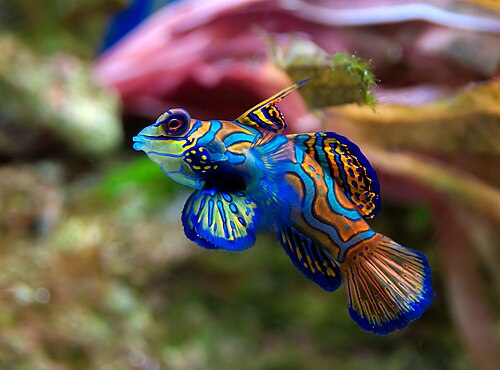
  • A male mandarinfish hovering in an aquarium with its tall, spiky first dorsal fin raised
    MaleOrange with wavy blue-green bands, a green face with blue stripes and a tall orange-and-blue first dorsal fin. Males are larger than females, up to about 6 cm.Big males win the most spawnsA male in an aquarium in Liège, Belgium. Note the tall first dorsal fin that only males grow. Photo: Luc Viatour, CC BY-SA 3.0
  • Close-up of a mandarinfish's green face with violet-blue stripes, a red eye and blue fins
    The green face with bold blue stripes and a red eye, Anilao, Philippines.Photo: Diego Delso, CC BY-SA 4.0
  • Two mandarinfish side by side rising above pale finger coral against dark water
    A pair rising together above finger coral at dusk to spawn, Lembeh Strait, Indonesia.Photo: Bernard DUPONT from FRANCE, CC BY-SA 2.0
  • Two mandarinfish pressed side by side, both pointing upwards in open water
    A spawning pair, side by side and heading up, Anilao, Philippines.Photo: Diego Delso, CC BY-SA 4.0
  • A mandarinfish with its tall first dorsal fin raised among finger coral, next to another mandarinfish
    A male raises his tall first dorsal fin beside another mandarinfish in finger coral, Lembeh Strait, Indonesia.Photo: Bernard DUPONT from FRANCE, CC BY-SA 2.0
  • Several small mandarinfish half hidden among the branches of a large finger coral
    Several mandarinfish sharing one clump of finger coral, Lembeh Strait, Indonesia.Photo: Bernard DUPONT from FRANCE, CC BY-SA 2.0
  • A tiny mandarinfish on a wide stretch of pink and brown coral rubble
    Tiny on a big reef: a mandarinfish on coral rubble, Malapascua, Philippines.Photo: Sodacan, CC BY-SA 4.0
  • A spotted mandarin, grey-green with dark spots ringed in orange and blue, resting on rubble
    Spotted mandarin (look-alike)A separate species, Synchiropus picturatus. Pale grey-green with dark spots ringed in orange and blue. It also has blue pigment cells.Hides in rubble below living coralThe look-alike spotted mandarin (Synchiropus picturatus), the only other fish known with blue pigment cells when they were discovered. Photo: Rickard Zerpe, CC BY 2.0

Mandarinfish by the numbers

Measured by scientists and fish databases, with comparisons you can picture.

Length
up to 7 cm
About as long as your little finger⁠[1, 2]
Depth
1–18 m
sheltered lagoons and inshore reefs⁠[1, 2]
Water temperature
24–26 °C
warm tropical water⁠[2]
Eggs per spawn
12–205
counted from 40 females⁠[9]
Egg size
0.7–0.8 mm
Smaller than a grain of sugar⁠[2]
Time to hatch
≈ 12 hours
no parental care⁠[2]
Drifting larva
≈ 14 days
before settling on the reef (12–14 days at 24–26 °C)⁠[2, 9]
Spawns per male
up to 8
in a single night; a female spawns once at most⁠[8]
Sperm per spawn
50,000–230,000
bigger males release more⁠[10, 11]
First dorsal fin
4 spines
the first spine is long in males⁠[1, 2]

Mandarinfish myths and facts

Some of what you hear about this little fish is true. Some of it isn't.

0 of 8 answered

  1. “The mandarinfish's blue comes from real blue pigment.”

  2. “The 'mandarin goby' is a goby.”

  3. “Mandarinfish have scales like most fish.”

  4. “Mandarinfish are dangerous to people.”

  5. “Its bright colours warn predators that it tastes bad.”

  6. “Mandarinfish parents guard their eggs.”

  7. “A female mandarinfish can spawn every night.”

  8. “The mandarinfish is a cousin of the Chinese 'mandarin fish'.”

The life of a mandarinfish

From a floating egg to a dancer on the reef, in a couple of months.

  1. Sunset

    The rise

    A male and a female rise about a metre above the reef and release eggs and sperm into the water.⁠[2, 13]

  2. 12 hours

    Hatching

    The tiny, clear eggs, under 1 mm across, hatch while drifting in open water. No parent is around.⁠[2]

  3. 36 hours

    Eyes and mouth

    The larva's eyes darken and its mouth forms, so it can start catching food.⁠[2]

  4. 8–11 days

    Tail bends up

    The tip of the backbone bends up to form the tail fin, a big step on the way to a fish shape.⁠[2]

  5. 12–14 days

    Settling down

    The larva leaves the open water and settles on the reef. That is one of the shortest drifting stages known for a fish with floating eggs.⁠[2, 9, 14]

  6. 18–21 days

    Turning orange-brown

    The young fish darkens to an orange-brown colour.⁠[2]

  7. Second month

    Adult colours

    At just 1–1.5 cm long, it gets the blue and orange pattern of an adult.⁠[2]

  8. Adult

    Nightly spawner

    Adults stay in their home area and spawn at sunset, all year round.⁠[2, 8, 14]

Mandarinfish record-breakers

A small fish with some big firsts.

  • First blue pigment cells described

    1995

    Mandarinfish and spotted mandarin

    Before then, no blue pigment cells had been reported in any animal.⁠[4, 7]

  • Busiest night

    8 spawns

    A male mandarinfish

    The most spawns seen for one male in a single night, each with a different female.⁠[8]

  • Short childhood at sea

    ≈ 14 days

    Mandarinfish larva

    One of the shortest drifting larval stages known among sea fish that release floating eggs.⁠[14, 9]

Mandarinfish vs spotted mandarin vs ocellated dragonet

Three small, colourful dragonets that people often mix up.

Mandarinfish vs spotted mandarin (Synchiropus picturatus) vs ocellated dragonet (Synchiropus ocellatus)
MandarinfishSpotted mandarinOcellated dragonet
Scientific name⁠[1, 17, 18]Synchiropus splendidusSynchiropus picturatusSynchiropus ocellatus
Longest⁠[1, 17, 18]7 cm7 cm8.9 cm
Colour⁠[3, 18]Orange with wavy blue-green bands, green faceLight grey-green with ringed dark spotsA starry pattern of small spots
Blue pigment cells⁠[4]YesYesNot studied
Depth⁠[1, 17, 18]1–18 mUsually 0–20 m1–30 m
Habitat⁠[1, 17, 18]Sheltered lagoons and inshore reefs with coral and rubbleRubble below living coral on sheltered reefsSandy lagoons, rubble, algal turf and tide pools
Where⁠[1, 17, 18]Ryukyu Islands to AustraliaPhilippines, eastern Indonesia, NW AustraliaIndonesia to the Pitcairn Islands, Japan to Australia
IUCN Red List⁠[1, 17, 18]Least ConcernLeast ConcernLeast Concern

In dragonets the first dorsal fin often differs between males and females, so it is better for telling the sex than the species. Check the body pattern instead.

Is the mandarinfish endangered?

No. It is listed as Least Concern, but it is caught in large numbers for home aquariums, and that fishing is not managed.

IUCN Red List

Least Concern (LC)

The mandarinfish is listed as Least Concern. It has a wide range in the western Pacific and is fairly common where it lives.⁠[1, 3, 19]

IUCN Red List, assessed 2018

Threats

  • Aquarium collecting

    It is collected heavily in Southeast Asia, mainly the Philippines, for the aquarium trade, and the fishery is not managed. Because adults stay in one area, heavy fishing focused on one spot could hit local fish hard.⁠[14, 9]

  • Big males taken first

    Collectors target big males for their tall fins. Females left behind may have to spawn with smaller males that release less sperm.⁠[10, 11, 14]

  • Hard to keep

    Many refuse anything but live copepods and amphipods, which makes wild-caught mandarinfish hard to keep in home aquariums.⁠[3, 2]

What’s helping

  • Captive breeding

    Scientists have reared larvae in the lab and found that copepods as a first food greatly improve survival. Farmed fish could take pressure off wild reefs.⁠[9, 15]

  • Well-connected populations

    A genetic study found that mandarinfish at five sites in the Philippines were well mixed, probably thanks to eggs and larvae drifting between reefs.⁠[14]

  • Field research

    Studies of who spawns with whom show why leaving big males on the reef matters for the next generation.⁠[8, 10]

Relatives

  • Spotted mandarin (Synchiropus picturatus)Least Concern

    The look-alike cousin that also has blue pigment cells; assessed in 2022.⁠[17]

  • Ocellated dragonet (Synchiropus ocellatus)Least Concern

    A widespread, starry-patterned dragonet; assessed in 2022.⁠[18]

Mandarinfish quiz

12 questions. Every answer is somewhere on this page.

Question 1 of 12Score 0

What makes the mandarinfish's blue colour special?

Mandarinfish field notes

Diet, food web, safety and badges from the Snappit field guide.

Diet & Feeding

Mandarinfish are tiny hunters, mainly feasting on small worms and crustaceans found on the seabed.

Primary Foods

  • Copepods
  • Amphipods
  • Small worms
  • Gastropod larvae
  • Foraging Method: Foraging

Ecological connections

  • Red LionfishEaten by

    Larger reef fish are opportunistic predators.

  • Staghorn CoralShelter

    Hides among intricate coral branches.

  • Japanese Rockpool CopepodEats

    A primary food source for them.

Safety

Danger 2/5 · Low

Watch quietly from a distance and never try to feed or chase wild animals.

Traits

Collections

Classification

Kingdom
Animalia
Phylum
Chordata
Class
Actinopterygii
Order
Perciformes
Family
Callionymidae
Genus
Synchiropus

Also known as

Mandarin dragonet · Mandarin goby · Green mandarin · Striped mandarinfish · Mandarin Fish

Sources for these mandarinfish facts

20 studies and references · checked
  1. FishBase: Synchiropus splendidus, Mandarinfish (species summary).
  2. Animal Diversity Web (University of Michigan): Synchiropus splendidus, mandarin-fish.
  3. Wikipedia: Mandarinfish (Synchiropus splendidus).
  4. Goda M, Fujii R (1995). Blue chromatophores in two species of callionymid fish. Zoological Science 12(6): 811–813.
  5. Goda M, Fujiyoshi Y, Sugimoto M, Fujii R (2013). Novel dichromatic chromatophores in the integument of the mandarin fish Synchiropus splendidus. Biological Bulletin 224: 14–17.
  6. Stervander M, Cresko WA (2021). A highly contiguous nuclear genome assembly of the mandarinfish Synchiropus splendidus (Syngnathiformes: Callionymidae). G3 11(12): jkab306.
  7. KAKEN (Japan Society for the Promotion of Science): research project 06640888, Fujii R, chromatophores of poikilothermic vertebrates (1994–1995), project report.
  8. Sadovy de Mitcheson Y, Mitcheson G, Rasotto MB (2022). Mating system in a small pelagic spawner: field case study of the mandarinfish, Synchiropus splendidus. Environmental Biology of Fishes 105: 699–716.
  9. Sadovy Y, Mitcheson G, Rasotto MB (2001). Early development of the mandarinfish, Synchiropus splendidus (Callionymidae), with notes on its fishery and potential for culture. Aquarium Sciences and Conservation 3: 253–263.
  10. Rasotto MB, Sadovy de Mitcheson Y, Mitcheson G (2010). Male body size predicts sperm number in the mandarinfish. Journal of Zoology 281: 161–167.
  11. Practical Fishkeeping: Bigger mandarinfish produce more sperm (news report on Rasotto et al. 2010).
  12. Sadovy Y, Randall JE, Rasotto MB (2005). Skin structure in six dragonet species (Gobiesociformes; Callionymidae): interspecific differences in glandular cell types and mucus secretion. Journal of Fish Biology 66(5): 1411–1418.
  13. Oregon Coast Aquarium: Mandarin goby.
  14. Leung PTY, Ma KY, Liu M, Planes S, Sadovy de Mitcheson Y (2020). Population genetic structure of a marine pelagic egg producer and popular marine aquarium species, the mandarinfish Synchiropus splendidus. Zoological Studies 59: e68.
  15. Zeng C, Shao L, Ricketts A, Moorhead J (2018). The importance of copepods as live feed for larval rearing of the green mandarin fish Synchiropus splendidus. Aquaculture 491: 65–71.
  16. Wikipedia: Callionymidae (dragonets).
  17. FishBase: Synchiropus picturatus, Picturesque dragonet (species summary).
  18. FishBase: Synchiropus ocellatus, Ocellated dragonet (species summary).
  19. Wikidata: Synchiropus splendidus (Q77062), IUCN status Least Concern.
  20. Dunkley K, Matchette SR, Hau CY, Drerup C, Holmes RB, Sadovy de Mitcheson Y, Herbert-Read JE (2025). Individual identification of bony fishes using unique body markings: implications and applications. Journal of Fish Biology.

Frequently Asked Questions

How to identify Mandarinfish?

Look at body shape, where the fins sit and their outline, mouth position, stripes and spots. Young fish and breeding adults can wear different patterns, and aquarium color varieties can look nothing like wild fish. Fish Identifier: upload a photo and compare the visible details.

How long is Mandarinfish?

6-8 cm

How much does Mandarinfish weigh?

0.005-0.01 kg

How long does Mandarinfish live?

2-4 years

What does Mandarinfish eat?

Mandarinfish are tiny hunters, mainly feasting on small worms and crustaceans found on the seabed.

How fast can Mandarinfish swim?

0.1 km/h

Where is Mandarinfish usually found?

Coral reefs

How does Mandarinfish hunt?

Foraging

Why is the mandarinfish so blue?

Its skin holds blue pigment cells called cyanophores, first described in 1995. Most other blue animals make blue with light-reflecting crystals instead of pigment.

Is the mandarinfish poisonous?

It is harmless to people. It has no scales, and its skin is coated in a smelly, bitter slime that probably keeps predators away. How toxic the slime is has not been measured.

Is the mandarinfish a goby?

No. It is sometimes sold as the 'mandarin goby', but it is a dragonet, from the family Callionymidae.

When and how do mandarinfish mate?

Around sunset. A male and female line up side by side, rise about a metre above the reef and release eggs and sperm. The eggs float away and hatch in about 12 hours.

What do mandarinfish eat?

Tiny animals they peck off coral and rubble all day: copepods, amphipods, ostracods, small worms, tiny snails and fish eggs.

Where do mandarinfish live?

In sheltered lagoons and inshore reefs of the western Pacific, from Japan's Ryukyu Islands to Australia, 1–18 m deep, among coral and rubble.

How can you tell a male mandarinfish from a female?

Males are bigger and have a tall, spiky first dorsal fin. Females are smaller, usually under 4 cm, with a low first dorsal fin.

Is the mandarinfish endangered?

No. It is listed as Least Concern. But it is collected heavily for aquariums, mainly in the Philippines, and collectors take the big males first.

Take the discovery with you

Found Mandarinfish?

Snap it with Snappit to identify it, learn what makes it special, and add the discovery to your collection.

  1. 1Spot it
  2. 2Snap it
  3. 3Keep the discovery

More Fish