





Mandrillus
Mandrillus
Mandrills are colorful monkeys that live in the forests of Africa. They have bright blue and red faces and are known for their playful nature and strong social bonds with their families.
Habitat: Forests
The Mandrillus has a striking face with deep grooves and a bright red stripe down its nose, flanked by blue ridges. Its rump is equally vibrant with shades of red, blue, and purple, and its body is covered in olive-green fur.
Category
MammalsRarity
Common
Danger
3/5 · Moderate
Snaps
Be the first to snap!
Males' colors get even brighter when they are excited or showing off!
Mandrills store food in their cheek pouches for snacking later!
Their long canine teeth can grow up to 6.3 centimeters long!
They live in large groups called "hordes" that can have hundreds of members!
Mandrillus has a vivid face and rump that helps them send clear signals about their health and status to other mandrills.
Mandrillus can crush tough nuts and seeds because of their strong jaws and long, sharp canine teeth.
Mandrillus can sniff out hidden food like roots and insects because of their well-developed sense of smell.
Mandrills are omnivores, eating fruits, seeds, insects, and even small animals.
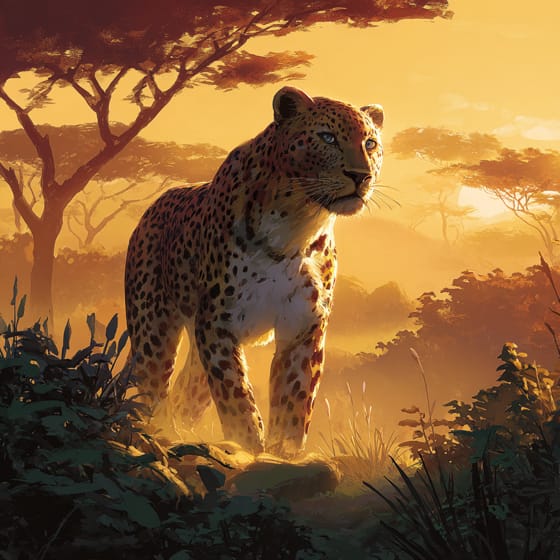
Panthera pardus
Leopards are a primary natural predator of mandrills.

Homo sapiens
Humans hunt mandrills for bushmeat and traditional medicine.
Ficus ovata
Mandrills frequently feed on the fruits and leaves of fig trees.
Dorylus fulvus
Mandrills consume various ant species, including driver ants.
Furry describes animals possessing a dense covering of soft hair or fur.
Social animals live in organized groups, cooperating for survival benefits such as foraging, defense, and raising offspring.
This trait identifies organisms whose diet includes both plant and animal matter.
Arboreal animals live primarily in trees, utilizing them for shelter, food, and protection from predators.

Colorful describes organisms or objects displaying a wide range of bright and distinct colors.

Forest habitats are terrestrial environments dominated by dense tree cover, supporting a high diversity of plant and animal life.

Diurnal animals are primarily active during daylight hours, typically resting or sleeping at night.

This trait identifies organisms that exhibit exceptional swiftness in movement for hunting, escape, or travel.

Endangered status indicates a species is at a very high risk of extinction in the wild in the near future.
Danger
3/5 · Moderate
Mandrills are wild animals and should be admired from a distance.
The easiest way to identify Mandrillus is to use the Snappit nature identifier app.
60-95 cm
10-37 kg
20-30 years
40 km/h
Mandrills are omnivores, eating fruits, seeds, insects, and even small animals.
Forests
Foraging
Zoom in to split clusters and explore where this object has been snapped.
Recent snaps will appear here as new observations are added.
Take the discovery with you
Snap it with Snappit to identify it, learn what makes it special, and add the discovery to your collection.




.jpg&width=800)

.JPG&width=800)



.jpg&width=800)
