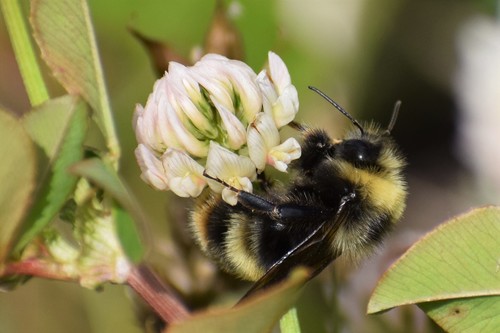


Mckay'S Western Bumble Bee
bombus mckayi
McKay'S Western Bumble Bee (Bombus mckayi) is a highly resilient and vital pollinator native to the cold, high-latitude environments of northwestern North America. Once classified as a northern subspecies of the Western Bumble Bee, genetic and morphological studies have elevated it to a distinct species. This robust, furry bee is superbly adapted to the subarctic climate, emerging early in the spring to forage when temperatures are too low for most other insect species. By visiting a wide variety of native wildflowers, they play an indispensable role in maintaining the health and biodiversity of northern ecosystems.
Habitat: Found in northern boreal forests, subalpine meadows, and shrubby tundra edges across Alaska, Yukon, and northern British Columbia.
This species has a stout, robust body covered in dense pile. It features a black head with yellow hairs on the front of the thorax, a distinct black band between the wings, and a bright yellow band on the second abdominal segment (T2). The distinguishing field mark is the tip of the abdomen (T5), which is pale white or soft cream-colored. Queens are notably larger, measuring up to 2.1 centimeters in length, while workers and males are smaller but share the same distinct tri-colored black, yellow, and white banding pattern.
Category
InsectsRarity
Common
Danger
1/5 · Very low
Snaps
Be the first to snap!
It was originally classified as a subspecies of the Western Bumble Bee but was given full species status following DNA analysis.
McKay's Western Bumble Bee is uniquely adapted to survive at high latitudes and can continue foraging under dense cloud cover and light drizzle.
Their extremely thick body hair allows them to trap solar radiation, effectively turning their own bodies into miniature solar-heating units.
The bee grabs a flower and rapidly vibrates its flight muscles, releasing stubborn pollen from tube-like anthers that other insects cannot access.
It can violently shiver its flight muscles to generate internal heat, allowing it to fly and forage in temperatures close to freezing.
Its exceptionally thick, dense coat of hair traps heat close to its body, acting as a natural winter coat in harsh northern climates.
Feeds primarily on sugar-rich nectar for daily flight energy and collects nutrient-dense pollen to feed and raise the colony's larvae.
Age differences: Adults feed almost exclusively on liquid nectar for immediate energy, whereas developing larvae are fed a protein-rich paste of pollen and nectar.

Chamerion angustifolium
Provides critical pollination services while gathering rich nectar from summer blooms.
Salix alaxensis
Relies heavily on its catkins as an essential pollen and nectar source immediately after emerging from hibernation.
Bombus bohemicus
An obligate nest parasite that invades the colonies of bumble bee queens to usurp the nest and lay its own eggs.
No trait badges are assigned for this object yet.
No aliases listed yet.
Collections for this object will appear here as more themes are added.
Danger
1/5 · Very low
No special safety notes yet.
Compare the antennae, wings, waist, body hair and legs. Yellow and black stripes show up on bees, wasps and harmless mimics alike. Bee & Wasp Identifier: upload a photo and compare the visible details.
1.2e-304+ kg
15 km/h
Feeds primarily on sugar-rich nectar for daily flight energy and collects nutrient-dense pollen to feed and raise the colony's larvae.
Found in northern boreal forests, subalpine meadows, and shrubby tundra edges across Alaska, Yukon, and northern British Columbia.
Foraging
Zoom in to split clusters and explore where this object has been snapped.
Recent snaps will appear here as new observations are added.
Take the discovery with you
Snap it with Snappit to identify it, learn what makes it special, and add the discovery to your collection.