





Megalodacne heros
Megalodacne heros
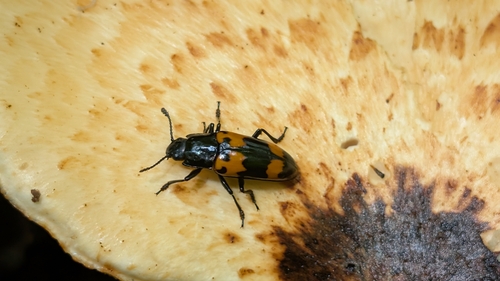
The Megalodacne heros is a special kind of beetle that loves to munch on leaves. It has a shiny, colorful shell that makes it look like a tiny jewel in the garden!
Habitat: Forests
The Megalodacne heros is a medium-sized beetle, featuring a glossy black, elongated-oval body adorned with two prominent, vibrant orange-red bands across its elytra. Its striking coloration provides a bold contrast, making it easily distinguishable among other forest insects.
Category
InsectsRarity
Common
Danger
1/5 · Very low
Snaps
4
Its larvae also munch on fungi, growing inside them before pupating.
Megalodacne heros means 'hero large fungus-eater' – a fitting name!
Their bright colors act as a warning sign to hungry birds and lizards!
This beetle helps forests by eating fungi that decompose trees!
Megalodacne heros can digest tough bracket fungi because of specialized gut enzymes that help them break down wood-decaying material.
Megalodacne heros has bright orange-red markings that help them warn predators they might be unpalatable or toxic.
Megalodacne heros can detect specific fungi from a distance using its clubbed antennae that help them locate their food source efficiently.
This beetle loves to eat various types of bracket fungi found on dead or decaying wood.
Age differences: Larvae and adults both feed on fungi.
Trametes versicolor
Adults and larvae consume its fruiting bodies.

Poecile carolinensis
Small birds might prey on adult beetles.

Peromyscus leucopus
Rodents foraging on logs may eat the beetles.
Solitary animals live alone for most of their lives, only interacting with others for mating or parental care.
Colorful describes organisms or objects displaying a wide range of bright and distinct colors.
This trait characterizes organisms whose diet consists entirely or primarily of plant material.
Describes organisms that break down dead organic material, recycling nutrients back into the ecosystem.

Forest habitats are terrestrial environments dominated by dense tree cover, supporting a high diversity of plant and animal life.

Diurnal animals are primarily active during daylight hours, typically resting or sleeping at night.

Describes organisms that transfer pollen, enabling the fertilization and reproduction of plants.
No aliases listed yet.
Danger
1/5 · Very low
Be gentle and watch where you step to avoid squishing tiny beetles like this one.
The easiest way to identify Megalodacne heros is to use the Snappit nature identifier app.
24-36 mm
12-18 mm
45-120 days
7 km/h
This beetle loves to eat various types of bracket fungi found on dead or decaying wood.
Forests
Foraging
Zoom in to split clusters and explore where this object has been snapped.
Apr 28, 2026
Selmier State ForestPhoto attribution
(c) Peyton Phelps, some rights reserved (CC BY)
License: CC BY 4.0 ↗
Image may be shown cropped inside the card frame.

Connecticut, US
You might spot Hobblebush, Pink Lady's Slipper, and Red Trillium.
View guide →

New York, US
You might spot American Cancer-Root, Ring-Billed Gull, and Water Caltrop.
View guide →
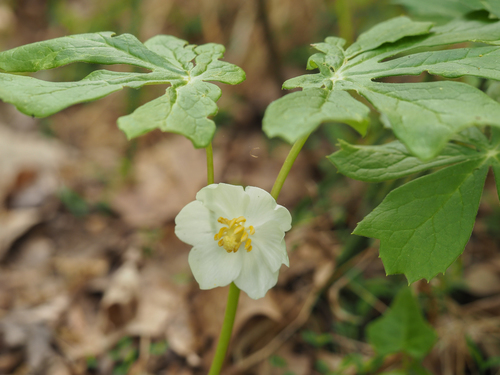
Indiana, US
You might spot Mayapple, Virginia Bluebells, and Prairie Trillium.
View guide →

Pennsylvania, US
You might spot Hemlock Varnish Shelf, Mountain Laurel, and Cinnamon Fern.
View guide →

Pennsylvania, US
You might spot Partridgeberry, Eastern Hemlock, and American Beech.
View guide →
Take the discovery with you
Snap it with Snappit to identify it, learn what makes it special, and add the discovery to your collection.







.jpg&width=800)


