





Milbert's Tortoiseshell
Aglais milberti
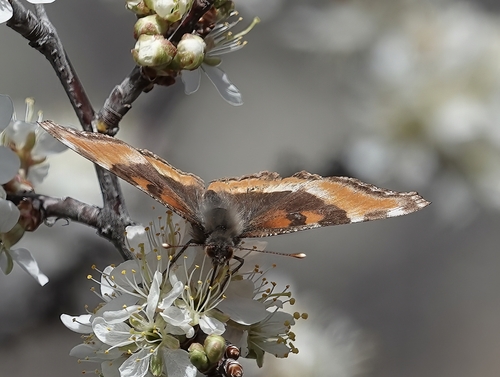
Milbert's Tortoiseshell is a beautiful butterfly with orange and black wings. It loves to flutter around gardens and fields, bringing joy to everyone who sees it!
Habitat: Fields and gardens
The Milbert's Tortoiseshell has dark, chocolatey-brown upperwings with a striking bright orange or yellow band across the middle. This band is bordered by black, and the outer wing edges feature a row of tiny blue spots. Its mottled brown underside helps it blend in with tree bark or dead leaves.
Category
InsectsRarity
Common
Danger
1/5 · Very low
Snaps
5
Adults sometimes drink minerals from damp soil puddles, a behavior called 'puddling'!
Its larvae, called caterpillars, munch only on stinging nettle plants!
The Milbert's Tortoiseshell is one of only two species in its genus in North America!
These tough butterflies can sometimes be seen flying when snow is still on the ground!
Milbert's Tortoiseshell can survive cold winters by hibernating in sheltered spots, allowing them to emerge early in spring.
Milbert's Tortoiseshell has mottled brown undersides that help them blend perfectly with tree bark or dead leaves when their wings are closed.
Milbert's Tortoiseshell can drink nectar from flowers using its long proboscis, providing essential energy for flight and reproduction.
Adult Milbert's Tortoiseshells sip sweet nectar, while their caterpillars chomp on stinging nettle leaves!
Age differences: Caterpillars eat nettle leaves; adults drink nectar and sap.
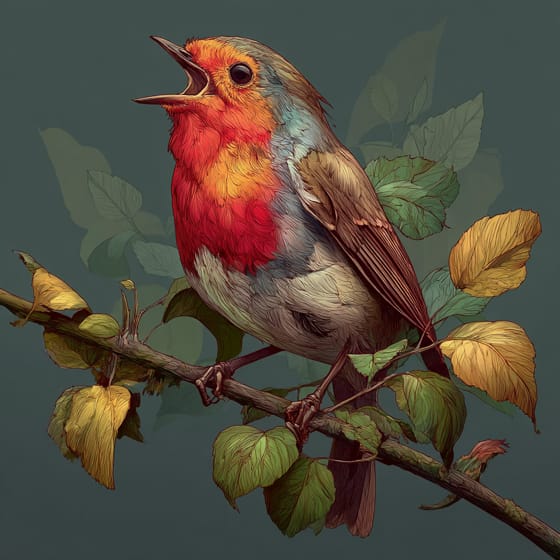
Turdus migratorius
Often prey upon adult butterflies and caterpillars.
Cirsium arvense
Adults visit flowers, transferring pollen as they feed on nectar.
Urtica dioica
Caterpillars feed exclusively on the leaves of this plant.
Solitary animals live alone for most of their lives, only interacting with others for mating or parental care.
Colorful describes organisms or objects displaying a wide range of bright and distinct colors.
Grassland habitats are terrestrial biomes dominated by grasses and herbaceous plants, supporting a variety of grazing animals.
This trait characterizes organisms whose diet consists entirely or primarily of plant material.

This trait characterizes organisms with an exceptionally long lifespan compared to others of their kind.

Diurnal animals are primarily active during daylight hours, typically resting or sleeping at night.

Migratory animals undertake seasonal movements from one region to another, typically in response to changes in climate or food availability.

This habitat trait indicates species that can coexist with humans in urban and suburban environments, utilizing man-made structures and green spaces.

Describes organisms that transfer pollen, enabling the fertilization and reproduction of plants.
Danger
1/5 · Very low
Butterflies are friendly and safe to watch, but don't try to catch them.
The easiest way to identify Milbert's Tortoiseshell is to use the Snappit nature identifier app.
45-63 mm
16-28 mm
90-240 days
15 km/h
Adult Milbert's Tortoiseshells sip sweet nectar, while their caterpillars chomp on stinging nettle leaves!
Fields and gardens
Foraging
Zoom in to split clusters and explore where this object has been snapped.
Apr 12, 2026
Sioux County CourthousePhoto attribution
(c) Colin Croft, some rights reserved (CC BY)
License: CC BY 4.0 ↗
Image may be shown cropped inside the card frame.

Montana, US
You might spot Bighorn Sheep and Mountain Goat.
View guide →

Wyoming, US
You might spot Moose, Arrowleaf Balsamroot, and Black Bear.
View guide →

Colorado, US
You might spot Black-Billed Magpie and Twinberry Honeysuckle.
View guide →

Nebraska, US
You might spot Nine-Spotted Lady Beetle and Convergent Lady Beetle.
View guide →
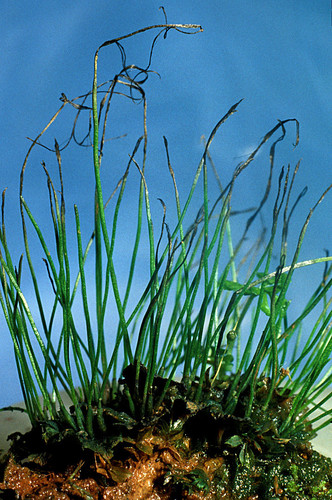
British Columbia, CA
You might spot Hornwort, Silverleaf Phacelia, and Big Rough Fescue.
View guide →
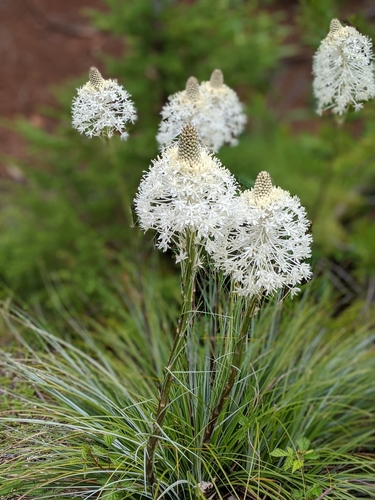
British Columbia, CA
You might spot Common Beargrass and White-Flowered Rhododendron.
View guide →
Take the discovery with you
Snap it with Snappit to identify it, learn what makes it special, and add the discovery to your collection.






.jpg&width=800)



