

Mount Diablo Manzanita
arctostaphylos auriculata
The Mount Diablo Manzanita (Arctostaphylos auriculata) is a rare and striking evergreen shrub endemic to the sandstone slopes of Mount Diablo in Contra Costa County, California. Known for its gorgeous, silvery foliage and smooth, mahogany-colored bark, this chaparral specialist is a true botanical treasure of the San Francisco Bay Area. Its unique ear-like leaf bases, which clasp the stems, set it apart from other manzanita species. As an obligate seeder, this resilient plant relies on the natural cycle of wildfire to crack open its hard seeds and initiate new growth. It plays a vital role in its localized ecosystem, providing crucial nectar for native bees and hummingbirds in late winter when few other plants are in bloom.
Habitat: Found primarily on dry sandstone ridges and chaparral slopes in the microclimate of the Mount Diablo region.
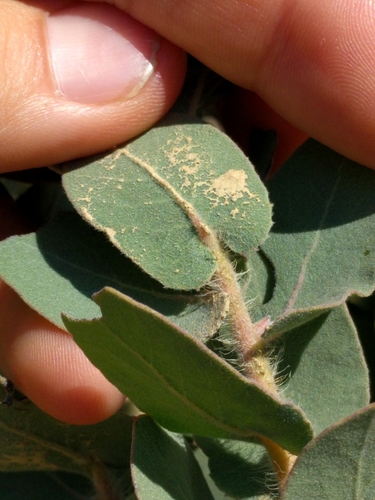
This erect shrub typically grows between 100 to 450 centimeters tall, featuring heavily branched structures covered in fine, white-velvety hairs when young, which mature into smooth, dark reddish-brown bark. The most distinguishing feature is its leaves: they are pale gray-green, ovate, densely hairy on both sides, and uniquely overlap or clasp the stem with ear-like lobes at the base. Clusters of small, urn-shaped flowers in shades of white to pale pink bloom in winter, followed by round, sticky, hairy dark red berries.
Category
PlantsRarity
Common
Danger
1/5 · Very low
Snaps
1
Because it lacks a basal burl, this manzanita cannot resprout from its roots after a fire; instead, its entire population regenerates purely from seed.
It is highly localized, found almost exclusively on the sandstone soils of Mount Diablo and nowhere else in the world.
The scientific species name 'auriculata' translates to 'eared' in Latin, referring directly to the ear-shaped lobes at the base of its leaves.
Its seeds have a tough coating that remains dormant in the soil for decades, germinating only after fire opens them.
The overlapping leaf bases clasp the stems tightly, which may help direct condensation down the branches toward the root system.
Dense, soft white hairs covering its leaves and young twigs act as a natural shield to reduce moisture loss.
As a photoautotrophic plant, it synthesizes its own food using sunlight, carbon dioxide, water, and soil nutrients through photosynthesis.
Bombus vosnesenskii
Feeds on the early winter nectar and serves as a key pollinator for the shrub.

Calypte anna
Feeds on the winter-blooming flowers' nectar and assists in pollination.

Lepus californicus
Consumes the fallen berries and potentially aids in seed dispersal.
No trait badges are assigned for this object yet.
No aliases listed yet.
Collections for this object will appear here as more themes are added.
Danger
1/5 · Very low
No special safety notes yet.
Start with the whole plant, then compare leaf arrangement, leaf edges, stems and any flowers or fruit. Opposite leaves grow in pairs; alternate leaves come one at a time along the stem. These details tell you far more together than a single green leaf does. Plant Identifier: upload a photo and compare the visible details.
100-450 cm
20-100 years
As a photoautotrophic plant, it synthesizes its own food using sunlight, carbon dioxide, water, and soil nutrients through photosynthesis.
Found primarily on dry sandstone ridges and chaparral slopes in the microclimate of the Mount Diablo region.
Zoom in to split clusters and explore where this object has been snapped.
Take the discovery with you
Snap it with Snappit to identify it, learn what makes it special, and add the discovery to your collection.