
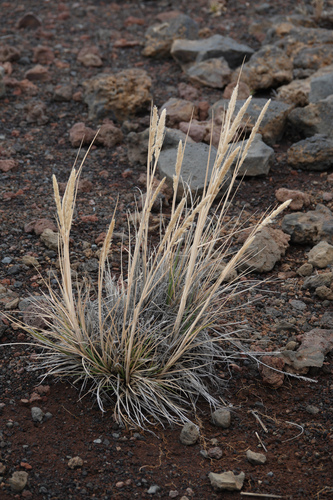


Mountain Pili
trisetum glomeratum
Mountain Pili, scientifically known as Trisetum glomeratum, is a resilient and widely distributed perennial grass integral to various high-altitude and circumpolar ecosystems. Thriving in harsh conditions where few other plants survive, it plays a crucial role in stabilizing alpine soils and providing forage for numerous herbivorous animals. Its ability to adapt to extreme temperatures, strong winds, and nutrient-poor substrates makes it a fascinating example of botanical endurance, contributing significantly to the biodiversity and ecological balance of its montane and arctic habitats.
Habitat: Found in a wide range of cold and high-altitude environments, including alpine meadows, rocky slopes, tundra, subalpine forests, and moist or dry grasslands.
This sturdy perennial grass typically grows in tufts, reaching heights of 10 to 60 centimeters. Its leaves are narrow, often rolled or flat, ranging from green to grayish-green, and can be hairy. The most distinctive feature is its dense, spikelike inflorescence, which appears as a compact, cylindrical or somewhat interrupted cluster of small, purplish to greenish spikelets at the top of the stem. The spikelets each contain several florets, often with delicate awns (bristle-like appendages) that give the inflorescence a soft, textured appearance.
Category
PlantsRarity
Common
Danger
1/5 · Very low
Snaps
Be the first to snap!
Despite its common name, 'Pili grass' typically refers to a different species (Heteropogon contortus); Trisetum glomeratum is more accurately known as Spiked Trisetum or Alpine Oatgrass.
It is one of the few plants found growing at extremely high altitudes, often near the snowline, making it a pioneer species in harsh environments.
Studies have shown this grass can accumulate heavy metals, suggesting a potential role in phytoremediation in contaminated alpine soils.
The extensive root system of Mountain Pili is vital for preventing soil erosion on steep mountain slopes, acting as a natural binder for loose substrates.
Possesses physiological adaptations allowing it to withstand extreme cold, strong winds, and short growing seasons characteristic of high-altitude and polar regions.
Utilizes a creeping rhizome system to form dense mats, effectively colonizing bare ground and stabilizing loose soils against erosion in its challenging environments.
Produces lightweight seeds, often equipped with awns, facilitating efficient wind dispersal across vast distances, aiding in its widespread distribution and colonization of new areas.
As an autotroph, Trisetum glomeratum produces its own food through photosynthesis, converting sunlight, carbon dioxide, and water into sugars for energy and growth. It absorbs essential minerals from the soil.

Marmota spp.
Provides a food source for grazing mammals in alpine ecosystems.
Various bacterial and fungal species
Its extensive root system helps stabilize soil, particularly on sloped terrain, preventing erosion.

Ochotona princeps
Serves as forage for various small rodents that inhabit its mountainous environments.

Glomeromycota spp.
Forms beneficial associations with mycorrhizal fungi that enhance its ability to absorb essential nutrients from nutrient-poor soils.
No trait badges are assigned for this object yet.
No aliases listed yet.
Collections for this object will appear here as more themes are added.
Danger
1/5 · Very low
No special safety notes yet.
Compare seed heads, stem shape, how leaves attach, and the joint where leaf meets stem. A patch of mown lawn rarely shows enough for an exact ID. Grass Identifier: upload a photo and compare the visible details.
10-60 cm
0.005-0.05 kg
3-10 years
As an autotroph, Trisetum glomeratum produces its own food through photosynthesis, converting sunlight, carbon dioxide, and water into sugars for energy and growth. It absorbs essential minerals from the soil.
Found in a wide range of cold and high-altitude environments, including alpine meadows, rocky slopes, tundra, subalpine forests, and moist or dry grasslands.
Zoom in to split clusters and explore where this object has been snapped.
Recent snaps will appear here as new observations are added.
Take the discovery with you
Snap it with Snappit to identify it, learn what makes it special, and add the discovery to your collection.


















