
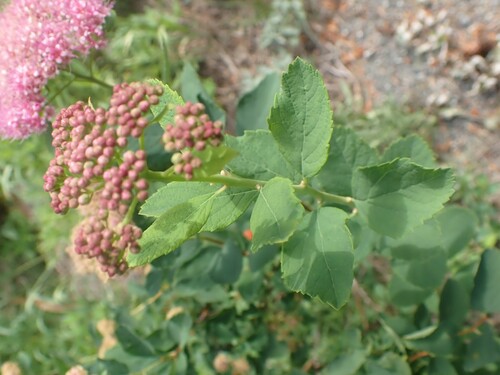


Mountain Spirea
spiraea splendens
Mountain Spirea (Spiraea splendens) is a delightful, low-growing deciduous shrub native to the mountainous regions of western North America. Often found decorating subalpine meadows, rocky slopes, and moist forest clearings, this resilient plant is celebrated for its dense, rose-pink flower clusters. These fuzzy, pom-pom-like blooms light up high-elevation landscapes during the short summer season, attracting an array of native pollinators. Standing up to a meter tall, it plays a vital role in stabilizing mountain soils and offering cover for small alpine wildlife. Beyond its ecological value, Mountain Spirea is highly valued by native plant enthusiasts for its robust nature and striking summer displays, standing as a beautiful symbol of high-altitude resilience.
Habitat: Found in moist subalpine forests, montane meadows, rocky slopes, and along the banks of mountain streams.
This compact shrub typically grows between 30 and 100 centimeters tall, featuring erect, branching reddish-brown woody stems. Its leaves are alternating, oval-shaped, and display bright green coloring with finely tooth-serrated edges. The most defining feature is the dense, flat-topped clusters of tiny, five-petaled pink to rose-colored flowers. These clusters have a uniquely fuzzy appearance due to numerous long stamens that extend significantly beyond the delicate petals.
Category
PlantsRarity
Common
Danger
1/5 · Very low
Snaps
Be the first to snap!
It is highly adapted to heavy snowpack, which actually protects its dormant buds from dry, sub-zero winter air.
Native American tribes, including the Thompson and Okanagan, traditionally brewed a medicinal tea from the leaves and bark to treat colds.
The fluffy look of its flower clusters comes from numerous long, protruding stamens that extend far beyond the petals.
Leverages deep winter snow cover as an insulating blanket to survive freezing alpine temperatures and harsh winds.
Produces a sweet, potent fragrance and highly visible pink flowers to attract scarce high-altitude pollinators quickly during a short growing season.
Regenerates and spreads effectively after physical damage or mountain wildfires via a hardy underground root system.
As an autotroph, it synthesizes its own food through photosynthesis, utilizing sunlight, carbon dioxide, water, and essential soil minerals.
Bombus vosnesenskii
Provides nectar and pollen to support native bee populations in high-elevation ecosystems.

Odocoileus hemionus
Browses on the leaves and tender young shoots during the spring and summer months.

Euphydryas chalcedona
Serves as an occasional host plant and nectar source for the caterpillars and adult butterflies.
No trait badges are assigned for this object yet.
No aliases listed yet.
Collections for this object will appear here as more themes are added.
Danger
1/5 · Very low
No special safety notes yet.
Start with the whole plant, then compare leaf arrangement, leaf edges, stems and any flowers or fruit. Opposite leaves grow in pairs; alternate leaves come one at a time along the stem. These details tell you far more together than a single green leaf does. Plant Identifier: upload a photo and compare the visible details.
30-100 cm
10-30 years
As an autotroph, it synthesizes its own food through photosynthesis, utilizing sunlight, carbon dioxide, water, and essential soil minerals.
Found in moist subalpine forests, montane meadows, rocky slopes, and along the banks of mountain streams.
Zoom in to split clusters and explore where this object has been snapped.
Recent snaps will appear here as new observations are added.
Take the discovery with you
Snap it with Snappit to identify it, learn what makes it special, and add the discovery to your collection.


















