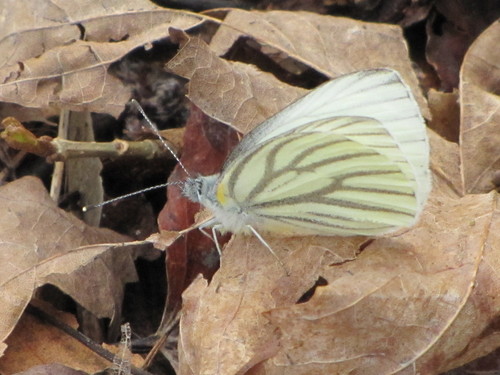


Mustard White
pieris oleracea
The Mustard White (Pieris oleracea) is a delicate and enchanting butterfly native to the cool, moist woodlands of North America. Unlike its bolder, sun-loving cousins, this species is a gentle spirit of the forest floor, gracefully dancing through the dappled shade of deciduous trees. It is highly valued by ecologists as an indicator of healthy, mature forest ecosystems because of its reliance on pristine understory environments and native wild mustards. Watching a Mustard White float silently through a woodland glade is a serene experience that connects nature-watchers to the delicate balance of temperate forests.
Habitat: Found in damp, shaded deciduous and mixed forests, often near woodland streams, wetlands, and rich damp meadows.
With a wingspan of 4 to 6 cm, the Mustard White displays a soft, chalky white upper wing surface, sometimes with a faint grey dusting at the tips. The species is highly dimorphic between seasons: the spring generation features striking, dark grey-green veins outlined on the creamy-yellow underside of the hindwings, while the summer generation is almost entirely pristine, milky white with nearly invisible veins.
Category
InsectsRarity
Common
Danger
1/5 · Very low
Snaps
Be the first to snap!
Invasive garlic mustard acts as a deadly 'ecological trap' for them; butterflies readily lay eggs on it, but the larvae cannot survive its chemical defenses.
The spring and summer generations look so drastically different that early entomologists mistook them for two completely separate species.
Unlike most butterflies that seek bright, sunlit meadows, the Mustard White actively avoids hot, open areas and prefers the cool shelter of deep woods.
Capable of flying and navigating in dense, shaded woodland interiors where other butterflies struggle due to low light and cool temperatures.
Alters its physical appearance based on the season of emergence, producing heavily veined wings in spring for thermoregulation and lighter wings in summer.
Larvae possess specialized gut enzymes that allow them to safely digest the toxic glucosinolates found in native mustard plants.
Caterpillars feed exclusively on the foliage of native crucifers, while adults sip nectar from various woodland wildflowers.
Age differences: Caterpillars consume leafy green foliage of the mustard family, whereas adults transition to a liquid diet of floral nectar.

Cardamine diphylla
A primary host plant that serves as a vital food source and egg-laying site for developing caterpillars.

Alliaria petiolata
An invasive plant acting as an ecological trap; females lay eggs on it, but the toxic leaves kill emerging caterpillars.

Polistes fuscatus
A common wasp predator that actively hunts and feeds upon the slow-moving caterpillars on host foliage.
No trait badges are assigned for this object yet.
No aliases listed yet.
Collections for this object will appear here as more themes are added.
Danger
1/5 · Very low
No special safety notes yet.
Compare the wing outline, spots, bands, eyespots and wing edges. The underside can look completely different from the top. Check for tails, the antennae and where the markings sit instead of relying on color alone. Butterfly Identifier: upload a photo and compare the visible details.
0.0001505002166827054+ kg
0+ years
12 km/h
Caterpillars feed exclusively on the foliage of native crucifers, while adults sip nectar from various woodland wildflowers.
Found in damp, shaded deciduous and mixed forests, often near woodland streams, wetlands, and rich damp meadows.
Foraging
Zoom in to split clusters and explore where this object has been snapped.
Recent snaps will appear here as new observations are added.
Take the discovery with you
Snap it with Snappit to identify it, learn what makes it special, and add the discovery to your collection.