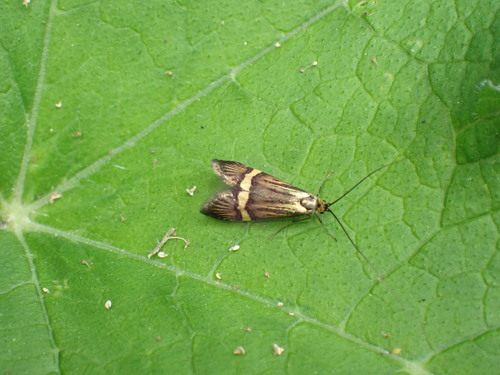


Nemophora Degeerella
nemophora degeerella
The Nemophora degeerella, commonly known as the Long-horn Moth, is a fascinating and easily recognizable insect known for the extraordinary length of its antennae, particularly in males. These small, day-flying moths are a delightful sight in woodlands and clearings during late spring and early summer. They are celebrated for their distinctive courtship displays, where males gather in swarms to perform an aerial ballet, showcasing their elongated antennae to attract females. This behavior, combined with their striking metallic wings, makes them a captivating subject for nature enthusiasts and an important component of their ecosystems as pollinators and detritivores in their larval stage.
Habitat: Found in deciduous and mixed woodlands, forest edges, clearings, and meadows where broadleaf trees and various flowering plants are present.
Nemophora degeerella is a small moth, typically exhibiting a wingspan of 1.6 to 2.4 cm. Its forewings are a shimmering metallic golden-bronze, often with a faint purplish sheen, while the hindwings are darker and more purplish-brown. The most distinguishing feature is the antennae: in males, they are remarkably long, often two to three times the length of their body, slender and white-tipped. Females have shorter, though still proportionally long, antennae that are darker in coloration. Their slender bodies are dark, contrasting with their iridescent wings.
Category
InsectsRarity
Common
Danger
1/5 · Very low
Snaps
Be the first to snap!
The males' antennae can be up to three times their body length, making them some of the longest relative to body size among all insects.
Their larvae construct a unique portable case from silk and detritus, which they carry for protection while feeding on decaying matter.
They perform elaborate aerial 'leks' where dozens of males swarm and bob in the air to attract females, a behavior more common in birds than moths.
Unlike most moths, Nemophora degeerella is strictly diurnal, flying actively during the day, especially in sunshine.
Male Nemophora degeerella possess antennae that can be two to three times their body length, a remarkable adaptation primarily used in elaborate courtship displays to attract mates.
Males gather in swarms, often called leks, flying in a characteristic up-and-down bobbing motion while showcasing their long antennae to attract and compete for females.
The larvae live within a portable, silken case covered in detritus, which provides camouflage and protection as they feed on decaying plant material on the forest floor.
The diet of Nemophora degeerella varies significantly between life stages. Larvae are detritivores, feeding on decaying plant matter and fungal hyphae found on the forest floor. Adult moths are nectarivorous, primarily consuming nectar from various flowering plants.
Age differences: Yes, diet changes significantly from detritivorous larvae to nectarivorous adults.
Crataegus monogyna
Adults feed on nectar, aiding in the pollination of these plants.
Quercus robur
Larvae consume decaying plant matter, contributing to nutrient cycling.

Erithacus rubecula
Adult moths are a food source for various insectivorous birds.
Ichneumonidae
Moth larvae can be parasitized by various wasps.
No trait badges are assigned for this object yet.
No aliases listed yet.
Collections for this object will appear here as more themes are added.
Danger
1/5 · Very low
No special safety notes yet.
Compare resting wing shape, forewing markings, antennae and body build. Small brown moths can hinge on fine details a phone photo can't always catch. Moth Identifier: upload a photo and compare the visible details.
0-1 cm
1-2 cm
0.0001-0.0002 kg
0 years
8 km/h
The diet of Nemophora degeerella varies significantly between life stages. Larvae are detritivores, feeding on decaying plant matter and fungal hyphae found on the forest floor. Adult moths are nectarivorous, primarily consuming nectar from various flowering plants.
Found in deciduous and mixed woodlands, forest edges, clearings, and meadows where broadleaf trees and various flowering plants are present.
Zoom in to split clusters and explore where this object has been snapped.
Recent snaps will appear here as new observations are added.
Take the discovery with you
Snap it with Snappit to identify it, learn what makes it special, and add the discovery to your collection.