





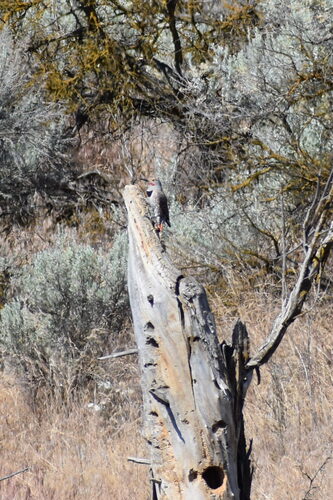
Northern Flicker
Colaptes auratus
The Northern Flicker is a fun and colorful bird! They love to peck on the ground for ants and beetles, making them unique among woodpeckers.
Habitat: Forests and open fields
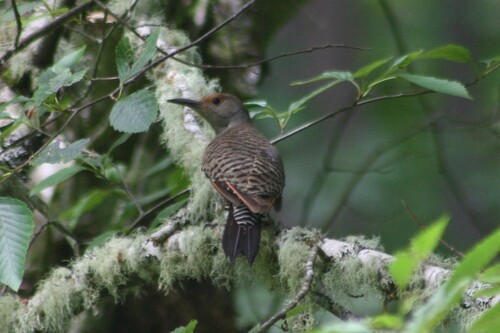
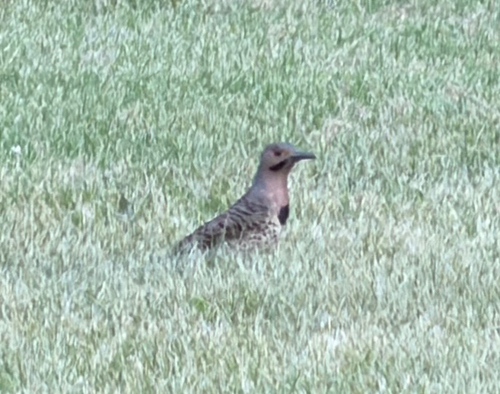
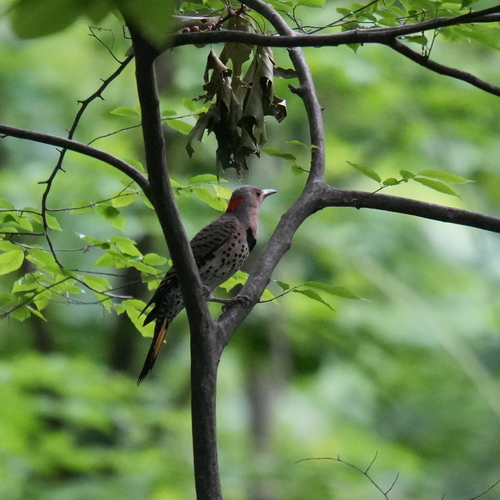
The Northern Flicker has a brownish body with black barring on its back and a distinct black crescent on its chest. Its underparts are white with round black spots. In flight, a flash of white on its rump is visible, along with yellow or red underwings, depending on the region.
Category
BirdsRarity
Common
Danger
1/5 · Very low
Snaps
205
Different flickers are yellow or red under their wings!
Flickers can bang their heads 15 times a second without injury!
They can extend their sticky tongue up to 2 inches beyond their beak!
They sometimes nest inside old buildings or even mailboxes!
Northern Flicker has an incredibly long, barbed tongue that helps them reach deep into ant tunnels to catch insects.
Northern Flicker can forage mainly on the ground, a unique trait among woodpeckers, because they love to eat ants.
Northern Flicker can communicate by drumming rapidly on trees or even metal objects to attract mates or mark territory.
This bird loves to eat ants and other insects it finds on the ground or in dead wood.
Wildlife encompasses all undomesticated animal and plant life existing in their natural habitats.
Feathered describes animals, primarily birds, possessing a covering of feathers.
Aerial creatures spend a significant portion of their lives airborne, utilizing flight for various activities such as hunting, migration, or nesting.
Singing animals produce complex vocalizations, often for purposes of attracting mates, defending territory, or communicating within their species.

This trait identifies organisms whose diet primarily consists of insects and other small invertebrates.

Forest habitats are terrestrial environments dominated by dense tree cover, supporting a high diversity of plant and animal life.

Diurnal animals are primarily active during daylight hours, typically resting or sleeping at night.
Danger
1/5 · Very low
Northern Flickers are friendly birds. Just enjoy watching them from a distance and don't try to touch them.
The easiest way to identify Northern Flicker is to use the Snappit nature identifier app.
31-35 cm
42-51 cm
0.1-0.16 kg
5-12 years
55 km/h
This bird loves to eat ants and other insects it finds on the ground or in dead wood.
Forests and open fields
Zoom in to split clusters and explore where this object has been snapped.
Jun 19, 2026
Bloedel ReservePhoto attribution
no rights reserved
License: CC0 1.0 ↗
Image may be shown cropped inside the card frame.
Jun 7, 2026
Toledo Botanical GardenPhoto attribution
no rights reserved
License: CC0 1.0 ↗
Image may be shown cropped inside the card frame.
Jun 6, 2026
Reeves-Reed ArboretumPhoto attribution
(c) foxsu, some rights reserved (CC BY)
License: CC BY 4.0 ↗
Image may be shown cropped inside the card frame.
Jun 4, 2026
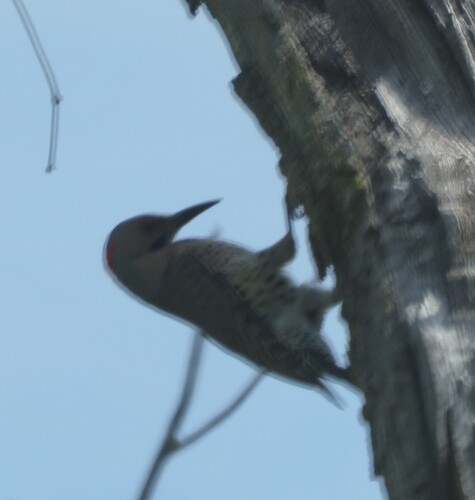
Brady's Bluff Prairie State Natural AreaPhoto attribution
(c) Marilynn Miller, some rights reserved (CC BY)
License: CC BY 4.0 ↗
Image may be shown cropped inside the card frame.
May 22, 2026
Drumheller Channels National Natural LandmarkPhoto attribution
no rights reserved
License: CC0 1.0 ↗
Image may be shown cropped inside the card frame.

Ohio, US
You might spot Eastern Fox Squirrel and Spotted Lanternfly.
View guide →

New Mexico, US
You might spot Tree Cholla, Colorado Pinyon, and House Finch.
View guide →
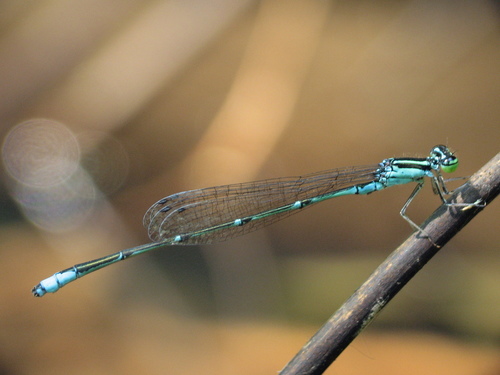
New York, US
You might spot Stream Bluet, Variable Dancer, and Eastern Pondhawk.
View guide →

Washington, US
You might spot Pacific Tree Frog and Long-Toed Salamander.
View guide →

Vermont, US
You might spot Asian Bittersweet, Alder Buckthorn, and Eastern Newt.
View guide →

New Jersey, US
You might spot White-Tailed Deer and Eastern Gray Squirrel.
View guide →
Take the discovery with you
Snap it with Snappit to identify it, learn what makes it special, and add the discovery to your collection.





.jpg&width=800)








