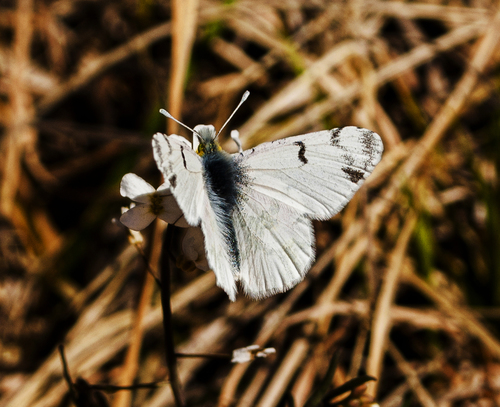


Olympia Marble
euchloe olympia
The Olympia Marble (Euchloe olympia) is a delicate and captivating spring butterfly belonging to the Pieridae family of whites and sulfurs. Native to North America, this species is highly anticipated by butterfly enthusiasts as one of the first true indicators of spring, emerging in early sunshine when ambient temperatures are still crisp. It is a highly specialized butterfly, typically forming small, localized populations that are strictly restricted to high-quality, undisturbed habitats such as rocky glades, shale barrens, and sandy lake dunes where its wild mustard host plants thrive. Its rapid, low-to-the-ground flight makes it appear like a fleeting, white phantom dancing through open fields.
Habitat: Found in dry, open habitats such as limestone glades, shale barrens, sandy dunes, and rocky woodlands where wild crucifers grow.
The Olympia Marble is a small butterfly with a wingspan of 3 to 5 centimeters. The upper surface of its wings is chalky white, featuring a dark, marbled grey pattern at the forewing tips and a narrow, black discal bar. Its most identifying characteristic is found on the underside of the hindwings, which display an intricate, marbled pattern of greenish-grey to olive-yellow veins against a white background, highlighted by a subtle but beautiful rosy-pink flush that is most vivid in freshly emerged adults.
Category
InsectsRarity
Common
Danger
1/5 · Very low
Snaps
Be the first to snap!
Olympia Marble caterpillars can be cannibalistic; if multiple eggs hatch on the same small host plant, the larger caterpillar may consume the unhatched eggs or smaller larvae to eliminate competition.
The distinctive rosy-pink coloration on the underside of their wings is at its brightest immediately after they emerge from the chrysalis and slowly fades to white as they age.
Unlike many butterfly species that have multiple broods throughout the summer, the Olympia Marble is strictly univoltine, meaning it produces only one generation per year, flying for just a few weeks in spring.
This species can spend up to ten months of the year inside its chrysalis, safely waiting out summer heat and freezing winter temperatures to emerge precisely when spring host plants begin to bloom.
The delicate pink and greenish-yellow marbling on the wing undersides perfectly mimics the developing buds of host rockcresses, rendering the butterfly invisible when resting.
It flies extremely low to the ground, allowing it to navigate and forage effectively in windy, exposed barrens and dune environments where higher-flying insects struggle.
Caterpillars feed exclusively on the leaves, buds, and young seedpods of mustard family plants, while adult butterflies feed on nectar from early spring wildflowers.
Age differences: Larvae are specialist herbivores restricted to plants in the Brassicaceae family, whereas adults are generalist nectar-drinkers that visit various early-season flowers.
Arabis lyrata
The caterpillar of the Olympia Marble feeds on the flowers, leaves, and seedpods of this native rockcress.

Misumena vatia
This predatory crab spider hides inside spring flowers to ambush and feed on visiting adult Olympia Marbles.
No trait badges are assigned for this object yet.
No aliases listed yet.
Collections for this object will appear here as more themes are added.
Danger
1/5 · Very low
No special safety notes yet.
Compare the wing outline, spots, bands, eyespots and wing edges. The underside can look completely different from the top. Check for tails, the antennae and where the markings sit instead of relying on color alone. Butterfly Identifier: upload a photo and compare the visible details.
2-3 cm
3-5 cm
0.0001-0.0003 kg
1 years
12 km/h
Caterpillars feed exclusively on the leaves, buds, and young seedpods of mustard family plants, while adult butterflies feed on nectar from early spring wildflowers.
Found in dry, open habitats such as limestone glades, shale barrens, sandy dunes, and rocky woodlands where wild crucifers grow.
Zoom in to split clusters and explore where this object has been snapped.
Recent snaps will appear here as new observations are added.
Take the discovery with you
Snap it with Snappit to identify it, learn what makes it special, and add the discovery to your collection.