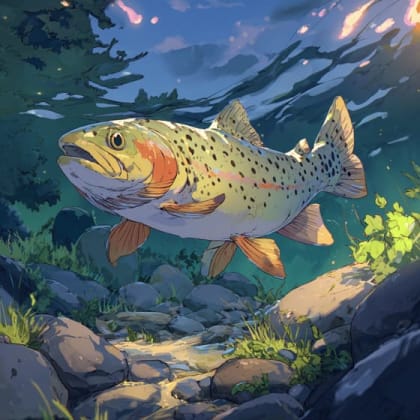

Oscar
Astronotus ocellatus
Oscar fish are curious and playful, often swimming around to explore their tank. They can recognize their owners and even come to the surface for food!
The Oscar is a robust fish, often showcasing a dark body adorned with vibrant patterns of red, orange, or yellow. Its most distinctive feature is a prominent black ocellus (eye-spot) ringed with orange or yellow at the base of its caudal fin, making it visually unique.
Category
FishRarity
Common
Danger
2/5 · Low
Snaps
Be the first to snap!
Oscar fish are sometimes called "water puppies" due to their playful and interactive personalities!
Oscars use their large, powerful mouth to suck up prey and even small stones from the bottom!
Their scientific name, *Astronotus ocellatus*, means "star-back eye-spotted" for its tail pattern.
They can recognize their human caregivers, often swimming to the front of the tank to greet them.
Oscar can change its color intensity and patterns because it helps them communicate their mood or stress levels.
Oscar has strong fins and a powerful mouth that helps them dig and rearrange the riverbed or tank substrate.
Oscar can fiercely guard its eggs and fry because it helps ensure the survival of its babies from predators.
Oscars are carnivores, eating a variety of small animals from insects to fish.
Cichla ocellaris
Larger fish that preys on Oscar fish.
Hemigrammus rhodostomus
Oscar preys on smaller schooling fish.
Macrobrachium rosenbergii
Oscar consumes various crustaceans.
Wildlife encompasses all undomesticated animal and plant life existing in their natural habitats.
Social animals live in organized groups, cooperating for survival benefits such as foraging, defense, and raising offspring.
Colorful describes organisms or objects displaying a wide range of bright and distinct colors.
This trait describes organisms that manipulate external objects to achieve a specific goal.

This trait characterizes organisms with an exceptionally long lifespan compared to others of their kind.

This trait identifies organisms whose diet consists entirely or primarily of animal tissue.

Freshwater habitats include non-saline aquatic environments such as rivers, lakes, ponds, and wetlands, vital for numerous species.

Aquatic habitats encompass environments where organisms live predominantly in water, including oceans, rivers, lakes, and wetlands.
Danger
2/5 · Low
Watch quietly from a distance and never try to feed or chase wild animals.
The easiest way to identify Oscar is to use the Snappit nature identifier app.
20-35 cm
0.5-1.5 kg
10-15 years
Oscars are carnivores, eating a variety of small animals from insects to fish.
12 km/h
Ambush
5 m
Zoom in to split clusters and explore where this object has been snapped.
Recent snaps will appear here as new observations are added.
Take the discovery with you
Snap it with Snappit to identify it, learn what makes it special, and add the discovery to your collection.