

PūKiawe
leptecophylla tameiameiae
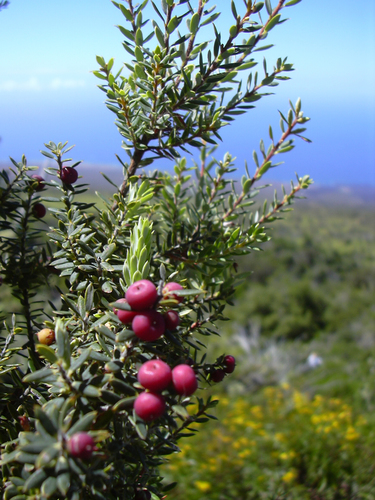
Pūkiawe (Leptecophylla tameiameiae) is an iconic, highly resilient evergreen shrub native to the Hawaiian and Marquesas Islands. Renowned for its remarkable ability to colonize harsh, newly formed volcanic landscapes, this versatile plant can be found clinging to barren lava flows, scaling high-altitude alpine zones, or standing tall in wet forests. For centuries, Pūkiawe has held deep cultural significance in traditional Hawaiian practices, where its smoky wood was utilized in sacred purification rituals to lift spiritual restrictions (kapu) from chiefs before they mingled with commoners. What makes Pūkiawe truly captivating is its vibrant aesthetic and adaptability. Depending on environmental factors like altitude and soil quality, it can range from a low-lying ground cover to a small, branching tree. Its dense foliage of needle-like leaves is beautifully accented by clusters of round, jewel-like berries that transition through shades of white, pink, and deep crimson.
Habitat: Found in a wide range of Hawaiian ecosystems, from coastal dunes and dry lava fields to wet forests and subalpine shrublands.
Pūkiawe is easily identified by its small, narrow, needle-like leaves that are dark green on top with pale, striped undersides, measuring about 1 to 1.5 cm in length. The shrub features tiny, bell-shaped flowers that are white to pale pink. Its most striking feature is the abundance of round, glossy, fleshy berries, which grow up to 1 cm in diameter and display a diverse palette of colors—including bright white, pastel pink, and rich crimson—often occurring simultaneously on a single branch.
Category
PlantsRarity
Common
Danger
1/5 · Very low
Snaps
Be the first to snap!
Hawaiian priests (kahuna) used the smoke of burning pūkiawe wood in a special ritual to cleanse chiefs, allowing them to safely interact with commoners without passing on their intense spiritual kapu.
Pūkiawe's leaves have a distinctive white underside with parallel veins, which helps distinguish it from other similar-looking montane shrubs.
The colorful berries, while safe for birds like the Nēnē goose, are dry, mealy, and largely tasteless to humans.
Capable of establishing roots in highly acidic, nutrient-poor basaltic lava flows where few other plants can survive.
Possesses small, waxy, needle-like leaves that minimize water loss, allowing it to withstand extreme winds and intense high-altitude sunlight.
Exhibits highly variable growth forms, existing as a stunted prostrate shrub in alpine zones but growing into a tall tree in sheltered forest canopies.
As a photoautotrophic plant, Pūkiawe produces its own organic compounds using sunlight, water, and carbon dioxide through the process of photosynthesis.
Branta sandvicensis
The Nēnē (Hawaiian Goose) feeds on the fleshy berries of Pūkiawe, subsequently dispersing the seeds across volcanic landscapes in its droppings.
Hylaeus anthracinus
Endemic Hawaiian yellow-faced bees visit the small bell-shaped flowers for nectar, acting as key native pollinators.
No trait badges are assigned for this object yet.
No aliases listed yet.
Collections for this object will appear here as more themes are added.
Danger
1/5 · Very low
No special safety notes yet.
Start with the whole plant, then compare leaf arrangement, leaf edges, stems and any flowers or fruit. Opposite leaves grow in pairs; alternate leaves come one at a time along the stem. These details tell you far more together than a single green leaf does. Plant Identifier: upload a photo and compare the visible details.
30-500 cm
20-100 years
As a photoautotrophic plant, Pūkiawe produces its own organic compounds using sunlight, water, and carbon dioxide through the process of photosynthesis.
Found in a wide range of Hawaiian ecosystems, from coastal dunes and dry lava fields to wet forests and subalpine shrublands.
Photosynthesis
Zoom in to split clusters and explore where this object has been snapped.
Recent snaps will appear here as new observations are added.

Hawaii, US
You might spot ʻōhiʻa Lehua, Red Junglefowl, and Red-Crested Cardinal.
View guide →

Hawaii, US
You might spot 'āhinahina, Kūpaoa, and Chukar.
View guide →

Hawaii, US
You might spot Māmane, Great Mullein, and Wand Mullein.
View guide →
Take the discovery with you
Snap it with Snappit to identify it, learn what makes it special, and add the discovery to your collection.