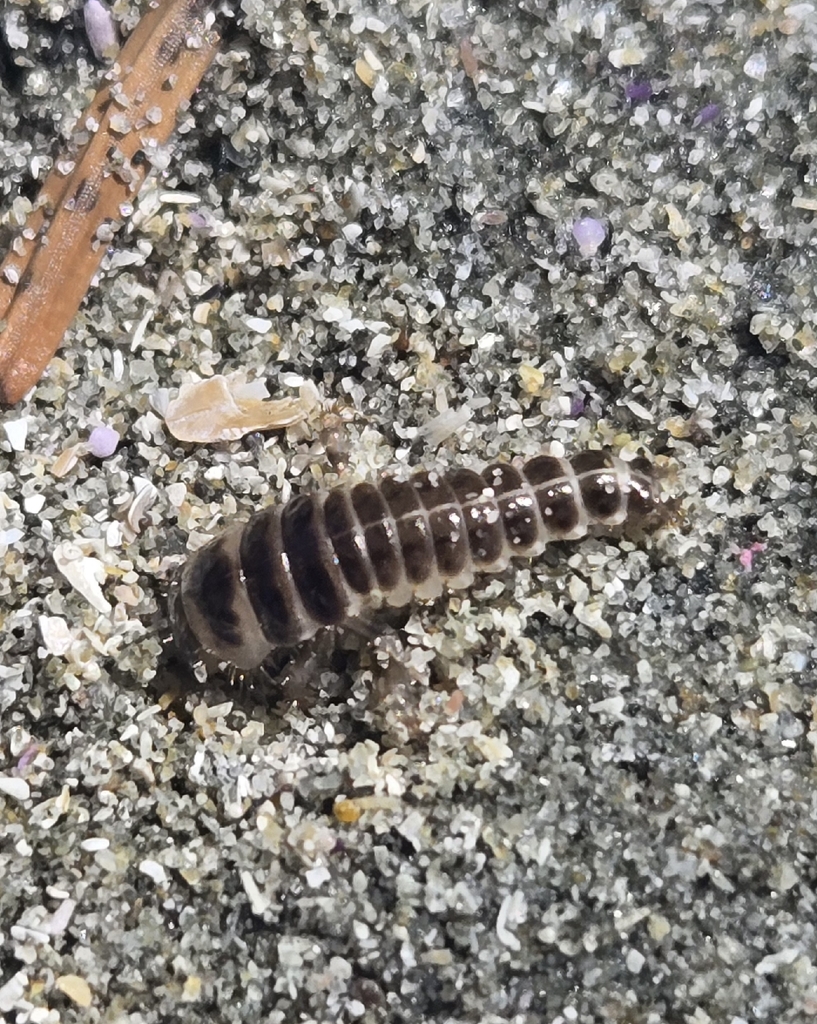





Pictured Rove Beetle
Thinopinus pictus
The Pictured Rove Beetle is a small, colorful beetle that loves to explore! It has a shiny body with beautiful patterns that can be red, orange, or yellow. These beetles are great at hiding in the leaves and soil.
Habitat: Grasslands
The Pictured Rove Beetle is an elongated, flattened beetle, 15-20mm long, with short, dark elytra revealing most of its segmented abdomen. It has distinctive pale yellow or reddish-brown markings, often banded, across its body against a darker brown to black background. Its head and thorax are usually dark.
Category
InsectsRarity
Common
Danger
1/5 · Very low
Snaps
Be the first to snap!
Its tough body helps it survive crashing waves and buried in shifting sands.
These beetles breathe air trapped under special hairs, even when submerged by the tide!
This beetle hunts at night by the ocean, seeking small creatures on the sand.
When disturbed, it might wiggle its tail like a scorpion, but it cannot sting!
Pictured Rove Beetle can sprint rapidly over sand because of its long, powerful legs that help it chase prey and escape predators.
Pictured Rove Beetle can survive living right by the ocean because it has special hairs that trap air, allowing it to breathe during high tide.
Pictured Rove Beetle can scare away attackers by raising its abdomen like a scorpion, which helps it look more dangerous than it actually is.
This quick hunter snacks on small creatures found on sandy beaches near the ocean.
Megalorchestia californiana
an active predator on these common beach hoppers

Calidris alba
a quick meal for shorebirds foraging on the tideline
Arctosa littoralis
can become prey for larger wolf spiders inhabiting sandy shores.
Solitary animals live alone for most of their lives, only interacting with others for mating or parental care.
Colorful describes organisms or objects displaying a wide range of bright and distinct colors.
Grassland habitats are terrestrial biomes dominated by grasses and herbaceous plants, supporting a variety of grazing animals.
This trait identifies organisms whose diet primarily consists of insects and other small invertebrates.
Describes organisms that break down dead organic material, recycling nutrients back into the ecosystem.
This trait identifies organisms that exhibit exceptional swiftness in movement for hunting, escape, or travel.
Describes organisms that transfer pollen, enabling the fertilization and reproduction of plants.
No aliases listed yet.
Danger
1/5 · Very low
Be gentle and watch where you step when exploring outside; insects are small and can be easily hurt.
Look for hard wing covers meeting in a line down the back, then compare the antennae, body shape, legs and markings. Metallic colors shift a lot with lighting. Beetle Identifier: upload a photo and compare the visible details.
25-35 mm
15-20 mm
300-365 days
This quick hunter snacks on small creatures found on sandy beaches near the ocean.
Grasslands
Pursuit
6
Zoom in to split clusters and explore where this object has been snapped.
Recent snaps will appear here as new observations are added.
Take the discovery with you
Snap it with Snappit to identify it, learn what makes it special, and add the discovery to your collection.