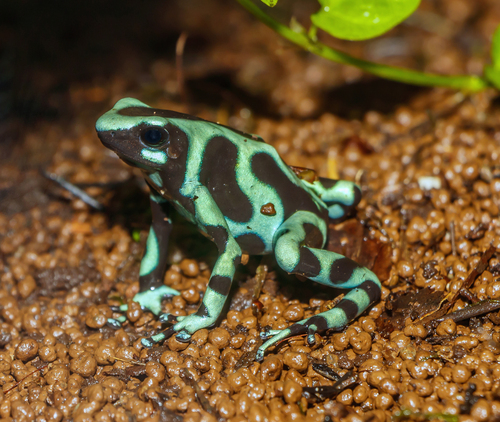


Poison Dart Frogs
dendrobatidae
Poison Dart Frogs, belonging to the family Dendrobatidae, are a captivating group of small, brightly colored amphibians native to the tropical rainforests of Central and South America. Renowned for their vibrant, iridescent skin, these frogs utilize their striking coloration as a warning sign to predators, indicating their potent toxicity. While most species are indeed poisonous, deriving their toxins from their arthropod diet, many captive-bred individuals lose their toxicity when not fed their natural diet. Beyond their iconic chemical defense, these frogs exhibit fascinating parental care behaviors, with many species involved in transporting their tadpoles to individual pools of water.
Habitat: Poison Dart Frogs are typically found in the humid understory of tropical rainforests and cloud forests, often among leaf litter, mossy rocks, or bromeliads, usually close to small water bodies.
These frogs are typically small, ranging from 1.5 to 6 centimeters in length, with smooth, moist skin. Their most distinctive feature is their brilliant aposematic coloration, which can include vivid shades of red, blue, yellow, green, and black, often combined in intricate patterns, spots, or stripes. The intensity and specific hues vary greatly between species and even within populations, serving as a clear visual deterrent to potential predators.
Category
AmphibiansRarity
Common
Danger
1/5 · Very low
Snaps
Be the first to snap!
Many species of Poison Dart Frogs kept in captivity lose their toxicity over generations because their captive diets lack the specific arthropods that contribute to toxin production.
Only a few species, primarily from the genus Phyllobates, were historically used by indigenous tribes to tip blow darts with their potent neurotoxins for hunting.
Some male Poison Dart Frogs will defend their eggs and even feed their tadpoles unfertilized eggs until they are ready to metamorphose.
The toxins of Poison Dart Frogs are not produced by the frogs themselves but are sequestered from the arthropods they consume in their natural habitat, such as specific mites and ants.
Their vivid, contrasting colors are a clear warning to predators of their toxicity, making them easily identifiable and discouraging attacks.
Many species produce potent alkaloid toxins, such as batrachotoxin, in their skin glands, which can be lethal to predators upon contact or ingestion. This toxicity is derived from their diet of specific arthropods.
Adult frogs exhibit advanced parental care, with males or females carrying newly hatched tadpoles on their backs to small, often isolated, pools of water, such as those found in bromeliads or tree hollows, to ensure their survival.
Poison Dart Frogs primarily consume a variety of small arthropods, which are crucial for the development of their potent skin toxins in wild populations.
Age differences: Tadpoles are typically omnivorous or herbivorous, feeding on algae, detritus, and sometimes unfertilized eggs provided by the mother, while adults are strictly insectivorous.
Formicidae
Primary dietary component and source of toxins
Oribatida
Dietary component that contributes to toxin synthesis
Leptophis ahaetulla
Specific predator with toxin resistance
Termitidae
Common dietary component
No trait badges are assigned for this object yet.
No aliases listed yet.
Collections for this object will appear here as more themes are added.
Danger
1/5 · Very low
No special safety notes yet.
Check the toe pads, leg length, eye markings, back pattern and body shape. Don't lean on color: some frogs change shade to match their surroundings. Frog Identifier: upload a photo and compare the visible details.
1-6 cm
0.002-0.008 kg
3-10 years
Poison Dart Frogs primarily consume a variety of small arthropods, which are crucial for the development of their potent skin toxins in wild populations.
Poison Dart Frogs are typically found in the humid understory of tropical rainforests and cloud forests, often among leaf litter, mossy rocks, or bromeliads, usually close to small water bodies.
Foraging
2-30
Zoom in to split clusters and explore where this object has been snapped.
Recent snaps will appear here as new observations are added.

Ohio, US
You might spot Sand Tiger Shark, Nurse Shark, and Cow.
View guide →

Texas, US
You might spot White Tiger, Octopus, and Sand Tiger Shark.
View guide →

Hawaii, US
You might spot Tiger, Giant Anteaters, and Spider Monkey.
View guide →

Minnesota, US
You might spot Sand Tiger Shark, Loggerhead Sea Turtle, and Spiders.
View guide →

California, US
You might spot African Penguin, Coral, and Flies.
View guide →

Florida, US
You might spot Giraffes, Indian Rhinoceros, and Florida Black Bear.
View guide →
Take the discovery with you
Snap it with Snappit to identify it, learn what makes it special, and add the discovery to your collection.