


Prickly Cucumber
echinocystis lobata
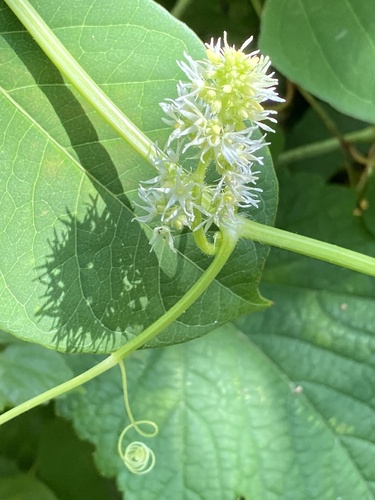
The Prickly Cucumber (Echinocystis lobata) is a fast-growing, native annual vine belonging to the gourd family. Characterized by its energetic climbing habit, this plant utilizes highly sensitive, coiling tendrils to scale shrubs, trees, and fences, often reaching heights of several meters in a single season. During mid-to-late summer, it produces dense, upright spikes of small, star-shaped white-green flowers that contrast beautifully with its star-like, lobed leaves. Despite its intriguing appearance and resemblance to culinary cucumbers, its fruit is inedible and dry.
Habitat: Found in moist soils along riverbanks, woodland edges, damp thickets, and low-lying disturbed areas.
This vigorous vine features alternate, light-green leaves with five distinct, sharply pointed lobes, giving them a star-like appearance. It produces two types of flowers on the same plant: small, fragrant, creamy-white male flowers arranged in upright clusters, and solitary female flowers at the leaf axils. The most distinctive feature is the inflated, egg-shaped fruit, which grows up to 5 centimeters long, is covered in soft, flexible green prickles, and eventually dries to a brown, papery, mesh-like skeleton containing four large, flat seeds.
Category
PlantsRarity
Common
Danger
1/5 · Very low
Snaps
Be the first to snap!
Despite its name and resemblance to edible garden cucumbers, the prickly cucumber contains bitter cucurbitacins and is toxic to humans.
It is also known as 'wild cucumber' or 'mock cucumber,' but belongs to a completely different genus (Echinocystis) than the cultivated cucumber.
The dried, fibrous interior of the empty fruit resembles a net-like skeleton, which historically saw utility use similar to natural loofah sponges.
The tendrils react quickly to physical touch, wrapping securely around nearby vegetation within minutes to climb toward sunlight.
Upon maturity, the base of the hollow, dry fruit opens up, dropping the seeds through the bottom holes to ensure successful dispersal.
As an annual, it germinates, climbs up to eight meters, flowers, and sets seed all within a single temperate growing season.
As a primary producer, this plant utilizes chlorophyll to synthesize sugars from carbon dioxide and water using sunlight.
Apis mellifera
Bees and flies visit the fragrant blossoms for nectar, acting as the primary pollinators for reproduction.
Acalymma vittatum
The beetles feed on the foliage and vines, occasionally introducing bacterial wilt to the plant.

Acer negundo
The vine climbs over the branches of the box elder to gain access to sunlight, competing for light resources.
No trait badges are assigned for this object yet.
No aliases listed yet.
Collections for this object will appear here as more themes are added.
Danger
1/5 · Very low
No special safety notes yet.
Start with the whole plant, then compare leaf arrangement, leaf edges, stems and any flowers or fruit. Opposite leaves grow in pairs; alternate leaves come one at a time along the stem. These details tell you far more together than a single green leaf does. Plant Identifier: upload a photo and compare the visible details.
300+ cm
0+ years
As a primary producer, this plant utilizes chlorophyll to synthesize sugars from carbon dioxide and water using sunlight.
Found in moist soils along riverbanks, woodland edges, damp thickets, and low-lying disturbed areas.
4+
90+ days
Zoom in to split clusters and explore where this object has been snapped.
Recent snaps will appear here as new observations are added.
Massachusetts, US
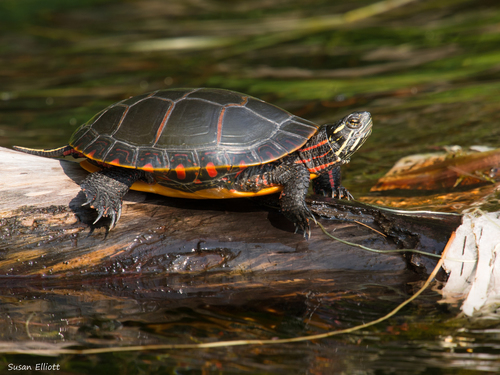
You might spot Painted Turtle, White Turtlehead, and Ragged-Robin.
View guide →

Iowa, US
You might spot Guelder-Rose, Prickly Cucumber, and Bluegill.
View guide →

North Dakota, US
You might spot Woodhouse's Toad, Scarlet Globemallow, and Turkey.
View guide →

Illinois, US
You might spot Virginia Bluebells and Wavy-Lined Emerald.
View guide →

Illinois, US
You might spot Prickly Cucumber and Golden Oyster Mushroom.
View guide →
Take the discovery with you
Snap it with Snappit to identify it, learn what makes it special, and add the discovery to your collection.

















