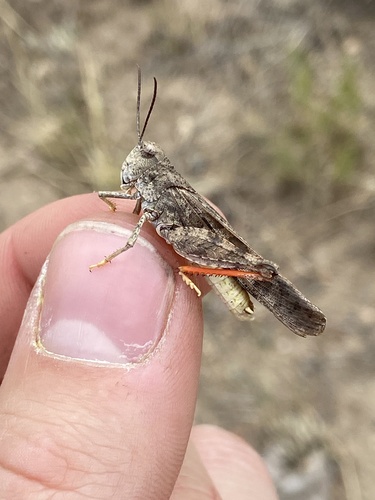


Pronotal Range Grasshopper
cratypedes neglectus
The Pronotal Range Grasshopper is a fascinating band-winged grasshopper native to the dry grasslands, foothills, and mountain meadows of Western North America. Active primarily during the mid-to-late summer, this insect is well-known for its impressive thermal tolerance and active lifestyle, bouncing between sun-drenched rocks and sagebrush. They serve as an important link in the grassland food web, recycling plant nutrients and serving as a high-protein meal for numerous bird and reptile species. One of the most notable features of this species is its dramatic aerial display. When flushed, it takes to the air with a sudden flash of brightly colored hindwings, accompanied by a distinctive snapping or crackling sound known as crepitation. This startling behavior is used to confuse potential predators while the grasshopper quickly relocates to safety, where it instantly blends back into the barren soil.
Habitat: Found in dry, open grasslands, montane meadows, and rocky foothill slopes, often closely associated with sagebrush habitats.
Adult Pronotal Range Grasshoppers measure between 2 and 4 cm in length, featuring a robust, heavily textured body with mottled brown, grey, or tan coloration that provides excellent camouflage against gravel and dry dirt. The pronotum (the shield-like structure behind the head) is highly rugose with a prominent central ridge. While they appear drab at rest, their hind wings reveal a stunning pale yellow or orange-yellow disc bordered by a dark, smoky-black band and a clear tip when spread in flight.
Category
InsectsRarity
Common
Danger
1/5 · Very low
Snaps
Be the first to snap!
The crackling 'crepitation' sound is produced by the sudden flexing and unfurling of the hind wings during flight, acting like miniature sails snapping in the wind.
They are highly adapted to rocky terrains, and their rough, wrinkled pronotum acts as structural reinforcement against rough abrasions when squeezing under rocks.
To survive freezing winter temperatures, their eggs undergo diapause, a suspended state of development buried safe under the soil.
Produces a sharp crackling or snapping noise during flight by snapping its hind wings, which startles predators and serves as a mating signal.
Possesses highly detailed mottled coloration and a textured exoskeleton that perfectly mimics dry soil, gravel, and lichens, making it invisible when stationary.
Adjusts its body posture relative to the sun to quickly raise its internal temperature, allowing it to remain active in cool montane mornings.
Feeds opportunistically on a variety of native grasses and broad-leaved herbaceous plants.
Age differences: Nymphs feed on tender, younger shoots, while adults consume tougher, fibrous grasses and dry vegetation.

Falco sparverius
Feeds heavily on grasshoppers during the summer nesting season.
Pseudoroegneria spicata
Host plant consumed by nymphs and adults for nourishment.
Epicauta pennsylvanica
Lays eggs in the soil which are sought after and consumed by beetle larvae.
No trait badges are assigned for this object yet.
No aliases listed yet.
Collections for this object will appear here as more themes are added.
Danger
1/5 · Very low
No special safety notes yet.
Look for six legs, antennae, three body sections and the shape of the wings. Beetles have hardened front wings; flies have just one working pair. Tiny insects may need a close view before their group is clear. Insect Identifier: upload a photo and compare the visible details.
2-4 cm
5-8 cm
0.001-0.003 kg
0-1 years
12 km/h
Feeds opportunistically on a variety of native grasses and broad-leaved herbaceous plants.
Found in dry, open grasslands, montane meadows, and rocky foothill slopes, often closely associated with sagebrush habitats.
Zoom in to split clusters and explore where this object has been snapped.
Recent snaps will appear here as new observations are added.
Take the discovery with you
Snap it with Snappit to identify it, learn what makes it special, and add the discovery to your collection.