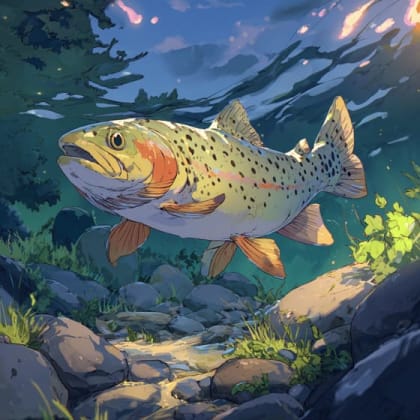
Pseudanthias pleurotaenia
Pseudanthias pleurotaenia
The Pseudanthias pleurotaenia, also known as the yellowtail anthias, is a colorful fish found in warm ocean waters. It loves to swim in groups and can be seen darting around coral reefs, making them a beautiful sight for divers.
Habitat: Coral reefs
The Pseudanthias pleurotaenia has a vibrant, purplish-pink body, with males featuring a distinctive rectangular reddish-yellow patch on their sides. Females are generally more orange-yellow, lacking the prominent lateral 'squarespot'. Their iridescent scales create a shimmering effect.
Category
FishRarity
Common
Danger
1/5 · Very low
Snaps
Be the first to snap!
If the dominant male disappears, the largest female in the group transforms into a male!
Males guard a 'harem' of up to 10 females, displaying their vibrant colors to impress them.
These fish often gather in giant shimmering schools, looking like living jewels on the reef.
They are sometimes called 'squarespot anthias' due to the male's distinct rectangular patch.
Pseudanthias pleurotaenia can change sex from female to male to ensure successful reproduction within their social group.
Pseudanthias pleurotaenia constantly swims against strong currents to snatch tiny plankton, ensuring a steady food supply.
Pseudanthias pleurotaenia can rapidly intensify its colors to signal dominance or attract mates among its school.
These vibrant fish gracefully feed on tiny plankton and small invertebrates floating in the water.
Age differences: null
Epinephelus coioides
Hunts them around reef structures.
Plectropomus maculatus
An ambush predator on coral reefs.
Pocillopora damicornis
Hides within its complex coral branches.
Social animals live in organized groups, cooperating for survival benefits such as foraging, defense, and raising offspring.
Camouflaged describes organisms that possess coloring or patterns that allow them to blend into their environment.
Colorful describes organisms or objects displaying a wide range of bright and distinct colors.
This trait identifies organisms whose diet consists entirely or primarily of animal tissue.

Diurnal animals are primarily active during daylight hours, typically resting or sleeping at night.

This trait identifies organisms that exhibit exceptional swiftness in movement for hunting, escape, or travel.

Aquatic habitats encompass environments where organisms live predominantly in water, including oceans, rivers, lakes, and wetlands.

Marine habitats encompass all saltwater environments of the Earth's oceans, supporting an immense diversity of aquatic life.
Danger
1/5 · Very low
Always watch from a distance when exploring the ocean; some fish can be shy.
The easiest way to identify Pseudanthias pleurotaenia is to use the Snappit nature identifier app.
8-12 cm
0.01-0.05 kg
5-10 years
These vibrant fish gracefully feed on tiny plankton and small invertebrates floating in the water.
8 km/h
Coral reefs
Filter Feeding
Zoom in to split clusters and explore where this object has been snapped.
Recent snaps will appear here as new observations are added.
Take the discovery with you
Snap it with Snappit to identify it, learn what makes it special, and add the discovery to your collection.