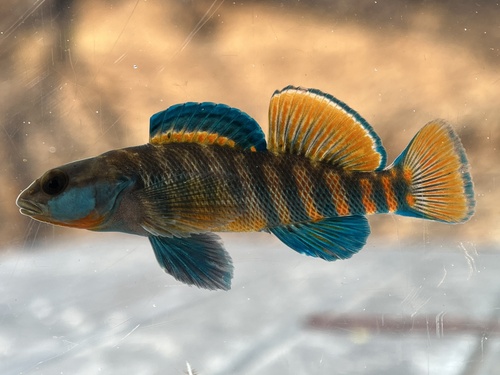


Rainbow Darter
etheostoma caeruleum
The Rainbow Darter is a small, vibrant freshwater fish native to North America, celebrated for its spectacular coloration that rivals tropical reef fish. Found primarily in clean, fast-flowing creeks and rivers, this active member of the perch family brings a splash of brilliance to temperate streams. These darters lack a functional swim bladder, allowing them to remain comfortably on the bottom of rocky, turbulent riffles where they feed and spawn. Their presence is a key indicator of high water quality, as they are highly sensitive to siltation, pollution, and low oxygen levels. Observing a male Rainbow Darter in the spring, with its body painted in brilliant bands of electric blue and fiery orange, is a highlight for any freshwater naturalist.
Habitat: Found in clean, cool, fast-flowing gravel and cobble riffles of small to medium streams and rivers.
A small, slender fish growing to about 5 to 8 cm in length, the Rainbow Darter features a compressed body with a blunt snout and large, fan-like pectoral fins. Breeding males are stunningly ornate, displaying alternating vertical bars of bright blue-green and deep orange-red along their flanks, complemented by an orange dorsal fin bordered in blue. Females and non-breeding males are much more cryptically colored, showing mottled shades of brown, olive, and tan that blend seamlessly with riverbed gravel.
Category
FishRarity
Common
Danger
1/5 · Very low
Snaps
3
Because they lack a functional swim bladder, Rainbow Darters sink to the bottom of the water column immediately when they stop swimming.
These fish are highly sensitive indicators of water health; their sudden disappearance from a stream is a clear sign of siltation or chemical pollution.
To spawn, females bury their bodies in the gravel of fast-flowing riffles, leaving only their eyes and tail exposed, while a male fertilizes the eggs from above.
Lacking a functional swim bladder, these fish can remain anchored to the rocky stream bottom even in strong, turbulent currents.
Uses enlarged, fan-shaped pectoral fins to dart rapidly from one rocky hiding spot to another instead of swimming continuously.
Males undergo a dramatic hormonal color transformation in spring, using ultra-bright blue and orange hues to signal dominance and attract mates in turbulent water.
Primarily feeds on benthic macroinvertebrates, especially the aquatic larvae of various insects, found among riverbed gravel.
Age differences: Juveniles feed on microscopic zooplankton like rotifers and copepods, transitioning to larger insect larvae as they mature.

Micropterus dolomieu
Predator that hunts adult darters in deeper pools near riffles.
Villosa iris
The darter serves as a host for the parasitic larval stage (glochidia) of this freshwater mussel.
Maccaffertium vicarium
An abundant aquatic insect whose larvae serve as a primary food source for the darter.
No trait badges are assigned for this object yet.
No aliases listed yet.
Collections for this object will appear here as more themes are added.
Danger
1/5 · Very low
No special safety notes yet.
Look at body shape, where the fins sit and their outline, mouth position, stripes and spots. Young fish and breeding adults can wear different patterns, and aquarium color varieties can look nothing like wild fish. Fish Identifier: upload a photo and compare the visible details.
4-8 cm
0.002-0.006 kg
3-4 years
5 km/h
Primarily feeds on benthic macroinvertebrates, especially the aquatic larvae of various insects, found among riverbed gravel.
Found in clean, cool, fast-flowing gravel and cobble riffles of small to medium streams and rivers.
Foraging
Zoom in to split clusters and explore where this object has been snapped.

Louisiana, US
You might spot Mississippi River Wakerobin and Lyreleaf Sage.
View guide →

Ohio, US
You might spot American Cancer-Root and Christmas Fern.
View guide →

Ohio, US
You might spot Blue-Ringed Dancer, Bee, and American Rubyspot.
View guide →
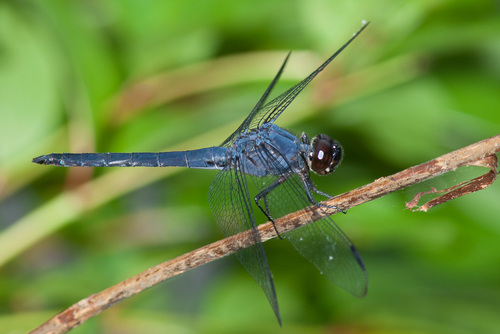
Arkansas, US
You might spot Slaty Skimmer and Common Eastern Bumble Bee.
View guide →
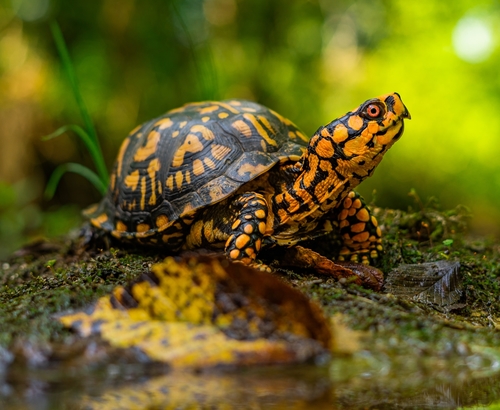
Kentucky, US
You might spot Eastern Box Turtle, Rainbow Darter, and Green Salamander.
View guide →

Ohio, US
You might spot Creek Chub, Ebony Jewelwing, and Western Blacknose Dace.
View guide →
Take the discovery with you
Snap it with Snappit to identify it, learn what makes it special, and add the discovery to your collection.