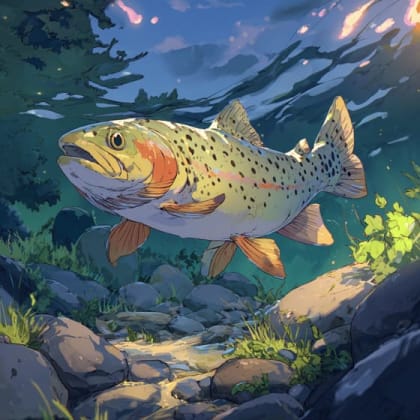

Bluespine unicornfish
Naso unicornis
The Bluespine unicornfish is a colorful fish that lives in warm ocean waters. It has a unique horn-like bump on its head and bright blue spines along its body, making it look like a magical creature from the sea!
Habitat: Coastal areas
The Bluespine unicornfish has a prominent bony horn-like projection on its forehead that gives it its name. Its body is typically a greyish-blue or olive-brown, distinguished by two bright blue, razor-sharp spines located near its tail base.
Category
FishRarity
Common
Danger
2/5 · Low
Snaps
1
Baby bluespine unicornfish look completely different, swimming without any horn at all!
These ocean gardeners munch on algae, keeping coral reefs healthy for countless other animals!
They use their sharp tail blades for fighting off rivals and protecting their favorite feeding spots!
This fish's famous 'horn' doesn't appear until it's much older, growing gradually!
Bluespine unicornfish has a unique horn-like protrusion that helps them navigate tight reef spaces and display dominance.
Bluespine unicornfish can defend themselves with two sharp blue spines on its tail, deterring predators effectively.
Bluespine unicornfish can efficiently graze on algae using specialized teeth, helping to keep coral reefs clean.
These fish are herbivores that graze on algae, helping keep coral reefs clean and healthy.
Age differences: Younger fish might occasionally munch on tiny zooplankton, but adults stick entirely to a plant-based diet.
Carcharhinus amblyrhynchos
A common predator in its reef habitat.
Epinephelus lanceolatus
Large groupers prey on many reef fish.
Labroides dimidiatus
Receives cleaning services, removing parasites.
Social animals live in organized groups, cooperating for survival benefits such as foraging, defense, and raising offspring.
Colorful describes organisms or objects displaying a wide range of bright and distinct colors.
This trait characterizes organisms whose diet consists entirely or primarily of plant material.
Possessing sharp, pointed projections or spines on the body or surface.

Coastal habitats are dynamic environments located along the interface between land and sea, influenced by tides, waves, and saltwater.

Diurnal animals are primarily active during daylight hours, typically resting or sleeping at night.

Describes a species whose presence and role have a disproportionately large effect on its environment.

Marine habitats encompass all saltwater environments of the Earth's oceans, supporting an immense diversity of aquatic life.
No aliases listed yet.
Danger
2/5 · Low
Always watch from a distance when observing fish in the ocean, and never try to touch them.
The easiest way to identify Bluespine unicornfish is to use the Snappit nature identifier app.
30-70 cm
3-8 kg
10-15 years
These fish are herbivores that graze on algae, helping keep coral reefs clean and healthy.
20 km/h
Coastal areas
Grazing
Zoom in to split clusters and explore where this object has been snapped.
Take the discovery with you
Snap it with Snappit to identify it, learn what makes it special, and add the discovery to your collection.