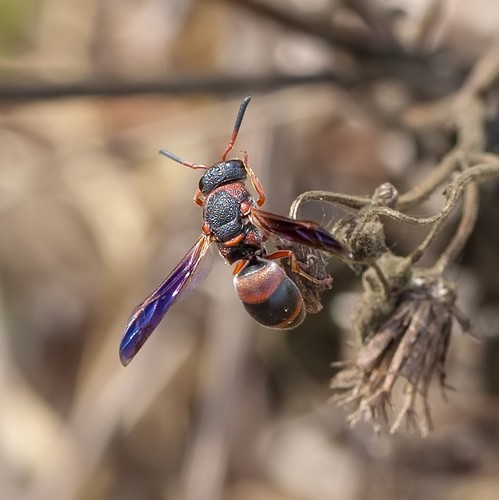


Red-Marked Pachodynerus Wasp
pachodynerus erynnis
The Red-Marked Pachodynerus Wasp (Pachodynerus erynnis) is a fascinating species of solitary mason wasp, often encountered in a variety of habitats across its range. Unlike their social relatives like hornets or yellowjackets, these wasps lead independent lives, with each female building and provisioning her own nest. They are critical insect predators, playing an important role in controlling populations of various insect larvae, particularly caterpillars and beetle grubs, which they use as food for their developing offspring. Their presence often indicates a healthy ecosystem where a diverse array of insects thrive.
Habitat: Found in open woodlands, fields, gardens, and suburban areas, often near human structures where nesting sites are abundant.
This medium-sized solitary wasp typically measures between 1.0 to 1.5 cm in length. Its body is predominantly black with striking yellow and distinct reddish-orange markings. The specific "red-marked" feature usually refers to prominent reddish bands or spots on the abdomen, and sometimes on the thorax or head. Its wings are clear or slightly dusky, and its body is relatively robust and somewhat stout compared to more slender wasp species. The antennae are dark, often with a slight club at the end, and the legs are mostly black or dark with some yellow accents.
Category
InsectsRarity
Common
Danger
1/5 · Very low
Snaps
Be the first to snap!
Despite being solitary, these wasps are not aggressive towards humans unless directly provoked or threatened, preferring to focus on their nesting and foraging activities.
Each paralyzed caterpillar or beetle grub placed in a nest cell remains alive but immobile, providing fresh food for the developing wasp larva over several days.
Female Pachodynerus erynnis wasps build individual mud nests, often utilizing abandoned beetle burrows or hollow stems, which they provision with paralyzed prey for their single offspring.
The 'red-marked' name highlights distinct reddish-orange patterns on their otherwise black and yellow bodies, which are key for species identification.
The female wasp possesses a potent venom used to paralyze insect larvae, such as caterpillars and beetle grubs. This allows her to transport living, but immobile, prey back to her nest cells for her offspring.
Females are skilled architects, constructing individual nest cells from mud. These nests are typically built in pre-existing cavities like abandoned beetle borings, hollow plant stems, or even human-made structures.
Each nest cell is meticulously stocked with several paralyzed prey items, ensuring a fresh and ample food supply for the single wasp larva that hatches within. This careful provisioning is crucial for the larva's development.
Adult Red-Marked Pachodynerus Wasps primarily feed on nectar from flowers for energy. Their larvae, however, are carnivorous, developing on paralyzed insect larvae provided by the mother.
Age differences: Larvae consume paralyzed insect prey, while adult wasps primarily feed on nectar and occasionally pollen.
Trichoplusia ni
Main food source for larvae, paralyzed and stored in nest cells.
Solidago spp.
Adult wasps feed on nectar from these flowers for energy.
Chalcididae spp.
Parasitic wasp whose larvae develop inside the Red-Marked Pachodynerus wasp larvae or pupae.

Sayornis phoebe
Known predator of various insects, including solitary wasps.
No trait badges are assigned for this object yet.
No aliases listed yet.
Collections for this object will appear here as more themes are added.
Danger
1/5 · Very low
No special safety notes yet.
Compare the antennae, wings, waist, body hair and legs. Yellow and black stripes show up on bees, wasps and harmless mimics alike. Bee & Wasp Identifier: upload a photo and compare the visible details.
1 cm
2-3 cm
0.0005-0.001 kg
0 years
Adult Red-Marked Pachodynerus Wasps primarily feed on nectar from flowers for energy. Their larvae, however, are carnivorous, developing on paralyzed insect larvae provided by the mother.
Found in open woodlands, fields, gardens, and suburban areas, often near human structures where nesting sites are abundant.
Adult Females Hunt And Paralyze Insect Larvae, Transporting Them To Their Nests. Adults Forage For Nectar.
Zoom in to split clusters and explore where this object has been snapped.
Recent snaps will appear here as new observations are added.
Take the discovery with you
Snap it with Snappit to identify it, learn what makes it special, and add the discovery to your collection.