

Richardson'S Geranium
geranium richardsonii
Richardson's Geranium is a charming perennial wildflower native to the mountainous regions of western North America. Renowned for its delicate white to pale pink blossoms adorned with intricate purple veins, this plant thrives in moist, high-altitude meadows, open coniferous forests, and along shaded stream banks. It plays a vital role in its native ecosystem by attracting a diverse array of pollinators, including native bees, butterflies, and flies, while also providing valuable forage for various herbivorous mammals. This resilient wildflower, named after the explorer and naturalist Sir John Richardson, stands as a beautiful testament to the rich biodiversity of subalpine environments. Its ability to colonize damp, disturbed soils makes it an important species for stabilizing banks and preventing soil erosion in fragile mountain watersheds.
Habitat: Found in moist mountain meadows, coniferous forests, and along subalpine stream banks at moderate to high elevations.
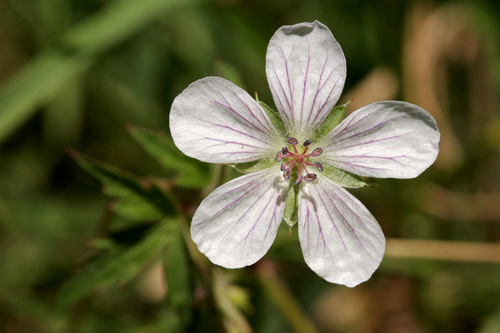
Growing up to 80 centimeters tall, this erect herbaceous perennial features deeply palmately lobed, dark green leaves with tooth-edged segments. Its eye-catching flowers, typically 2.5 to 4 centimeters in diameter, present five petals that are white to pale lavender-pink, detailed with distinct purple or reddish-pink veins that act as nectar guides. The flower center is adorned with prominent stamens bearing yellowish or purple-tipped anthers, and the entire plant is covered in glandular hairs, especially on the flower stems, giving them a sticky texture.
Category
PlantsRarity
Common
Danger
1/5 · Very low
Snaps
1
Indigenous peoples historically used roots of this plant to make a wash for sore eyes and to treat minor skin irritations.
Its seeds are launched violently away from the parent plant when the dry seed capsule splits open rapidly.
The genus name 'Geranium' comes from the Greek word for 'crane', referring to the fruit's resemblance to a crane's beak.
Utilizes a spring-like mechanism in the drying fruit column to fling mature seeds several feet away from the parent plant.
Covered in sticky, glandular hairs that deter crawling predatory insects from reaching the delicate flowers.
Features intricate ultraviolet-reflective purple veins on its petals that guide pollinating insects directly to the nectar source.
As a photosynthetic plant, it generates its own energy from sunlight, water, and carbon dioxide, while absorbing essential minerals from the soil.
Bombus bifarius
Feeds on the nectar and pollen, acting as a primary pollinator.

Odocoileus hemionus
Browses on the leaves and stems of the plant during the spring and summer.
Euphydryas chalcedona
Visits the flowers for nectar, contributing to pollination.
No trait badges are assigned for this object yet.
No aliases listed yet.
Collections for this object will appear here as more themes are added.
Danger
1/5 · Very low
No special safety notes yet.
Start with the whole plant, then compare leaf arrangement, leaf edges, stems and any flowers or fruit. Opposite leaves grow in pairs; alternate leaves come one at a time along the stem. These details tell you far more together than a single green leaf does. Plant Identifier: upload a photo and compare the visible details.
30-80 cm
3-10 years
As a photosynthetic plant, it generates its own energy from sunlight, water, and carbon dioxide, while absorbing essential minerals from the soil.
Found in moist mountain meadows, coniferous forests, and along subalpine stream banks at moderate to high elevations.
Zoom in to split clusters and explore where this object has been snapped.

Montana, US
You might spot Great Blanketflower and Seven-Spotted Lady Beetle.
View guide →

Colorado, US
You might spot Rocky Mountain Marsh-Marigold and American Bistort.
View guide →

Colorado, US
You might spot Black-Billed Magpie and Twinberry Honeysuckle.
View guide →
Take the discovery with you
Snap it with Snappit to identify it, learn what makes it special, and add the discovery to your collection.