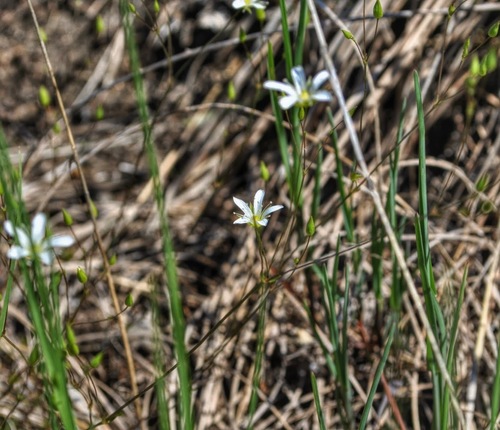


Rock Sandwort
sabulina michauxii
Rock Sandwort (Sabulina michauxii) is a resilient, low-growing perennial herb that thrives where few other plants can survive. Clinging to calcareous cliffs, rocky ledges, and gravelly barrens, this hardy species forms delicate, moss-like tufts of needle-shaped leaves. Despite its harsh and nutrient-poor habitats, it bursts into a beautiful display of small, star-shaped white flowers during the late spring and summer months, adding a touch of elegance to rugged landscapes. It plays an important role in stabilizing thin soils and colonizing exposed rock faces, making it a key pioneer species in limestone glades and alvars.
Habitat: Found on dry, calcareous rocky cliffs, limestone glades, gravelly slopes, and alvar habitats.
This species forms low, dense tufts or cushions of green foliage standing 5 to 20 cm tall. The leaves are stiff, needle-like, and very narrow, measuring about 1 to 2 cm in length, resembling tiny pine needles. The flowers are small, about 1 cm across, featuring five snowy-white, rounded petals that are twice as long as the underlying pointed green sepals, giving the bloom a distinct starry appearance.
Category
PlantsRarity
Common
Danger
1/5 · Very low
Snaps
Be the first to snap!
Despite its fragile appearance, this plant is exceptionally cold-hardy, surviving freezing winter winds on fully exposed cliff faces.
It is a classic indicator species for alvars, which are rare, naturally open ecosystems developed on flat limestone pavement.
It is named in honor of Andre Michaux, a famous 18th-century French botanist who documented the rich flora of North America.
It possesses extremely fine, tough roots that can penetrate minute cracks in solid limestone, anchoring the plant and absorbing deep-seated moisture.
Its needle-like, reduced leaf surface area minimizes water loss through transpiration, allowing it to survive on sun-baked, exposed rock faces.
It is a strict calciphile, capable of thriving in highly alkaline, calcium-rich soils that would stunt or kill other plant species.
As a photosynthetic plant, it manufactures its own sugars from carbon dioxide, water, and sunlight, while absorbing essential minerals from thin rock soils.

Lasioglossum species
Provides nectar and pollen to small wild bees visiting its starry white blossoms.

Odocoileus virginianus
Occasionally browses on the delicate foliage in barren or glade habitats where other forage is scarce.

Centaurea stoebe
Competes for precious space and light in narrow rock crevices and shallow soil pockets.
No trait badges are assigned for this object yet.
No aliases listed yet.
Collections for this object will appear here as more themes are added.
Danger
1/5 · Very low
No special safety notes yet.
Start with the whole plant, then compare leaf arrangement, leaf edges, stems and any flowers or fruit. Opposite leaves grow in pairs; alternate leaves come one at a time along the stem. These details tell you far more together than a single green leaf does. Plant Identifier: upload a photo and compare the visible details.
5-20 cm
3-10 years
As a photosynthetic plant, it manufactures its own sugars from carbon dioxide, water, and sunlight, while absorbing essential minerals from thin rock soils.
Found on dry, calcareous rocky cliffs, limestone glades, gravelly slopes, and alvar habitats.
Zoom in to split clusters and explore where this object has been snapped.
Recent snaps will appear here as new observations are added.
Take the discovery with you
Snap it with Snappit to identify it, learn what makes it special, and add the discovery to your collection.