





spotted knapweed
Centaurea stoebe
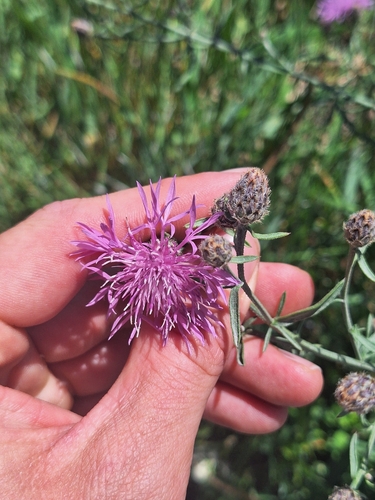
Spotted knapweed is a pretty flower with purple petals and dark spots. It grows in fields and can be found in many places, making the world a little brighter!
Habitat: Grasslands
The spotted knapweed has thistle-like purple-pink flowers that bloom atop stiff, branched stems. Look for the distinctive black-tipped bracts (leaf-like structures) beneath its flower heads, giving it a 'spotted' look and making it visually different from similar wildflowers.
Category
PlantsRarity
Common
Danger
1/5 · Very low
Snaps
8
It's sometimes called 'star thistle' because of its bracts!
Its taproots can dive over 6 feet deep underground!
One plant can produce over 1,000 seeds in a single year!
This plant is a 'super spreader' in many new habitats.
Spotted knapweed releases root chemicals that stop other plants from growing, helping it claim more space and nutrients.
Its long taproot, which can reach 6 feet deep, helps it find water and nutrients others can't.
It produces thousands of seeds that can stay viable in the soil for many years, waiting to sprout.
Apis mellifera
Gathers nectar and pollen from its flowers.
Bombus bifarius
Visits flowers for nectar, aiding reproduction.

Larinus minutus
Larvae feed on seeds within the flower heads.
Urophora quadrifasciata
Larvae develop inside seeds, reducing seed production.
Marked with spots or patches of a different color.
Flowering plants are any plants that produce flowers as part of their reproductive cycle.
Summer blooming plants produce their flowers during the summer season, often providing vibrant color when many other plants have finished.
Grassland habitats are terrestrial biomes dominated by grasses and herbaceous plants, supporting a variety of grazing animals.

Describes plants that are particularly attractive and beneficial to a wide range of pollinating organisms.

Rapid growing plants exhibit accelerated growth rates, quickly increasing in size and biomass within a short period.

Invasive species are non-native organisms that cause harm to the environment, economy, or human health.
Danger
1/5 · Very low
If you see this plant, it's best to look but not touch, as some plants can be tricky.
The easiest way to identify spotted knapweed is to use the Snappit nature identifier app.
30-150 cm
30-100 cm
1.5-2.5 cm
Summer
No
Mild
Perennial
Zoom in to split clusters and explore where this object has been snapped.
Jul 23, 2025
Sherburne Ranger Station Historic DistrictPhoto attribution
(c) Oscar Dove, some rights reserved (CC BY)
License: CC BY 4.0 ↗
Image may be shown cropped inside the card frame.

New York, US
You might spot Sundial Lupine, Spotted Horsemint, and New Jersey Tea.
View guide →

Wyoming, US
You might spot Moose, Uinta Ground Squirrel, and American Bison.
View guide →

Wyoming, US
You might spot Elk, Killdeer, and Black-Billed Magpie.
View guide →

Montana, US
You might spot Black Bear, Brown Bear, and Moose.
View guide →

British Columbia, CA
You might spot Oregon Grape, Shinyleaf Meadowsweet, and Bush Penstemon.
View guide →

New Jersey, US
You might spot Blue Corporal and Mountain Laurel.
View guide →
Take the discovery with you
Snap it with Snappit to identify it, learn what makes it special, and add the discovery to your collection.








.jpg&width=800)


_001.jpg&width=800)




